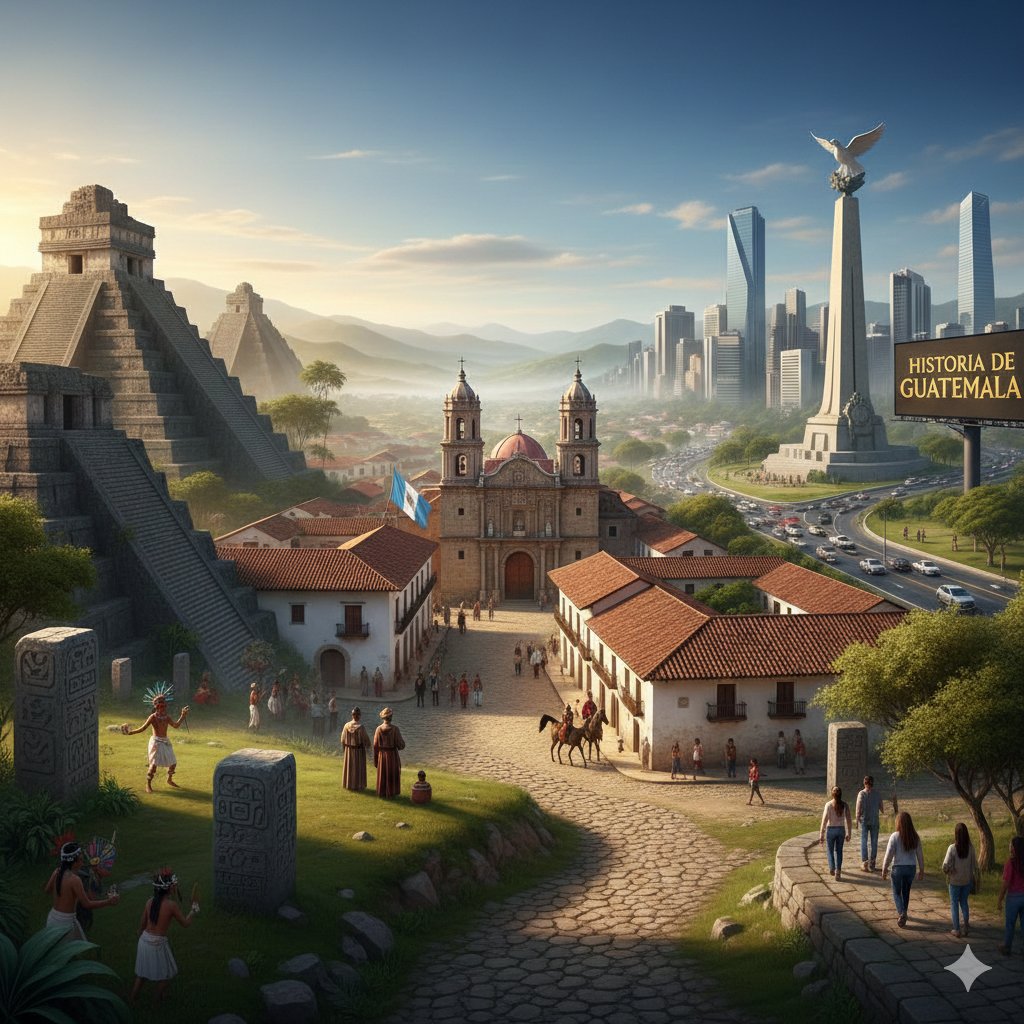
The history of Guatemala is a sprawling epic that spans several millennia, characterized by the rise of one of the world’s most sophisticated ancient civilizations, a brutal period of colonial subjugation, a turbulent quest for independence, and a modern era defined by both tragic conflict and a resilient struggle for democracy.
The Pre-Columbian Era: The Cradle of Maya Civilization
Long before the arrival of Europeans, the territory of modern-day Guatemala was the heart of the Maya civilization. This era is generally divided into three major periods: the Preclassic, the Classic, and the Postclassic.
The Preclassic Period (approx. 2000 BC – 250 AD)
During this formative stage, the Maya transitioned from nomadic hunter-gatherer groups to settled agricultural communities. They domesticated maize, beans, and squash—crops that remain central to the Guatemalan diet today. By 750 BC, cities like Nakbé and El Mirador began to emerge in the northern Petén lowlands. El Mirador, in particular, was a massive urban center with monumental pyramids, such as “La Danta,” which remains one of the largest structures in the ancient world.
The Classic Period (250 AD – 900 AD)
This was the “Golden Age” of the Maya. Guatemala was home to powerful city-states like Tikal, Uaxactún, and Quiriguá. These cities were marvels of architecture and engineering, featuring vast plazas, intricate stelae (carved stone monuments), and advanced irrigation systems.
-
- Intellectual Feats: The Maya developed a complex logosyllabic writing system, a sophisticated mathematical system including the concept of zero, and highly accurate astronomical calendars.
-
- The Collapse: Around 900 AD, the great lowland cities were mysteriously abandoned. Theories for this collapse include prolonged droughts, environmental degradation, and endemic warfare.
The Postclassic Period (900 AD – 1524 AD)
The focus of Maya civilization shifted to the highlands. New kingdoms emerged, such as the Kʼicheʼ (with their capital at Qʼumarkaj) and the Kaqchikel (based in Iximche). These groups were often in conflict, a rivalry that the Spanish would later exploit.
The Spanish Conquest and Colonial Rule (1524–1821)
The Spanish arrival in the early 16th century brought a cataclysmic shift to the region. Led by Pedro de Alvarado, a lieutenant of Hernán Cortés, Spanish forces entered Guatemala in 1524.
The Conquest
Alvarado utilized the existing rivalries between the Kʼicheʼ and the Kaqchikel. He initially allied with the Kaqchikel to defeat the Kʼicheʼ at the Battle of Quetzaltenango, where the legendary Maya hero Tecún Umán was killed. However, the Spanish soon turned on their allies, leading to decades of indigenous resistance. The last independent Maya kingdom, the Itza in Petén, did not fall until 1697.
The Colonial Order
Guatemala became the seat of the Captaincy General of Guatemala, which oversaw much of Central America.
-
- Social Structure: A rigid caste system was established, placing Spanish-born peninsulares and local-born criollos at the top, with the indigenous population and enslaved Africans at the bottom.
-
- The Church: The Catholic Church played a dual role, serving as both a tool of colonial control and, in the case of friars like Bartolomé de las Casas, a voice for the protection of indigenous rights.
Independence and the 19th Century
Inspired by the Enlightenment and the American and French Revolutions, Guatemala declared independence from Spain on September 15, 1821.
The Federal Republic
After a brief annexation to the Mexican Empire, Guatemala joined the Federal Republic of Central America (1823–1839). Internal tensions between Liberals, who wanted secularization and free trade, and Conservatives, who supported the Church and traditional elites, eventually tore the federation apart.
The Rise of Dictatorships
Following the collapse of the federation, Guatemala was ruled by a series of “caudillos” (strongmen):
-
- Rafael Carrera (1844–1865): A conservative who restored the Church’s power and protected indigenous lands.
-
- Justo Rufino Barrios (1873–1885): Known as “The Reformer,” he introduced coffee as a major export, which led to the seizure of indigenous communal lands and the creation of a vast, underpaid labor force.
The 20th Century: Revolution and Civil War
The 1900s were marked by the dominance of foreign interests—most notably the United Fruit Company (UFCO)—and a brutal 36-year civil war.
The “Ten Years of Spring” (1944–1954)
In 1944, a popular uprising overthrew the dictator Jorge Ubico. This ushered in a decade of democratic reforms under Presidents Juan José Arévalo and Jacobo Árbenz. Arévalo introduced social security and labor rights, while Árbenz implemented the Agrarian Reform Law, redistributing uncultivated land to peasants.
The 1954 Coup
The land reform threatened the interests of the UFCO. In the context of the Cold War, the U.S. government (via the CIA) orchestrated Operation PBSuccess to overthrow Árbenz, replacing him with a military junta. This event is often cited as the catalyst for the subsequent decades of violence.
The Guatemalan Civil War (1960–1996)
The war pitted the military-led government against various leftist guerrilla groups. It was one of the bloodiest conflicts in Latin American history.
-
- The Genocide: In the early 1980s, under the dictatorship of Efraín Ríos Montt, the military carried out a “scorched earth” policy. A UN-backed truth commission later determined that the state committed acts of genocide against the Maya population, resulting in over 200,000 deaths.
Modern Guatemala: 1996 to Present
The signing of the Peace Accords in 1996 officially ended the war, but the country continues to grapple with its legacy.32
| Key Aspect | Current Status |
| Justice | Efforts to prosecute former military leaders for war crimes (e.g., the trial of Ríos Montt) have seen mixed success. |
| Corruption | Significant anti-corruption movements, such as the 2015 “Guatemalan Spring,” led to the resignation of President Otto Pérez Molina. |
| Culture | Despite centuries of oppression, Maya culture remains vibrant, with over 20 distinct languages spoken and traditional weaving and spirituality flourishing. |
Guatemala today is a nation of incredible resilience, working to bridge the gap between its majestic past and a more equitable, democratic future.
Visit: www.dkbtech.com and www.allcircular.com