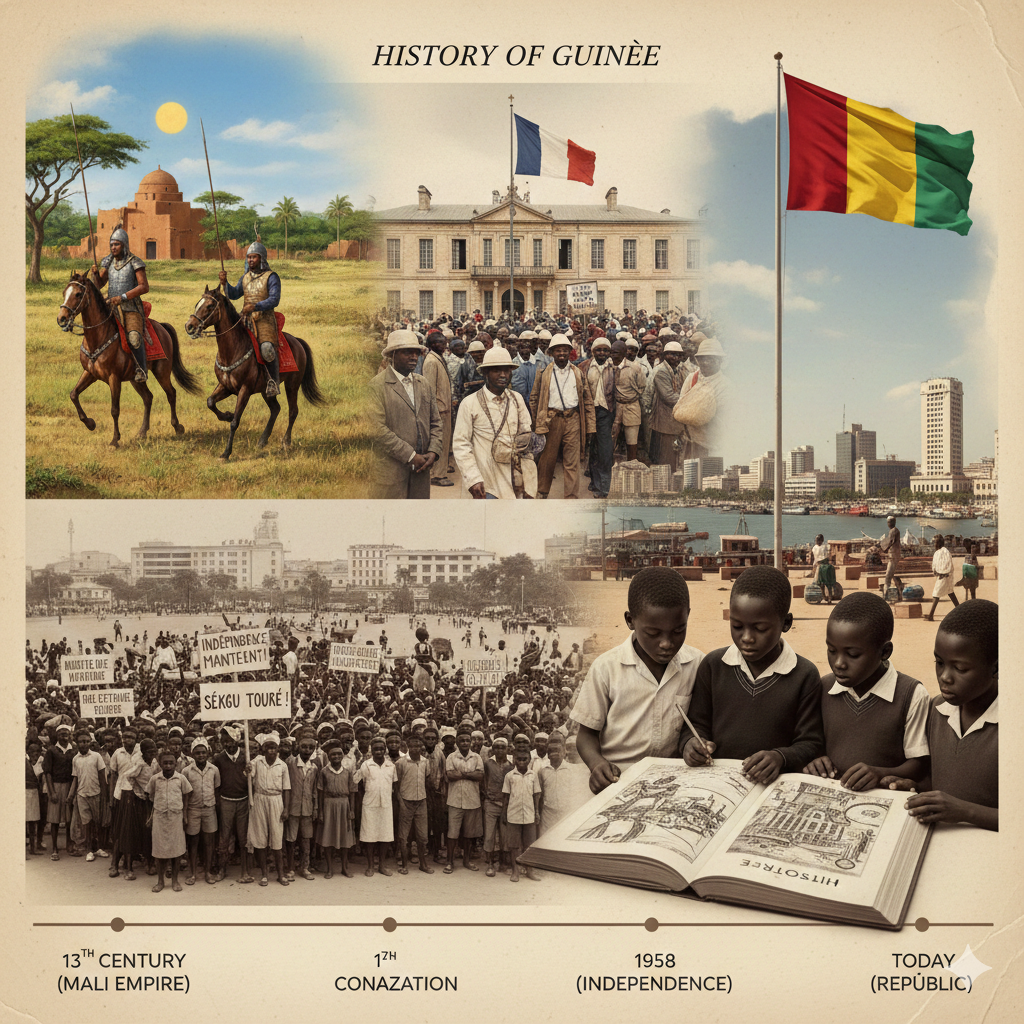
1. Ancient Foundations and the Great Empires
The History of Guinea (Republic of Guinea-Conakry) is deeply rooted in the rise and fall of West African empires. Long before colonial borders were drawn, the Upper Guinea region was a central hub for trade, culture, and power.
The Mali Empire (13th – 15th Century)
Guinea’s Savannah region was the heart of the Mali Empire, founded by Sundiata Keïta. The Mandinka people, who remain a dominant ethnic group today, established a sophisticated system of governance. During this era, the city of Niani (located in present-day Guinea) served as a capital. The empire controlled the trans-Saharan trade routes, exchanging gold from the Bure goldfields for salt and textiles.
The Rise of the Fulani and the Fouta Djallon Imamate
In the 18th century, the mountainous Fouta Djallon region became the site of a significant religious and political revolution. Fulani (Peul) scholars led a jihad that established the Imamate of Fouta Djallon in 1725. This was one of the first highly structured Islamic states in West Africa, featuring a unique alternating system of leadership between two ruling families (the Alfaya and the Soriya) to maintain stability.
2. Resistance to Colonial Intrusion
As the “Scramble for Africa” intensified in the 19th century, Guinea became a primary target for French expansion. However, the French met fierce resistance, most notably from Samori Touré.
Samori Touré’s Wassoulou Empire
Samori Touré, a brilliant military tactician, built the Wassoulou Empire. He modernised his army and manufactured his own firearms to resist French encroachment for nearly two decades. He is today celebrated as a national hero and a symbol of African defiance. He was eventually captured in 1898, marking the beginning of formal French colonial rule over “French Guinea.”
3. The Colonial Era (1898–1958)
Under French administration, Guinea was integrated into French West Africa (AOF). The colonial economy focused on:
-
- Infrastructure: The construction of the Conakry-Kankan railroad to export resources.
-
- Agriculture: Forced labor was often used to produce rubber, coffee, and bananas.
-
- Mining: The discovery of massive bauxite reserves (the raw material for aluminum) changed the country’s economic trajectory forever.
During this period, a new class of educated elites and labor unionists began to emerge. Among them was a young postal worker named Ahmed Sékou Touré, a descendant of Samori Touré, who would lead the country toward independence.
4. 1958: The Historic “No”
The defining moment of modern Guinean identity occurred in 1958. French President Charles de Gaulle offered French colonies a choice: join the “French Community” (retaining ties to France) or opt for immediate independence.
Sékou Touré famously declared:
“We prefer poverty in liberty to riches in slavery.”
Guinea was the only colony to vote “No” to the French Community. In retaliation, France withdrew abruptly, destroying infrastructure, taking colonial records, and severing all financial aid. Guinea became independent on October 2, 1958.
5. The Sékou Touré Era (1958–1984)
Guinea’s first 26 years of independence were marked by a shift toward Marxism-Leninism and Pan-Africanism.
-
- International Relations: Isolated by the West, Touré turned to the Soviet Union and China for support. He also hosted liberation movements from across the continent.
-
- Internal Governance: What began as a hopeful socialist experiment devolved into a highly repressive one-party state. The infamous Camp Boiro became a symbol of political purges where thousands of perceived “enemies of the state” were imprisoned or executed.
-
- Economy: State-led industrialization largely failed, leading to a massive exodus of the Guinean intelligentsia to neighboring countries.
6. Military Rule and Transition (1984–2010)
Following Sékou Touré’s death in 1984, Lansana Conté seized power in a bloodless coup.
-
- Liberalization: Conté dismantled the socialist system, encouraged foreign investment in mining, and re-established ties with France.
-
- The 2000s: Conté’s long rule saw growing corruption and economic stagnation. After his death in 2008, a military junta led by Moussa Dadis Camara took over. This period was marred by the 2009 stadium massacre in Conakry, which drew international condemnation.
7. The Modern Era (2010–Present)
In 2010, Guinea held its first democratic elections, won by Alpha Condé. His presidency saw significant investment in mining (specifically bauxite and the Simandou iron ore project) and the energy sector.
However, political tensions rose when Condé changed the constitution to run for a third term in 2020. This led to widespread protests and, ultimately, a military coup in September 2021 led by Colonel Mamady Doumbouya, who currently heads the transitional government.
Key Economic Pillars Today
| Resource | Significance |
| Bauxite | Guinea holds the world’s largest reserves; largest exporter to China. |
| Iron Ore | The Simandou mountains contain the world’s largest untapped high-grade deposit. |
| Hydropower | Known as the “Water Tower of West Africa” due to its many rivers (Niger, Senegal, Gambia). |
Visit: www.dkbtech.com and www.allcircular.com