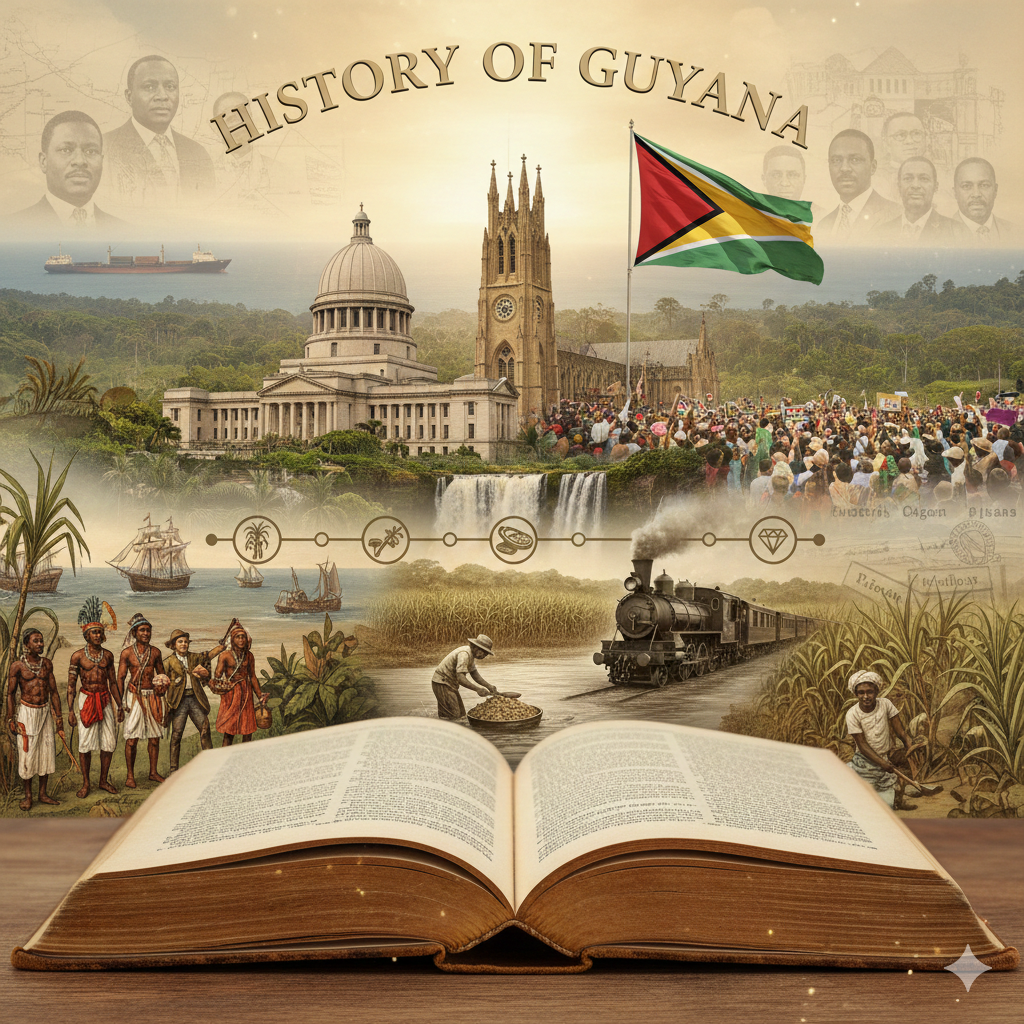
The History of Guyana, I have structured this into a detailed historical narrative covering the major epochs of the nation: from its Indigenous roots and colonial struggles to its independence and modern era.
I. The Land of Many Waters: Pre-Colonial Guyana
Before European sails appeared on the horizon, Guyana was home to diverse Indigenous groups. The name “Guyana” itself is derived from the Indigenous word meaning “Land of Many Waters.”
The Nine Tribes
The Indigenous population, often referred to as Amerindians, is comprised of nine distinct nations, including the Wai-Wai, Macushi, Patamona, Lokono (Arawak), and Kalina (Carib). These groups established sophisticated social structures and agricultural practices, specifically the cultivation of cassava. The Arawaks generally occupied the coastal regions, while the Caribs—known for their more nomadic and warrior-like culture—often pushed further inland.
II. The European Arrival and the “El Dorado” Myth
In the late 16th century, Guyana became the focus of European obsession due to the legend of El Dorado, the mythical city of gold. Sir Walter Raleigh’s 1595 expedition and his subsequent publication, The Discovery of Guiana, ignited a fever for exploration that brought Dutch, English, and French adventurers to the “Wild Coast.”
Dutch Dominance
While others searched for gold, the Dutch West India Company recognized the value of the soil. In 1616, they established the first permanent settlement at Kyk-Over-Al (See-Over-All) at the confluence of the Essequibo, Mazaruni, and Cuyuni rivers.
-
- The Three Colonies: The Dutch established three distinct administrative areas: Essequibo, Berbice, and Demerara.
-
- Hydraulic Engineering: Using their expertise in land reclamation, the Dutch built an intricate system of canals and dikes, turning the swampy coastline into fertile plantations. This infrastructure still defines the Guyanese landscape today.
III. The Era of Plantation Slavery
The shift from small-scale tobacco and cotton farming to sugar production transformed Guyana into a brutal plantation economy.
The Transatlantic Slave Trade
To power the sugar mills, tens of thousands of enslaved Africans were forcibly brought to the colonies. The conditions were horrific; the mortality rate was among the highest in the Americas due to the grueling labor in the mud-filled trenches and tropical diseases.
Resistance and the 1763 Berbice Uprising
Resistance was constant, but it peaked on February 23, 1763. Led by Cuffy (now Guyana’s national hero), over 2,500 enslaved people rose up in Berbice. For a year, the revolutionaries held much of the colony, attempting to establish an independent territory before they were eventually suppressed by European reinforcements. This rebellion remains a seminal moment in the fight for Caribbean freedom.
IV. British Rule and the Road to Emancipation
During the Napoleonic Wars, Britain seized the Dutch colonies, formally unifying them as British Guiana in 1831.
The 1823 Demerara Rebellion
A second massive uprising occurred in 1823, involving over 10,000 enslaved people. Though largely non-violent at the start, it was met with brutal British retaliation. The execution of leaders and the death of missionary John Smith in prison fueled the abolitionist movement in London.
1834–1838: Emancipation
Slavery was abolished in 1834, followed by a four-year period of “Apprenticeship.” In 1838, full freedom was granted. This led to the Village Movement, where former slaves pooled their meager savings to buy abandoned cotton and sugar estates (such as Victoria Village), establishing independent communities and refusing to work for their former masters for low wages.
V. Indentureship: The Melting Pot
With the labor force leaving the plantations, the British turned to indentured servitude. This changed the demographic face of Guyana forever.
-
- Portuguese and Chinese: Small numbers arrived in the mid-19th century but quickly moved into commerce and retail.
-
- The Indian Diaspora: Between 1838 and 1917, over 239,000 Indians were brought to Guyana under contracts. They brought their religions (Hinduism and Islam), languages, and culinary traditions.
-
- The Impact: This created a “Plural Society” where different ethnic groups lived side-by-side but often in competition for resources and political favor.
VI. The 20th Century: Political Awakening
By the early 1900s, a burgeoning middle class and labor movements began demanding representation.
The Rise of Burnham and Jagan
In the 1950s, two charismatic leaders emerged: Dr. Cheddi Jagan (an Indo-Guyanese dentist with Marxist leanings) and Forbes Burnham (an Afro-Guyanese lawyer). Initially, they worked together in the People’s Progressive Party (PPP) to fight for self-rule.
Cold War Interference
The PPP’s 1953 electoral victory alarmed the British and the Americans, who feared a “Second Cuba” in South America. The British suspended the constitution and sent in troops. This external pressure contributed to a split in the party along ethnic lines: Jagan led the PPP, while Burnham formed the People’s National Congress (PNC).
VII. Independence and the Cooperative Republic
Guyana achieved independence on May 26, 1966, and became a Republic in 1970.
The Burnham Era
Forbes Burnham led Guyana for over two decades. He moved the country toward “State Socialism,” nationalizing the bauxite and sugar industries. While he promoted Caribbean integration (founding CARICOM), his reign was marked by allegations of rigged elections and the tragic Jonestown Massacre in 1978, where over 900 members of an American cult died in the Guyanese jungle.
The Return to Democracy
After Burnham’s death in 1985 and the end of the Cold War, Guyana transitioned back to a market economy. In 1992, the first free and fair elections in decades saw Cheddi Jagan return to power.
VIII. Modern Guyana: The Oil Frontier
The 21st century has seen Guyana grapple with border disputes (particularly with Venezuela over the Essequibo region) and internal political tensions.
However, the discovery of massive offshore oil reserves in 2015 by ExxonMobil has fundamentally shifted Guyana’s trajectory. Currently one of the fastest-growing economies in the world, the nation faces the monumental task of using its “black gold” to modernize infrastructure while avoiding the “resource curse” and protecting its pristine rainforests.
Reflection on a Long History
Guyana’s history is a story of incredible resilience—from the engineering feats of the Dutch and the bravery of the enslaved, to the cultural tenacity of the indentured and the modern struggle for economic sovereignty.
Visit: www.dkbtech.com and www.allcircular.com