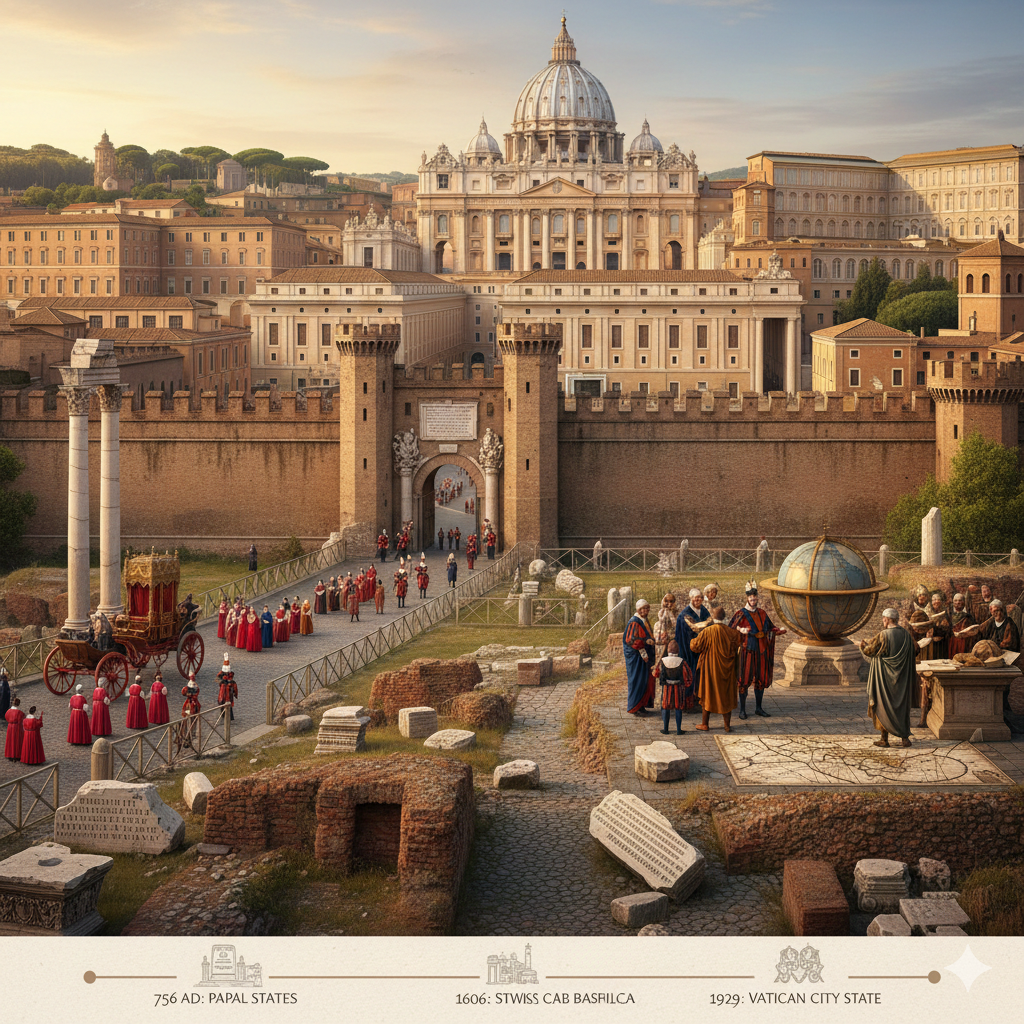
The History of Vatican City is to trace the history of Western civilization itself. From a swampy Roman suburb to the seat of global spiritual power, the story of this 44-hectare enclave is a saga of emperors, martyrs, Renaissance geniuses, and geopolitical survival.
I. The Ancient Roots: Ager Vaticanus
Long before it was the home of the Pope, the area on the west bank of the Tiber River was known as the Ager Vaticanus. In the days of the Roman Republic, it was an unremarkable, flood-prone plain.
The Etymology of “Vatican”
The name “Vatican” likely predates the Romans. Most historians believe it derives from the Etruscan settlement of Vatica or Vaticum. However, Roman writers like Varro linked it to the Latin word vaticinari (to prophesy), suggesting the hill was once home to soothsayers. Another charming, if less scientific, theory suggests it comes from Vaticanus, the Roman god of the first cry of a newborn child (va).
From Swamp to Imperial Playground
During the 1st century AD, the area began to transform. Agrippina the Elder drained the marshes to build gardens, and her son, the Emperor Caligula, began construction of a private chariot-racing track: the Circus of Caligula.
It was Caligula who brought a massive red granite obelisk from Heliopolis, Egypt, to stand in the center of his circus. That same obelisk—now devoid of its original pagan inscriptions—stands today in the center of St. Peter’s Square, a silent witness to two millennia of history.
The Martyrdom of Saint Peter
In 64 AD, a Great Fire ravaged Rome. Emperor Nero, seeking a scapegoat, targeted the fledgling Christian community. According to tradition, Saint Peter, the leader of the Apostles, was among those executed in Nero’s Circus. At his own request, Peter was crucified upside down, as he felt unworthy to die in the same manner as Jesus.
He was buried in a simple grave in a nearby necropolis (city of the dead) on the Vatican Hill. This humble grave would eventually become the literal and figurative foundation of the entire Vatican complex.
II. The Constantinian Era and the Middle Ages
The transformation of the Vatican from a burial ground to a center of worship began with Emperor Constantine the Great.
The First Basilica (324–349 AD)
Following his conversion to Christianity, Constantine ordered the construction of a massive basilica over the site of Saint Peter’s grave. To do this, his engineers had to level the Vatican Hill and fill in the ancient necropolis—a massive undertaking that preserved the tombs for modern archaeologists.
Old St. Peter’s Basilica was a classic five-aisled structure. For over a thousand years, it served as the primary destination for pilgrims from across Christendom. However, for most of this time, the Popes did not actually live there. Their official residence was the Lateran Palace on the other side of Rome.
The Rise of the Papal States
As the Western Roman Empire collapsed, the Popes stepped into the power vacuum. In 756 AD, the Frankish King Pepin the Short defeated the Lombards and granted a large swathe of central Italy to the Pope. This “Donation of Pepin” established the Papal States, a temporal kingdom that would last for over a millennium.
The Leonine Walls
In 846, Saracen pirates raided Rome and looted the unprotected St. Peter’s. In response, Pope Leo IV commissioned the construction of a massive wall (848–852 AD) to enclose the Vatican Hill. This area became known as the Leonine City, the first physical manifestation of the Vatican as a protected, distinct entity from the rest of Rome.
III. The Avignon Captivity and the Return to Rome
The 14th century was a period of profound crisis. Internal Roman politics became so violent that in 1309, Pope Clement V moved the papal court to Avignon, France.
The “Babylonian Captivity”
For 67 years, the Popes lived in Avignon under the influence of the French crown. When the Papacy finally returned to Rome in 1377 under Pope Gregory XI, they found the Lateran Palace in ruins. They sought refuge within the fortified walls of the Vatican, which from that point forward became the permanent papal residence.
IV. The Renaissance: Rebuilding the Holy City
The 15th and 16th centuries saw the Vatican become the epicenter of the High Renaissance. Popes like Nicholas V, Sixtus IV, and Julius II viewed art and architecture as a way to project the divine majesty of the Church.
The Sistine Chapel
In 1473, Pope Sixtus IV commissioned the Sistine Chapel. While its exterior is a plain, fortress-like rectangle, its interior became the world’s most famous gallery.
-
- The Walls: Originally decorated by Botticelli, Perugino, and Ghirlandaio.
-
- The Ceiling: Between 1508 and 1512, Michelangelo painted the Genesis cycle, including the iconic Creation of Adam.
-
- The Altar Wall: Decades later, Michelangelo returned to paint the titanic Last Judgment.
The New St. Peter’s Basilica
By 1500, the 1,100-year-old Constantinian basilica was literally falling apart. Pope Julius II made the controversial decision to tear it down and build a new one. The project took 120 years (1506–1626) and involved a “who’s who” of Renaissance talent:
-
- Bramante: Designed the original Greek cross plan.
-
- Raphael: Suggested a longer nave.
-
- Michelangelo: At age 71, he took over and designed the massive Dome, which dominates the Roman skyline.
-
- Bernini: Added the Baroque flourishes, including the massive bronze Baldacchino over the altar and the sweeping colonnades of St. Peter’s Square.
V. The “Prisoner in the Vatican” and Modern Sovereignty
The 19th century brought an end to the Pope’s status as a territorial king. During the Risorgimento (Italian Unification), the newly formed Kingdom of Italy gradually annexed the Papal States.
The Fall of Rome (1870)
In 1870, Italian troops entered Rome, making it the capital of a unified Italy. Pope Pius IX refused to recognize the new state. He retreated behind the Vatican walls and declared himself a “Prisoner in the Vatican.” For the next 59 years, a “Roman Question” hung over Italy: what was the legal status of the Pope?
The Lateran Treaty (1929)
The impasse was finally resolved on February 11, 1929. The Italian government (led by Benito Mussolini) and the Holy See (under Pope Pius XI) signed the Lateran Treaty.
The Three Parts of the Treaty:
-
- The Political Treaty: Created the independent State of Vatican City, a sovereign enclave of 44 hectares.
-
- The Concordat: Established Catholicism as the state religion of Italy (a status that lasted until 1984).
-
- The Financial Settlement: Italy paid the Holy See 1.75 billion lire as compensation for the loss of the Papal States.
VI. World War II and the Modern Era
During World War II, Vatican City maintained a delicate neutrality. Under Pope Pius XII, it became a sanctuary for thousands of refugees and Jews fleeing Nazi persecution, though the Pope’s public silence on the Holocaust remains a subject of intense historical debate.
Vatican II (1962–1965)
In the 1960s, Pope John XXIII called the Second Vatican Council. This “opening of the windows” modernized the Church, replacing Latin with local languages in the Mass and seeking better relations with other faiths.
The Vatican Today
Today, Vatican City is the smallest country in the world, yet it exercises a diplomatic “soft power” that rivals the world’s largest nations. It is a UNESCO World Heritage site in its entirety—the only country with such a designation.
Key Milestones in Vatican History
| Date | Event | Significance |
| c. 64 AD | Martyrdom of St. Peter | Establishes the site’s sacred foundation. |
| 324 AD | Construction of Old St. Peter’s | Begins the Vatican’s role as a pilgrimage hub. |
| 756 AD | Donation of Pepin | Establishes the Papal States (temporal power). |
| 1377 AD | Return from Avignon | Vatican becomes the permanent papal residence. |
| 1506 AD | New St. Peter’s Started | Marks the peak of Renaissance influence. |
| 1870 AD | Annexation of Rome | End of the Papal States; “Prisoner” era begins. |
| 1929 AD47 | Lateran Treaty48 | Birth of the modern Vatican City State.49 |
| 1962 AD50 | Vatican II51 | Modernization of the Catholic Church.52 |
Visit: www.dkbtech.com and www.allcircular.com