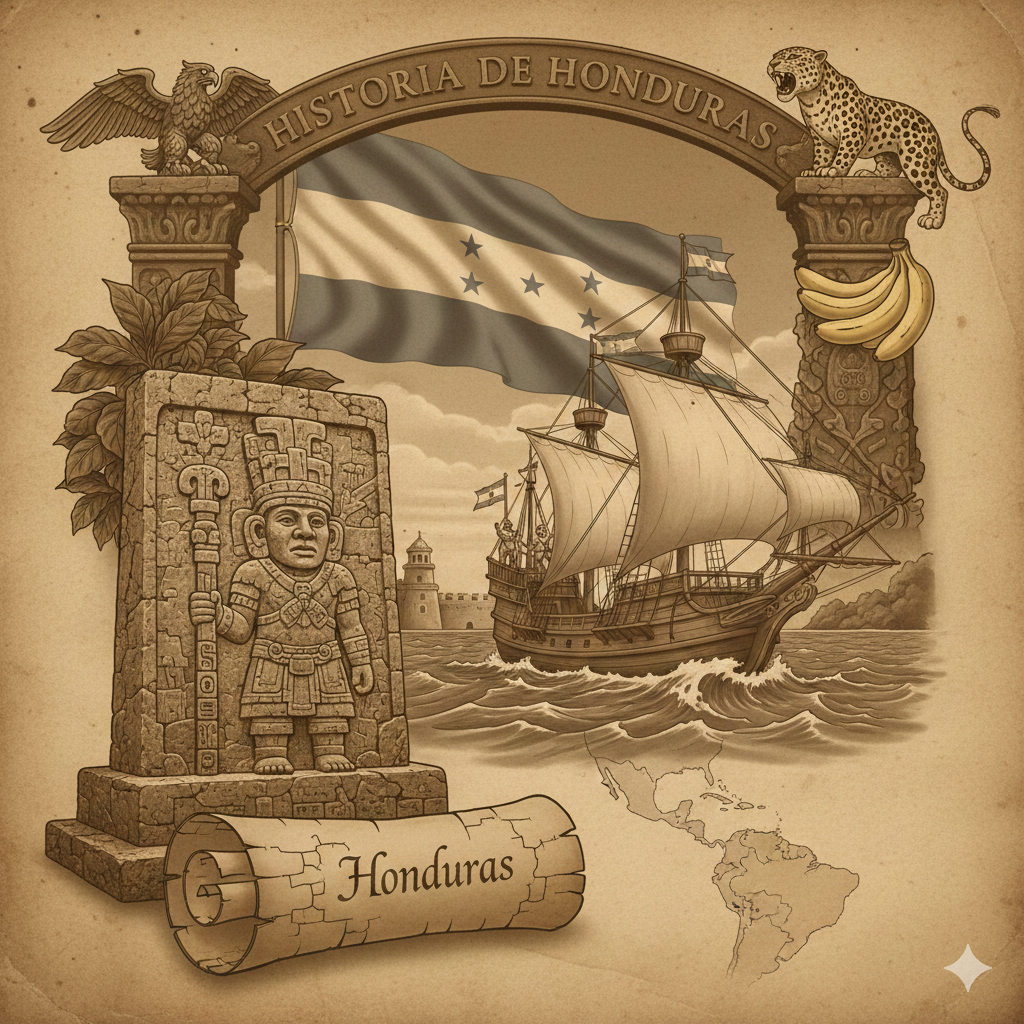
The history of Honduras is a sweeping narrative of resilience, characterized by the brilliance of ancient civilizations, the upheaval of colonial conquest, the struggle for sovereignty, and the persistent quest for political stability. Nestled in the heart of Central America, this nation has served as a bridge between cultures and a focal point for regional and global interests for millennia.
Pre-Columbian Foundations: The Maya and Beyond
Long before the first Spanish sails appeared on the horizon, the territory of modern-day Honduras was a vibrant tapestry of indigenous cultures. While many associate Central American prehistory exclusively with the Maya, Honduras was actually a meeting ground for two distinct cultural spheres: the Mesoamerican influence in the west and the Isthmo-Colombian (or Intermediate Area) influence in the east.
The Splendor of Copán
The crown jewel of Honduran archaeology is Copán, located in the lush western highlands. At its zenith during the Classic Period (250 to 900 AD), Copán was one of the most important centers of the Mayan world. Known for its extraordinary artistic and scientific achievements, the city was ruled by a dynasty of 16 kings, beginning with K’inich Yax K’uk’ Mo’ in 426 AD.
Copán is unique for its “Hieroglyphic Stairway,” the longest known Maya text, which records the dynastic history of the city. The city’s astronomers were among the most advanced in the ancient world, accurately calculating the length of the tropical year and predicting solar eclipses. However, like many other Mayan centers, Copán declined in the 9th century due to a combination of overpopulation, environmental degradation, and political instability, eventually being reclaimed by the jungle.
Diverse Indigenous Groups
Beyond the Maya, other groups flourished. The Lenca people occupied the central and western highlands and remain the largest indigenous group in Honduras today. In the east, groups like the Pech, Tawahka, and the ancestors of the Miskito lived in the dense tropical forests of La Mosquitia. Recent LiDAR technology has even revealed the remains of “lost cities” in this region, such as the legendary Ciudad Blanca (White City), proving that complex societies existed far beyond the Mayan frontier.
The Encounter and Spanish Colonization
The European chapter of Honduran history began in 1502 during Christopher Columbus’s fourth and final voyage. Legend has it that upon escaping a fierce storm off the northern coast, Columbus exclaimed, “Gracias a Dios que hemos salido de estas honduras!” (“Thank God we have left these depths!”), giving the country its name and its eastern cape (Cabo Gracias a Dios).
The Conquest (1524–1539)
The actual conquest of the mainland was a chaotic and bloody affair. Multiple Spanish expeditions—some from Mexico led by Hernán Cortés, others from Panama and the Caribbean—clashed not only with the indigenous populations but also with each other.
The most famous resistance came from the Lenca chieftain Lempira. In the 1530s, he unified over 200 indigenous tribes to fight the Spanish. Though he was eventually killed, Lempira remains a national hero; the Honduran currency is named in his honor. By 1539, the Spanish had largely consolidated control, making Honduras a province within the Kingdom of Guatemala.
Colonial Life and Mining
Unlike its neighbors, Honduras’s colonial economy was driven by silver and gold mining rather than just agriculture. The towns of Comayagua (the first capital) and Tegucigalpa grew as centers of wealth and administration. However, the labor-intensive mines led to the brutal exploitation of the indigenous population and the introduction of enslaved Africans, whose descendants contribute to the rich Garifuna and Afro-Honduran culture seen today on the northern coast.
Independence and the Dream of Union
As the Spanish Empire weakened in the early 19th century, the call for liberty reached Central America. On September 15, 1821, Honduras, along with its neighbors, declared independence from Spain.
The Central American Federation
Initially, the region was briefly annexed by the Mexican Empire, but by 1823, the Federal Republic of Central America was formed. This was a noble but fragile attempt to unite Costa Rica, El Salvador, Guatemala, Honduras, and Nicaragua into a single democratic state.
Honduras’s most famous son, Francisco Morazán, became the president of the Federation in 1830. A brilliant general and visionary liberal, Morazán fought to modernize the region, promoting freedom of speech, religion, and the separation of church and state. However, deep-seated rivalries between Liberals and Conservatives led to a series of civil wars. The Federation collapsed in 1838, and Honduras became a fully sovereign nation on November 5, 1838.
The Rise of the “Banana Republic”
The late 19th and early 20th centuries were defined by a dramatic economic shift. The Honduran government, seeking to modernize the country, granted massive land concessions to American fruit companies, most notably the United Fruit Company and the Standard Fruit Company.
The Era of the Fruit Companies
By the early 1900s, bananas accounted for the vast majority of Honduran exports. These companies built railroads, ports, and entire towns, effectively creating a “state within a state.” While this brought infrastructure, it also led to immense political interference. The term “Banana Republic” was coined by the writer O. Henry to describe this era, where companies frequently orchestrated coups or called for U.S. military intervention (the “Banana Wars”) to protect their profits.
Modern Honduras: Conflict and Democracy
The latter half of the 20th century was a tumultuous period marked by military dictatorships and regional Cold War tensions.
-
- The Soccer War (1969): A brief but intense conflict broke out with El Salvador. While triggered by a heated World Cup qualifying match, the underlying causes were land disputes and the mass migration of Salvadorans into Honduras.
-
- The 1980s and the Contras: During the Cold War, Honduras became a strategic “aircraft carrier” for the United States. It served as a base for the Contras fighting the Sandinista government in neighboring Nicaragua, leading to a massive increase in U.S. military aid but also internal human rights struggles.
Contemporary Challenges and Hope
In 1982, Honduras returned to civilian rule with a new constitution. Since then, the country has faced significant hurdles, including the devastation of Hurricane Mitch in 1998, a constitutional crisis and coup in 2009, and ongoing battles with gang violence and corruption.
In 2021, Honduras made history by electing its first female president, Xiomara Castro, signaling a new era of political shift and a renewed focus on social reform.
The history of Honduras is a testament to a people who have survived conquest, exploitation, and natural disasters, yet continue to preserve their rich cultural identity. From the stone stelae of Copán to the bustling streets of modern Tegucigalpa, Honduras remains a nation of “depths”—not just in its waters, but in its character.
Visit: www.dkbtech.com and www.allcircular.com