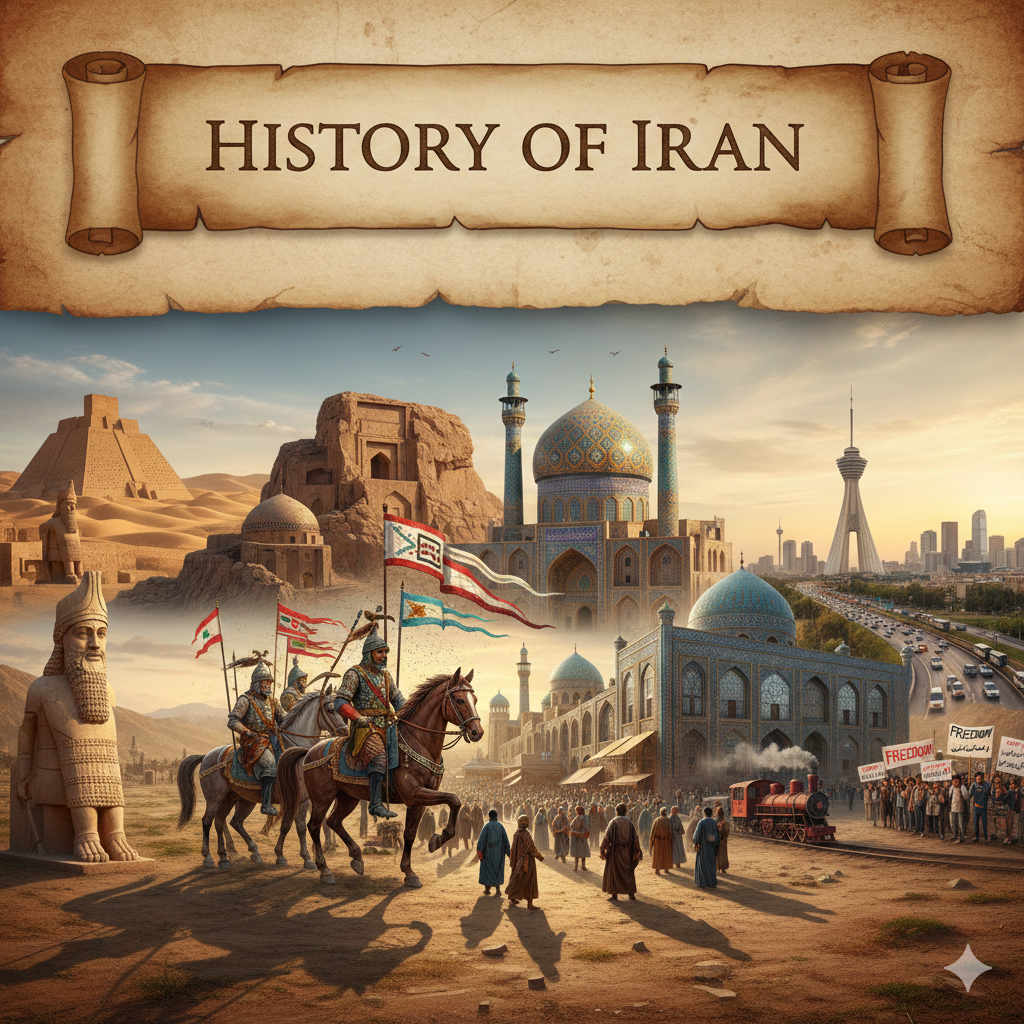
The history of Iran is a vast tapestry of shifting borders, religious transformations, and cultural resilience. Spanning over 3,000 years, it is the story of a civilization that has repeatedly fallen only to rise again, often absorbing its conquerors in the process.
1. The Dawn of Empire: Ancient Iran
Iranian history begins in earnest with the Elamites and the Medes, but the most iconic era of antiquity is the Achaemenid Empire (550–330 BCE). Founded by Cyrus the Great, this was the first truly global superpower, stretching from the Balkans to the Indus Valley.
Cyrus is remembered for the Cyrus Cylinder, often called the first charter of human rights, which allowed displaced peoples (including the Jews in Babylon) to return home. Following him, Darius the Great centralized the empire through the “Satrapy” system and the Royal Road, a postal network that could cross the empire in 15 days.
The Hellenistic and Pre-Islamic Eras
The Achaemenid era ended with the conquest of Alexander the Great, leading to the Greek Seleucid period. However, Iranian identity resurged through the Parthian Empire (247 BCE – 224 CE) and later the Sasanian Empire (224–651 CE). The Sasanians oversaw a “Golden Age” of Persian culture, rivaling the Roman and Byzantine Empires in art, philosophy, and military might.
2. The Islamic Conquest and the “Persianization” of Islam
In the 7th century, the Sasanian Empire fell to the Arab Muslim conquest. This was a pivotal turning point. While Iran adopted Islam, it did not become “Arabized” like many other regions. Instead, a process of Persianization occurred:
-
- The Shu’ubiyya Movement: Persians asserted their cultural and linguistic equality within the Islamic world.
-
- The Golden Age: Iranian scholars like Avicenna (Ibn Sina) and Al-Razi became the architects of Islamic science and medicine.
-
- Ferdowsi’s Shahnameh: This epic poem, “The Book of Kings,” is credited with saving the Persian language from being replaced by Arabic.
3. The Middle Ages: Fragmentation and Mongol Ruin
Between the 11th and 15th centuries, Iran was ruled by various Turkic and Mongol dynasties. The Mongol Invasions of the 13th century were particularly devastating, destroying entire cities and irrigation systems. Yet, even during this time, Iranian bureaucrats and artists often served their conquerors, ensuring that Persian culture continued to influence the courts of the Ilkhanate and later the Timurid Empire.
4. The Safavid Dynasty and the Birth of Modern Iran
In 1501, Shah Ismail I founded the Safavid Dynasty, marking the beginning of modern Iranian history. The Safavids:
-
- Unified Iran: They established the first stable, centralized Iranian state since the Sasanians.
-
- State Religion: They declared Twelver Shia Islam the official religion, distinguishing Iran from its Sunni neighbors (the Ottomans and Mughals).
-
- Cultural Zenith: Under Shah Abbas the Great, the capital, Isfahan, became one of the most beautiful cities in the world (“Isfahan is half the world”).
5. The Qajar and Pahlavi Eras: Modernity and Intervention
The 18th and 19th centuries under the Qajars were a period of decline and foreign interference. Iran lost significant territory to Russia and Britain. This led to the 1906 Constitutional Revolution, an early attempt at democracy.
In 1925, Reza Shah Pahlavi took power, seeking to modernize and secularize the country rapidly. His son, Mohammad Reza Pahlavi, continued these reforms (the “White Revolution”) but ruled with an iron fist. Rising resentment over his autocratic style, Western influence, and economic inequality culminated in the 1979 Islamic Revolution.
6. The Islamic Republic
Led by Ayatollah Ruhollah Khomeini, the revolution overthrew the monarchy and established a theocracy. The new state was almost immediately tested by the brutal eight-year Iran-Iraq War (1980–1988). Since then, Iran has navigated complex domestic social changes and a tense relationship with the international community, particularly regarding its nuclear program and regional influence.
Visit: www.dkbtech.com and. www.allcircular.com