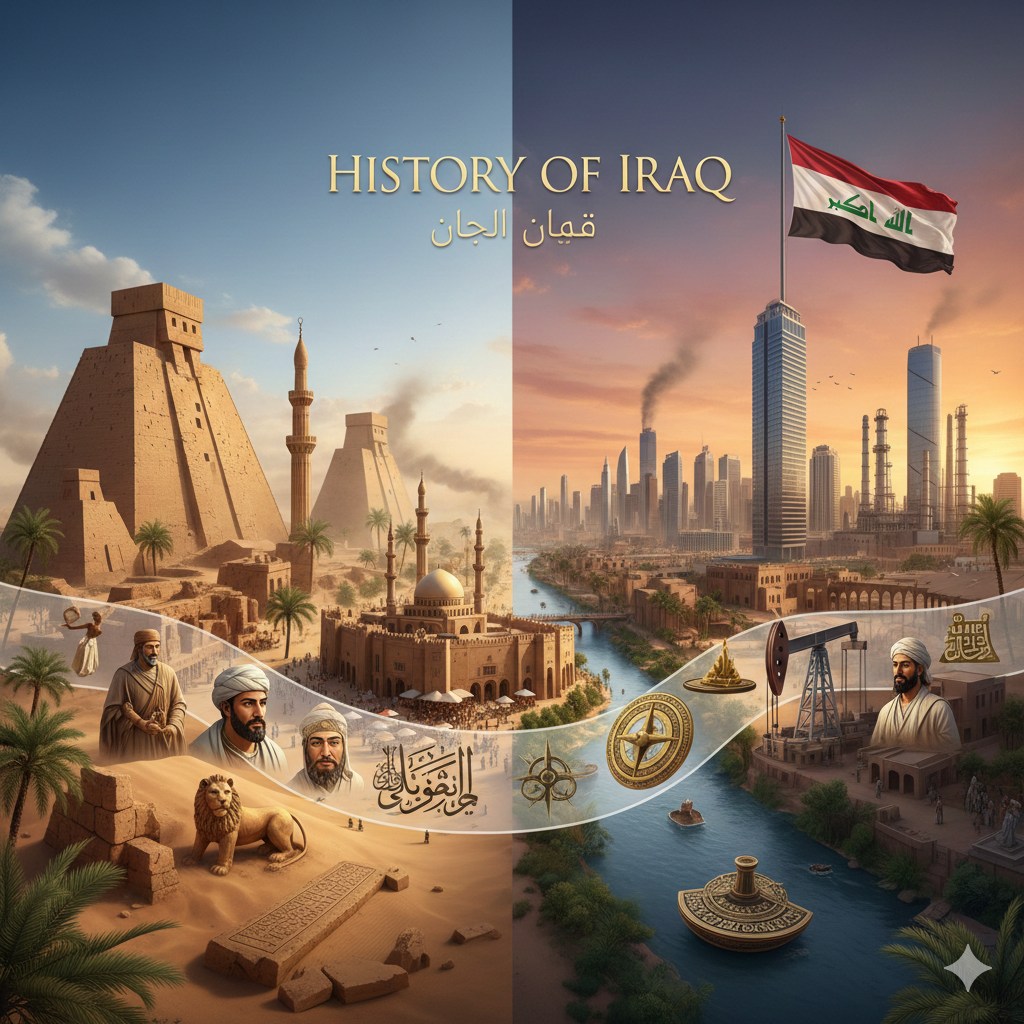
The history of Iraq is not merely the history of a modern nation-state; it is the chronicle of the very dawn of human civilization. Often referred to as the Cradle of Civilization, the land of Mesopotamia—the “Land Between the Rivers”—has served as the stage for some of humanity’s most transformative breakthroughs, from the invention of writing to the codification of law.
Ancient Mesopotamia: The Dawn of Time
The story begins in the fertile alluvial plains between the Tigris and Euphrates rivers. Around 5,000 BCE, the Sumerians settled in southern Mesopotamia, establishing the world’s first true cities, such as Eridu, Uruk, and Ur.
The Sumerian Innovations
The Sumerians were visionary architects of society. They developed Cuneiform, the earliest known system of writing, initially for accounting but soon for literature and law. Their mathematical contributions gave us the sexagesimal system (base 60), which is why we still have 60 seconds in a minute and 360 degrees in a circle today.
The Rise of Empires: Akkad and Babylon
By 2334 BCE, Sargon of Akkad conquered the Sumerian city-states, creating what is often considered the world’s first multi-ethnic empire. Following the Akkadians, the Old Babylonian Empire rose to prominence under Hammurabi (r. 1792–1750 BCE).
The Code of Hammurabi: One of the earliest and most complete written legal codes, famous for the principle of “lex talionis”—an eye for an eye. It established that justice was a matter of law, not just the whim of a ruler.
The Assyrian and Neo-Babylonian Eras
In the north, the Assyrians built a formidable military machine. At its height, the Neo-Assyrian Empire (911–609 BCE) controlled a vast territory stretching from Egypt to the Persian Gulf. They were followed by the Neo-Babylonians under Nebuchadnezzar II, who restored Babylon to its former glory, allegedly constructing the Hanging Gardens and the Ishtar Gate.
The Islamic Golden Age and Baghdad
The 7th century CE marked a radical shift as Arab-Muslim forces defeated the Sassanid Persians at the Battle of al-Qadisiyyah (636 CE). Iraq soon became the heart of the Islamic world.
The Abbasid Caliphate
In 762 CE, the Abbasid Caliphate founded Baghdad as its capital. For nearly 500 years, Baghdad was the intellectual center of the world.
-
- The House of Wisdom: A grand library and translation institute where scholars preserved Greek, Persian, and Indian knowledge while making original leaps in algebra, medicine, and optics.
-
- Harun al-Rashid: His reign (786–809 CE) is often associated with the peak of the Islamic Golden Age and the legendary tales of The Thousand and One Nights.
The Mongol Catastrophe
The “Golden Age” came to a violent end in 1258 CE, when the Mongol forces under Hulagu Khan sacked Baghdad. The Tigris was said to have run black with the ink of books and red with the blood of scholars. This began a long period of decline and fragmentation.
Ottoman Rule and the British Mandate
In the 16th century, Iraq was absorbed into the Ottoman Empire, divided into three provinces: Mosul, Baghdad, and Basra. For four centuries, it remained a frontier territory between the Ottomans and the Persian Safavids.
The Birth of Modern Iraq
Following World War I and the collapse of the Ottoman Empire, the League of Nations granted Britain a mandate over the region. The modern borders of Iraq were largely drawn during this time, often ignoring ethnic and sectarian realities.
-
- 1921: Faisal I, a Hashemite prince, was installed as the first King of Iraq.
-
- 1932: Iraq gained formal independence, though British influence remained strong.
The Republic and the Era of Saddam Hussein
The monarchy was short-lived, ended by a bloody military coup in 1958 that established the Republic of Iraq. After a decade of instability, the Ba’ath Party seized power in 1968.
The Rule of Saddam Hussein (1979–2003)
Saddam Hussein consolidated power in 1979, beginning a period defined by authoritarianism and devastating conflicts:
-
- Iran-Iraq War (1980–1988): A brutal eight-year stalemate that left hundreds of thousands dead.
-
- Invasion of Kuwait (1990): Leading to the Gulf War (1991) and crippling international sanctions.
Modern Iraq: 2003 to the Present
The 2003 U.S.-led invasion overthrew Saddam Hussein but plunged the country into years of sectarian violence and insurgency.
Recent Challenges and Resilience
Iraq has since transitioned to a parliamentary democracy, though it has struggled with corruption, the rise and fall of ISIS (2014–2017), and ongoing protests for reform. Today, Iraq remains a land of immense potential, balancing its rich ancient heritage with the complex task of rebuilding a modern, inclusive state.
| Era | Key Power | Major Achievement/Event |
| Ancient | Sumer/Babylon | Invention of Writing, Code of Hammurabi |
| Medieval | Abbasid Caliphate | Islamic Golden Age, Founding of Baghdad |
| Early Modern | Ottoman Empire | Integration into Ottoman trade routes |
| Modern | Republic of Iraq | Nationalization of oil, 2003 Transition |
Visit : www.dkbtech.com and www.allcircular.com