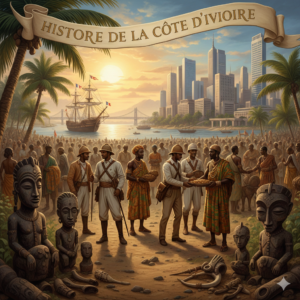
The history of Ivory Coast (Côte d’Ivoire) is a rich tapestry of powerful West African empires, the complex dynamics of the trans-Atlantic trade, a transformative colonial era, and a modern journey marked by both “miraculous” prosperity and challenging civil strife.
1. Pre-Colonial Era: The Land of Great Kingdoms
Before European arrival, the territory was inhabited by various ethnic groups who established sophisticated social and political structures.
-
Early Settlements: The northern regions were influenced by the great Saharan trade routes. Groups like the Guro and Dan were among the earliest inhabitants.
-
The Rise of the Abron (Gyaman): In the 17th century, the Abron kingdom became a dominant power in the east, establishing a centralized state that controlled gold production and trade.
-
The Baoulé Migration: Led by Queen Pokou in the mid-18th century, a branch of the Ashanti people migrated from present-day Ghana. Legend says she sacrificed her son to cross the Comoé River, giving birth to the Baoulé people, who became a major political force in the central region.
-
Islamic Influence: The northern city of Kong became a significant center of Islamic learning and commerce under the Wattara dynasty.
2. European Contact and the Colonial Period
The “Ivory Coast” received its name from Portuguese and French merchants who traded in elephant tusks and, tragically, enslaved people.
-
The French Arrival: France established its first permanent settlement at Grand-Bassam in 1843. Through a series of treaties with local chiefs, France expanded its influence inward.
-
Resistance: The occupation was not peaceful. Samori Ture, the founder of the Wassoulou Empire, led a fierce 16-year resistance against French forces in the north before being captured in 1898.
-
Official Colony: In 1893, Ivory Coast was officially declared a French colony. Under colonial rule, the French implemented a “head tax” and forced labor to build infrastructure and develop cocoa and coffee plantations, which remain the backbone of the economy today.
3. The Path to Independence (1944–1960)
Post-WWII sentiment shifted toward decolonization. The pivotal figure in this movement was Félix Houphouët-Boigny, a medical doctor and plantation owner.
-
Political Mobilization: In 1944, Houphouët-Boigny formed the Syndicat Agricole Africain (SAA) to protect African farmers from discriminatory colonial policies.
-
The PDCI: This grew into the Democratic Party of Côte d’Ivoire (PDCI). Houphouët-Boigny served in the French Parliament, skillfully negotiating for African rights while maintaining a close relationship with France (a policy later known as Françafrique).
-
Independence: On August 7, 1960, Ivory Coast gained full independence, with Houphouët-Boigny as its first president.
4. The “Ivorian Miracle” (1960–1980)
For two decades, Ivory Coast was the envy of Africa. While neighboring countries faced coups and economic collapse, Ivory Coast flourished.
-
Economic Boom: By focusing on agriculture (cocoa, coffee, and timber), the country achieved an annual growth rate of nearly 10%. Abidjan became known as the “Paris of West Africa.”
-
Stability: Houphouët-Boigny maintained a one-party state but used economic patronage to keep various ethnic groups satisfied.
5. Crisis and Civil War (1990–2011)
The “Miracle” began to fade in the 1980s due to falling cocoa prices and rising debt.
-
Succession Struggles: After Houphouët-Boigny’s death in 1993, Henri Konan Bédié took power and introduced the concept of Ivoirité (Ivorianness). This xenophobic policy aimed to exclude political rivals—specifically Alassane Ouattara—by claiming they were not “pure” Ivorians.
-
The First Civil War (2002–2007): A failed coup in 2002 escalated into a full-scale rebellion. The country was split: the rebel-held North (New Forces) and the government-held South (led by Laurent Gbagbo).
-
The 2010 Election Crisis: After years of delays, an election was held in 2010. Both Alassane Ouattara and Laurent Gbagbo claimed victory. The ensuing conflict led to thousands of deaths until Gbagbo was arrested in April 2011.
6. Contemporary Ivory Coast (2011–Present)
Under President Alassane Ouattara, the country has seen a significant economic recovery.
-
Infrastructure Growth: Massive investments in bridges, roads, and energy have returned Ivory Coast to its status as a regional economic powerhouse.
-
Reconciliation: While the economy has soared, political reconciliation remains a work in progress. The return of former presidents Gbagbo and Bédié to the political fold in recent years has signaled a move toward a more inclusive, albeit still fragile, political landscape.
| Period | Key Theme | Major Figure |
| Pre-1800 | Tribal Kingdoms & Trade | Queen Pokou |
| 1893–1960 | French Colonialism | Samori Ture (Resistance) |
| 1960–1993 | The Golden Era | Félix Houphouët-Boigny |
| 2002–2011 | Civil War & Division | Laurent Gbagbo / Alassane Ouattara |
| 2011–Present | Modern Recovery | Alassane Ouattara |
Visit : www.dkbtech.com and www.allcircular.com