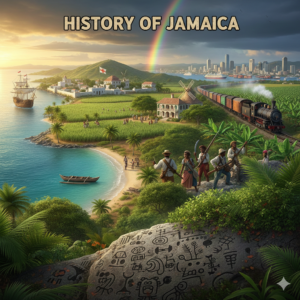
The History of Jamaica: From Xaymaca to Independence
History of Jamaica is a tapestry of resilience, resistance, and cultural synthesis. It is the story of a small island that has exerted a disproportionately large influence on the world’s music, politics, and social thought.
1. The First Inhabitants: The Taíno (600–1494)
Long before European contact, Jamaica was inhabited by the Taíno people, who migrated from South America. They called the island Xaymaca, meaning “Land of Wood and Water”.
-
Lifestyle: They were skilled farmers and fishers, living in organized village structures led by a cacique (chief).
-
Legacy: Though their population was decimated following Spanish arrival, their influence remains in words like barbecue, hammock, and tobacco, as well as in the Jamaican coat of arms.
2. Spanish Occupation (1494–1655)
Christopher Columbus arrived in 1494, claiming the island for Spain. The Spanish period was characterized by:
-
The Encomienda System: A brutal system of forced labor that, combined with European diseases, led to the near-extinction of the indigenous Taíno.
-
Seville Town and Spanish Town: They established the first capitals, but the Spanish largely viewed Jamaica as a supply base rather than a primary source of gold.
-
Introduction of African Labor: As the Taíno population collapsed, the Spanish began importing the first enslaved Africans to the island.
3. British Conquest and the Rise of King Sugar (1655–1834)
In 1655, an English expedition sent by Oliver Cromwell seized Jamaica. This era transformed the island into the “Jewel in the British Crown”.
-
Port Royal: Known as the “wickedest city on earth,” it became a haven for pirates and privateers like Henry Morgan, who were used by the British to defend the island against Spain.
-
The Plantation Economy: The British shifted focus to large-scale sugar production. This required a massive, brutal influx of enslaved Africans, making Jamaica one of the largest slave societies in the world.
-
Resistance and Maroons: Not all stayed enslaved. The Maroons (runaway slaves) fled to the mountainous interior (the Blue Mountains and Cockpit Country) and fought two major wars against the British, eventually winning their sovereignty and land rights in 1739.
4. Emancipation and Social Change (1834–1938)
The 19th century was defined by the struggle for freedom.
-
The Christmas Rebellion (1831): Led by Sam Sharpe, this massive uprising was a catalyst for the British Parliament to pass the Slavery Abolition Act.
-
Emancipation: Full freedom was granted in 1838. However, the “Post-Emancipation” era was difficult; former slaves faced high taxes and no land.
-
Morant Bay Rebellion (1865): Led by Paul Bogle and George William Gordon, this protest against injustice resulted in a brutal British crackdown but ultimately led to the dismantling of the corrupt local assembly and the start of Crown Colony government.
5. The Birth of a Nation (1938–1962)
Economic hardship in the 1930s led to widespread labor riots, which birthed the modern Jamaican political system.
-
Founding Fathers: Alexander Bustamante (founder of the JLP) and Norman Manley (founder of the PNP) emerged as the primary leaders advocating for workers’ rights and self-governance.
-
Independence: On August 6, 1962, Jamaica gained full independence from Britain.
6. Modern Jamaica and Global Influence
Post-independence Jamaica has navigated the challenges of a developing economy while becoming a global cultural powerhouse.
-
Reggae and Rastafari: Figures like Bob Marley took the Jamaican struggle and spirituality to the world stage, making “One Love” a global anthem.
-
Political Evolution: The island has seen intense political rivalry, particularly in the 1970s, but has remained a stable democracy.
| Era | Key Event | Significance |
| Pre-1494 | Taíno Settlement | Established the agricultural roots of the island. |
| 1655 | British Capture | Shifted Jamaica toward a sugar-based slave economy. |
| 1739 | Maroon Treaty | First successful autonomy granted to formerly enslaved people. |
| 1834 | Abolition | Legal end of slavery; beginning of the “New Jamaica.” |
| 1962 | Independence | Jamaica becomes a sovereign nation. |
Visit : www.dkbtech.com and wwww.allcircular.com