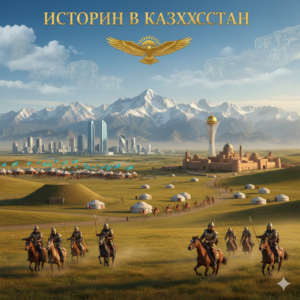
I. Prehistory and the Dawn of Nomadism (c. 1.5 Million Years Ago – 500 BC)
The history of Kazakhstan begins not with borders, but with the vast, undulating grass of the Eurasian Steppe. Archaeological evidence suggests that early humans inhabited the region as early as the Lower Paleolithic period. However, the most transformative moment in the region’s prehistory occurred around the 4th millennium BC with the domestication of the horse.
Recent genetic and archaeological studies, particularly at the Botai culture sites in Northern Kazakhstan, indicate that the ancestors of modern Kazakhs were likely the first to tame horses for transport and food. This innovation revolutionized human history, allowing for the birth of a nomadic lifestyle that could traverse the immense distances of the steppe.
By the Bronze Age (c. 2000 BC), the Andronovo culture flourished. These people were skilled metallurgists, mining copper and tin to produce bronze tools and weapons. They were also the architects of the chariot, a technological leap that allowed them to dominate the plains. The transition to the Iron Age saw the emergence of the Saka (Asian Scythians), a confederation of nomadic warriors who left behind magnificent burial mounds known as kurgans. The most famous of these, the Issyk Kurgan, revealed the “Golden Man”—a Saka warrior clad in thousands of gold pieces, symbolizing the wealth and sophisticated artistry of ancient steppe civilizations.
II. The Turkic Era and the Silk Road (500 BC – 1200 AD)
As the Saka influence waned, the region became a melting pot of migrating tribes. In the south, the Wusun and Kangju established early states, while the Huns (Xiongnu) moved through the northern reaches on their way toward Europe.
The 6th century AD marked a pivotal turning point: the formation of the Turkic Khaganate. This was the first time the vast majority of Central Asian tribes were united under a single political entity. The Turkic language and culture became the dominant framework of the region, superseding Indo-Iranian influences.
During this era, the Silk Road flourished. Cities like Taraz, Otrar, and Turkestan became vital nodes in a global trade network. Kazakhstan was the bridge between the Tang Dynasty in China and the Byzantine Empire in the West. It was not just goods like silk and spices that moved; ideas flowed too. Buddhism, Nestorian Christianity, and eventually Islam took root. The Battle of Talas in 751 AD, fought between the Abbasid Caliphate and the Tang Dynasty near modern-day Taraz, cemented Islam’s presence in the region and introduced papermaking technology to the Islamic world.
III. The Mongol Storm and the Golden Horde (1200 – 1465)
The early 13th century brought the most significant geopolitical disruption in the history of Eurasia: the invasion of Genghis Khan. By 1219, the Mongol armies had swept through the Qara Khitai and the Khwarazmian Empire. While the destruction of cities like Otrar was catastrophic, the Mongol conquest also brought “Pax Mongolica,” a period of relative stability and trade.
After Genghis Khan’s death, the territory of Kazakhstan was divided among his sons. Most of it fell into the Ulus of Jochi, better known as the Golden Horde. Over the next two centuries, the Mongol ruling class became increasingly Turkified, adopting the Kipchak language and the Islamic faith. The Golden Horde eventually fractured into several smaller entities, including the White Horde, the Nogai Horde, and the Siberian Khanate. It was from the ashes of these successor states that the Kazakh identity began to crystallize.
IV. The Kazakh Khanate: Sovereignty and the Zhuzes (1465 – 1847)
In 1465, two sultans, Kerei and Zhanibek, led a mass migration of tribes away from the Uzbek Khanate of Abul-Khayr. They settled in the Semirechye region (Zhetysu), founding the Kazakh Khanate. This event is celebrated as the birth of the Kazakh state.
The Khanate reached its peak under Kasym Khan (r. 1511–1518), who unified the tribes and codified the first laws of the steppe. However, the vastness of the territory and the nomadic nature of the people led to a decentralized structure. The population organized into three Zhuzes (Hordes):
-
The Senior Zhuz (Uly Zhuz): Located in the south and southeast (Zhetysu).
-
The Middle Zhuz (Orta Zhuz): Occupying the central and northern steppes.
-
The Junior Zhuz (Kishi Zhuz): Covering the western regions toward the Caspian Sea.
The 17th and 18th centuries were defined by the “Great Disaster”—the brutal invasions of the Dzungars, a Western Mongol federation. The Kazakhs faced an existential threat, leading to the legendary Battle of Anrakay in 1729, where the unified Zhuzes finally defeated the Dzungars. Weakened by war, the Kazakh Khans began looking toward the Russian Empire for protection, a decision that would change the course of their history.
V. Russian Imperialism and the Alash Autonomy (1731 – 1920)
Seeking a buffer against the Dzungars, Abul Khair Khan of the Junior Zhuz swore allegiance to Empress Anna Ioannovna in 1731. What began as a defensive alliance slowly turned into colonial absorption. Throughout the 19th century, Russia abolished the power of the Khans and established military fortresses (such as Verniy, now Almaty).
Resistance was fierce. Kenesary Khan led a decade-long uprising (1837–1847) to restore the Khanate, but he was eventually defeated. By the late 1800s, the Russian Empire began a policy of mass settlement, bringing millions of Russian and Ukrainian peasants to the “virgin” lands of the steppe. This marginalized the nomadic Kazakhs, leading to the Revolt of 1916, a bloody uprising against conscription and land seizure.
Following the Russian Revolution of 1917, Kazakh intellectuals formed the Alash Orda, a short-lived autonomous government that sought a democratic, secular state. However, in the chaos of the Russian Civil War, the Bolsheviks eventually asserted control.
VI. The Soviet Era: Tragedy and Transformation (1920 – 1991)
Kazakhstan’s 70 years under Soviet rule were a paradox of immense suffering and rapid modernization.
-
The Famine (Asharshylyk): In the early 1930s, Stalin’s forced collectivization and the settlement of nomads resulted in a catastrophic famine. Approximately 1.5 million Kazakhs perished—nearly a third of the population—and millions of livestock were lost.
-
The “Laboratory of Peoples”: During WWII and the Cold War, Kazakhstan became a destination for deported ethnic groups (Germans, Chechens, Koreans) and the site of the Gulag system (notably the ALZhIR and Karlag camps).
-
Space and Atoms: Kazakhstan hosted the Semipalatinsk Test Site, where over 450 nuclear tests were conducted, and the Baikonur Cosmodrome, from which Yuri Gagarin became the first human in space.
-
Virgin Lands: Under Khrushchev, millions of hectares of steppe were plowed for grain, forever altering the ecology and demographics of the region.
VII. Independence and the Nazarbayev Era (1991 – 2019)
On December 16, 1991, Kazakhstan was the last Soviet republic to declare independence. Under its first president, Nursultan Nazarbayev, the country navigated a difficult transition.
-
Economic Boom: Leveraging vast oil and mineral reserves, Kazakhstan became the wealthiest nation in Central Asia.
-
Multivector Diplomacy: Nazarbayev balanced relations between Russia, China, and the West.
-
New Capital: In 1997, the capital was moved from Almaty to Akmola (renamed Astana), a futuristic city built in the heart of the steppe.
VIII. “New Kazakhstan” and the Future (2019 – 2026)
In 2019, Nazarbayev resigned, handing power to Kassym-Jomart Tokayev. The transition was tested by the “Bloody January” protests of 2022, which began over fuel prices but grew into a demand for systemic reform.
Since then, Tokayev has championed the concept of a “New Kazakhstan,” aiming to decentralize presidential power, combat corruption, and diversify the economy away from oil. As of 2026, Kazakhstan stands as a critical middle power, serving as a transit hub for China’s Belt and Road Initiative and a leading voice in regional security
| Name | Role | Legacy |
| Kerei & Zhanibek | Founders | Established the Kazakh Khanate in 1465. |
| Ablai Khan | Diplomat/Warrior | Unified the three Zhuzes against the Dzungars. |
| Chokan Valikhanov | Scholar | Bridged Kazakh culture and Russian academia. |
| Alikhan Bukeikhanov | Political Leader | Head of the Alash Orda autonomy. |
| Nursultan Nazarbayev | 1st President | Led the nation through post-Soviet transition. |
| Kassym-Jomart Tokayev | Current President | Initiated “New Kazakhstan” reforms. |
Visit: www.dkbtech.com , wwww.allcircular.com