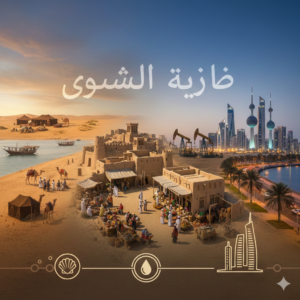
The History of Kuwait: From Pearling Outpost to Global Power
Kuwait’s history is a story of resilience, strategic location, and rapid transformation. Situated at the tip of the Persian Gulf, it has served as a vital bridge between Mesopotamia, the Arabian Peninsula, and the Indian Ocean for millennia.
1. Ancient Foundations and Failaka Island
The history of Kuwait does not begin with the modern city, but on the islands nearby. Failaka Island is one of the most significant archaeological sites in the Gulf.
-
The Dilmun Civilization: During the Bronze Age (c. 2000 BCE), Failaka was a major hub for the Dilmun civilization, serving as a religious and commercial link between Sumer (modern Iraq) and the Indus Valley.
-
Hellenistic Influence: In the 4th century BCE, after the conquests of Alexander the Great, the Greeks established a colony on the island named Ikaros. Ruins of Greek temples and coins from this era prove that Kuwait was a cosmopolitan node even in antiquity.
2. The Rise of the Bani Utub (18th Century)
The modern state of Kuwait was founded in the early 18th century by the Bani Utub confederation, a group of families (including the Al-Sabah) who migrated from the Najd region of central Arabia.
-
Strategic Location: They chose a site near a small “Kut” (fortress), which gave the country its name.
-
Governance: In 1752, the community selected Sheikh Abu Abdullah Sabah bin Jaber (Sabah I) as their first leader. This established the Al-Sabah dynasty, which continues to rule to this day.
-
Maritime Economy: Unlike its neighbors, Kuwait lacked water for large-scale agriculture. Instead, it became a seafaring powerhouse. By the late 1700s, Kuwait possessed one of the largest dhow fleets in the region, specializing in pearl diving and long-distance trade with India and East Africa.
3. The British Protectorate (1899–1961)
As the Ottoman Empire sought to increase its influence in the Gulf, Sheikh Mubarak Al-Sabah (“Mubarak the Great”) looked for a strategic ally.
-
The 1899 Treaty: To prevent Ottoman encroachment and the potential for a German-controlled railway terminal, Mubarak signed a secret agreement with Great Britain. In exchange for protection, Kuwait agreed not to cede territory or conduct foreign policy without British consent.
-
The Great Depression and Oil: The 1920s and 30s were difficult. The invention of the Japanese cultured pearl devastated the local economy. However, in 1938, the Burgan field—one of the world’s largest oil deposits—was discovered. Due to World War II, commercial exports didn’t begin until 1946.
4. Independence and the Golden Era (1961–1980s)
On June 19, 1961, Kuwait became the first British protectorate in the Gulf to gain full independence.
-
The First Constitution: In 1962, Kuwait adopted a constitution, establishing a unique political system: a hereditary Emirate with a powerful, elected National Assembly.
-
Modernization: Using oil wealth, the state built a “cradle-to-grave” welfare system. Kuwait became a cultural beacon in the Arab world, known for its free press, literary journals, and the iconic Kuwait Towers (completed in 1979).
5. The Crisis: The Iraqi Invasion (1990–1991)
The defining moment of modern Kuwaiti history occurred on August 2, 1990, when Iraqi forces under Saddam Hussein invaded the country.
-
Occupation: Iraq claimed Kuwait as its “19th province,” citing historical claims and oil debt disputes.
-
Operation Desert Storm: A US-led coalition of 35 nations intervened in early 1991. After a devastating air campaign and a 100-hour ground war, Kuwait was liberated on February 26, 1991.
-
The Aftermath: The retreating Iraqi army set fire to over 600 oil wells, creating an unprecedented environmental disaster. Kuwait spent the next decade and billions of dollars rebuilding its infrastructure and economy.
6. 21st Century: Vision 2035
Today, Kuwait is a key player in global finance and diplomacy.
-
Economic Diversification: Through the “New Kuwait” (Vision 2035) initiative, the country is working to reduce its reliance on oil by developing its northern Silk City project and investing in technology.
-
Diplomatic Role: Kuwait is frequently a mediator in regional conflicts (such as the Qatar diplomatic crisis) and remains a major center for international humanitarian aid.
| Period | Focus | Key Turning Point |
| Ancient | Trade & Religion | Hellenistic settlement on Failaka |
| 1750–1899 | Seafaring & Pearling | Establishment of Al-Sabah rule |
| 1899–1961 | British Protection | Discovery of oil (1938) |
| 1961–1990 | Independence | Constitutionalism & Modernization |
| 1990–1991 | Invasion/Liberation | Operation Desert Storm |
| 2000–Present | Modern Statehood | Economic Diversification (Vision 2035) |
Visit : www.dkbtech.com, www.allcircular.com