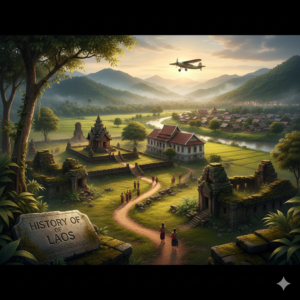
The History of Laos is a rich tapestry woven with threads of ancient kingdoms, colonial influences, and a resilient spirit. Nestled in the heart of Southeast Asia, Laos’s story is deeply intertwined with its powerful neighbors and its strategic location along the Mekong River.
Early Kingdoms and the Rise of Lan Xang
The earliest evidence of human settlement in Laos dates back to the Paleolithic period. However, the true foundations of Lao identity began to solidify with the migration of Tai peoples from southern China into the Indochinese peninsula. By the 8th century, various Tai principalities, known as muang, dotted the landscape.
The pivotal moment in Lao history arrived in the mid-14th century with the establishment of the Kingdom of Lan Xang (Million Elephants) by King Fa Ngum. Fa Ngum, educated at the Khmer court of Angkor, united the disparate muang and adopted Theravada Buddhism as the state religion, a decision that profoundly shaped Lao culture and identity. Lan Xang quickly grew into a powerful regional state, controlling significant trade routes and maintaining diplomatic relations with its neighbors. Its capital, Luang Prabang (then known as Xieng Dong Xieng Thong), became a renowned center of Buddhist learning and art.
Lan Xang flourished for centuries, experiencing a golden age under King Setthathirath in the 16th century, who moved the capital to Vientiane, a more strategic location. He oversaw the construction of significant religious monuments, including the iconic That Luang stupa, which remains a national symbol. However, internal divisions and external pressures, particularly from the encroaching Burmese and Siamese empires, eventually led to the kingdom’s fragmentation. By the early 18th century, Lan Xang had split into three rival kingdoms: Luang Prabang, Vientiane, and Champasak.
Colonial Era and French Indochina
The 19th century witnessed increasing foreign intervention in the region. Siam (Thailand) exerted considerable influence over the fragmented Lao states, leading to periods of direct rule and cultural assimilation. This dominance was challenged by the arrival of European colonial powers. France, having established control over Vietnam and Cambodia, gradually extended its influence westward, culminating in the establishment of French Indochina in the late 19th and early 20th centuries.
Laos officially became a French protectorate in 1893. French rule brought a centralized administration, the introduction of Western education (albeit limited), and infrastructure development such as roads and telegraph lines. However, it also led to the exploitation of resources, the imposition of taxes, and a suppression of local autonomy. The French largely preserved the traditional monarchical system in Luang Prabang, using it as a tool of indirect rule. Despite its relatively small population and perceived lack of strategic importance compared to Vietnam, Laos became a quiet but integral part of the French colonial empire.
Independence, Conflict, and the Path to the Lao PDR
The tides of nationalism began to rise in Laos following World War II. Japan’s brief occupation of Indochina weakened French authority, allowing for the emergence of the Lao Issara (Free Laos) movement, which declared independence in 1945. However, the French quickly reasserted control. True independence was eventually granted in 1953, establishing the Kingdom of Laos as a constitutional monarchy.
However, the newly independent nation quickly became entangled in the geopolitical struggles of the Cold War and the wider conflict in Vietnam. Laos was declared neutral, but its strategic location along the Ho Chi Minh Trail, a vital supply route for North Vietnam, made it a battleground for proxy wars. The United States launched a massive covert bombing campaign against Pathet Lao and North Vietnamese forces in Laos from 1964 to 1973, making Laos the most heavily bombed country per capita in history. This period is often referred to as the “Secret War.”
The conflict intensified, leading to a civil war between the Royal Lao Government and the communist Pathet Lao, supported by North Vietnam. In 1975, with the fall of Saigon and the communist victories in Vietnam and Cambodia, the Pathet Lao emerged victorious. The monarchy was abolished, and the Lao People’s Democratic Republic (Lao PDR) was proclaimed in December 1975.
Modern Laos
Since 1975, Laos has been governed by the Lao People’s Revolutionary Party. The initial years of the Lao PDR were marked by socialist policies, nationalization, and isolation. However, in the late 1980s, influenced by reforms in Vietnam and China, Laos embarked on economic liberalization through the “New Economic Mechanism.” This shift embraced market-oriented policies, opened the country to foreign investment, and gradually integrated Laos into the global economy.
Today, Laos is a developing nation with a growing economy, primarily driven by hydropower, mining, agriculture, and tourism. While still facing challenges in poverty reduction and infrastructure development, Laos is actively engaging with regional and international partners. The legacy of its complex history, from ancient kingdoms to colonial rule and devastating conflict, continues to shape its identity and its path forward as it navigates the complexities of the 21st century.
_________________________________________________________________________________________