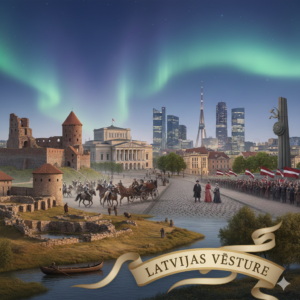
The History of Latvia is a saga of resilience, a narrative of a people who preserved their unique language and culture through centuries of foreign domination to emerge as a modern European nation. Strategically positioned on the Baltic Sea, the territory of present-day Latvia has long been a crossroads for trade, conquest, and cultural exchange.
1. Prehistoric Roots and Baltic Tribes
The first human inhabitants arrived in Latvia around 9000 BCE, following the retreat of the glaciers. These early hunter-gatherers were eventually joined by Proto-Baltic tribes around 3000 BCE. By the first millennium CE, four distinct Baltic tribes—the Curonians, Latgalians, Selonians, and Semigallians—along with the Finnic Livonians, had established organized societies. They were known as skilled traders, particularly of “Baltic Gold” (amber), which reached as far as the Roman Empire.
The Era of Foreign Hegemony
Starting in the 12th century, Latvia’s strategic location at the mouth of the Daugava River made it a target for expansion.
-
German Crusades (1180–1290): German missionaries and knights, specifically the Livonian Brothers of the Sword, initiated the Northern Crusades. Despite fierce resistance (notably by the Semigallian leader Viesturs), the tribes were eventually conquered. In 1201, Bishop Albert founded Riga, which became a pivotal member of the Hanseatic League in 1282.
-
The Struggle for Power: For the next several centuries, Latvian lands (known then as Livonia) were a battleground for regional powers.
-
The Polish-Lithuanian Commonwealth: Gained control over much of the territory in the late 16th century.
-
Swedish Rule (1629–1710): Sweden took control of Riga and northern Latvia. This era is often remembered as the “Good Swedish Times” because the crown limited the power of German barons and promoted education.
-
The Russian Empire (1710–1918): Following the Great Northern War, Peter the Great annexed the region. Under Russian rule, Latvia industrialized rapidly, and Riga grew into the empire’s third-largest port.
-
2. National Awakening and First Independence
The mid-19th century saw the Latvian National Awakening, led by the “Young Latvians” (Krišjānis Valdemārs, Krišjānis Barons). They promoted the Latvian language and identity, culminating in the first National Song Festival in 1873.
The chaos of World War I and the Russian Revolution provided a window for sovereignty. On November 18, 1918, Latvia proclaimed its independence. After a brutal War of Independence against both Bolshevik and German forces, Latvia enjoyed two decades of prosperous, though later autocratic (under Kārlis Ulmanis), independence.
3. The Dark Century: Occupation and Resistance
The Molotov-Ribbentrop Pact of 1939 sealed Latvia’s fate, leading to three successive occupations during World War II:
-
Soviet Union (1940–1941): Marked by mass executions and the June 14, 1941, deportations of 15,000 people to Siberia.
-
Nazi Germany (1941–1944): Resulted in the horrific Holocaust, where approximately 70,000 Latvian Jews were murdered.
-
Soviet Union (1944–1991): Following the war, Latvia was forcibly incorporated as the Latvian SSR. This era was characterized by collectivization, censorship, and “Russification,” but also by the quiet preservation of Latvian traditions.
4. The Singing Revolution and Modern History of Latvia
In the late 1980s, Mikhail Gorbachev’s glasnost allowed for the “Singing Revolution.” Latvians used folk songs and peaceful protests, such as the Baltic Way (a human chain connecting Tallinn, Riga, and Vilnius in 1989), to demand freedom.
On May 4, 1990, the declaration to restore independence was passed, and full sovereignty was achieved on August 21, 1991. Since then, Latvia has integrated into the West, joining NATO and the European Union in 2004 and adopting the Euro in 2014.
| Year | Event |
| 1201 | Foundation of Riga by Bishop Albert |
| 1710 | Russia captures Riga during the Great Northern War |
| 1918 | Proclamation of the Republic of Latvia (Nov 18) |
| 1940 | First Soviet occupation begins |
| 1991 | Restoration of de facto independence (Aug 21) |
| 2004 | Latvia joins the EU and NATO |