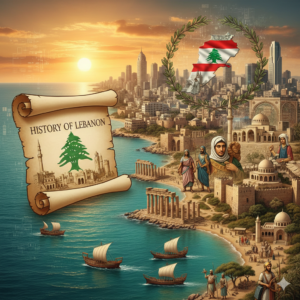
1. The Dawn of Civilization: The Phoenicians
History of Lebanon begins with the Phoenicians, a maritime civilization of Semitic origin. From roughly 2500 BCE to 539 BCE, cities like Byblos, Tyre, and Sidon became the world’s most significant trading hubs.
-
The Alphabet: Perhaps Lebanon’s greatest gift to the world was the Phoenician alphabet, the ancestor of almost all modern phonetic writing systems.
-
Maritime Mastery: They were the masters of the Mediterranean, trading “Tyrian Purple” dye (harvested from Murex shells) and the famous Cedars of Lebanon, which were used by Egyptians and Israelites for temples and ships.
2. Classical Antiquity: Greco-Roman Influence
After the conquest by Alexander the Great in 332 BCE, Lebanon became part of the Hellenistic world.
-
Roman Baalbek: Under Roman rule, the sanctuary at Baalbek (Heliopolis) saw the construction of some of the largest temples ever built, including the Temple of Jupiter.
-
Berytus: Modern-day Beirut became famous for its Law School, which helped codify the Justinian Code—the foundation of modern Western law.
3. The Middle Ages: Arab Conquests and the Crusades
The 7th century brought Islam and the Arabic language to the region.
-
The Maronites and Druze: During this time, the rugged Mount Lebanon became a refuge for persecuted groups. The Maronite Christians fled from the Orontes valley to the mountains, and later, the Druze faith established a strong presence in the Shouf region.
-
The Crusader Interlude: From the 11th to the 13th centuries, Lebanon was a primary battleground. Massive fortresses like the Sea Castle in Sidon and Byblos Castle stand as remnants of the County of Tripoli.
4. The Ottoman Era (1516–1918)
For four centuries, Lebanon was part of the Ottoman Empire. However, it often enjoyed a level of autonomy under local emirs.
-
Fakhreddine II: Known as the “Engineer of Modern Lebanon,” he sought to unite the Druze and Maronites and opened the doors to European trade and culture.
-
The 1860 Conflict: Tensions between Maronites and Druze led to a civil war, prompting European intervention and the creation of the Mount Lebanon Mutasarrifate, an autonomous subdivision that paved the way for modern statehood.
5. The French Mandate and Independence (1920–1943)
Following the collapse of the Ottoman Empire in WWI, the League of Nations granted France a mandate over Lebanon.
-
Greater Lebanon: In 1920, “Le Grand Liban” was declared, expanding the mountain borders to include Beirut and the coastal cities.
-
Independence: On November 22, 1943, Lebanon gained independence. The “National Pact” established a unique confessional system of government, distributing power among the country’s diverse religious sects.
6. The Golden Age and the Civil War
The 1950s and 60s are often called Lebanon’s “Golden Age.” Beirut was the “Paris of the Middle East,” a hub of banking, tourism, and intellectual freedom.
-
The Collapse: Regional tensions, including the arrival of the PLO and internal sectarian imbalances, led to a brutal Civil War (1975–1990).
-
The Taif Agreement: The war ended with an agreement that redistributed political power more evenly but left the country under a long period of Syrian tutelage.
7. Modern Challenges (2000–Present)
The 21st century has been a period of extreme highs and lows:
-
The Cedar Revolution (2005): Following the assassination of Rafik Hariri, mass protests led to the withdrawal of Syrian troops.
-
Economic Crisis: Since 2019, Lebanon has faced one of the world’s worst financial collapses, compounded by the 2020 Beirut Port explosion.
_______________________________________________________________________________________
www.dkbtech.com , www.allcircular.com