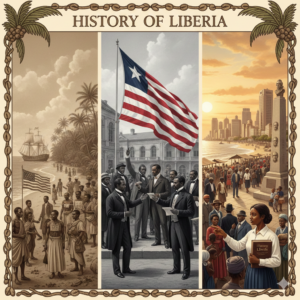
In the History of Liberia, I have structured this overview into key eras, tracing its journey from an idealistic (though complex) settlement project to Africa’s first republic, through its era of upheaval, and into its modern recovery.
1. The Roots of Liberia: Pre-Settlement and the ACS
Before the arrival of settlers in the 19th century, the land now known as Liberia was inhabited by various indigenous ethnic groups, including the Kpelle, Bassa, Gio, Kru, Grebo, and Mano. These groups had established complex social structures and trade networks long before European contact.
In the early 1800s, the American Colonization Society (ACS) was formed in the United States. It was a controversial organization composed of both Quakers (who opposed slavery) and slaveholders (who feared the presence of free Black people would incite slave rebellions). Their goal was to “repatriate” free Black Americans to Africa. In 1822, the first permanent settlement was established on Providence Island, eventually becoming the city of Monrovia, named after U.S. President James Monroe.
2. Independence and the Americo-Liberian Era (1847–1980)
Liberia declared its independence on July 26, 1847, making it the first African republic. Its constitution and flag were heavily modeled after those of the United States.
However, the new nation faced a deep internal divide:
-
The Americo-Liberian Elite: Descendants of the original settlers who controlled the political and economic levers of the country through the True Whig Party.
-
The Indigenous Population: The majority of the people, who were often denied citizenship, voting rights, and equal access to resources for over a century.
Despite these internal tensions, Liberia remained one of the few African nations to maintain its sovereignty during the “Scramble for Africa,” largely due to its diplomatic ties with the U.S.
3. The 1980 Coup and the Descent into Conflict
The long-standing exclusion of indigenous groups reached a breaking point in 1980. Samuel Doe, a master sergeant of indigenous Krahn descent, led a violent military coup that executed President William Tolbert and ended the Americo-Liberian political monopoly.
While initially welcomed by many, Doe’s regime became increasingly authoritarian and ethnically polarized. This instability culminated in 1989 when Charles Taylor led an incursion from neighboring Ivory Coast, sparking the First Liberian Civil War.
4. Civil War and Recovery (1989–2003)
The civil wars (1989–1996 and 1999–2003) were devastating, characterized by the use of child soldiers and widespread human rights abuses. An estimated 250,000 people died, and the country’s infrastructure was decimated.
The conflict finally ended with the Accra Comprehensive Peace Agreement in 2003. Charles Taylor was forced into exile and later became the first former head of state to be convicted of war crimes by an international tribunal (the Special Court for Sierra Leone).
5. Modern Liberia: Democracy and Challenges
In 2005, Liberia made history by electing Ellen Johnson Sirleaf, the first elected female head of state in Africa. Her administration focused on:
-
Debt Relief: Successfully clearing billions in national debt.
-
Reconstruction: Rebuilding schools, roads, and hospitals.
-
The Ebola Crisis: Managing the 2014 outbreak that severely tested the nation’s fragile healthcare system.
In 2017, the country saw its first peaceful democratic transition of power in decades when former soccer star George Weah was elected president, succeeded later by Joseph Boakai in 2023.
Visit: www.dkbtech.com . www.allcircular.com