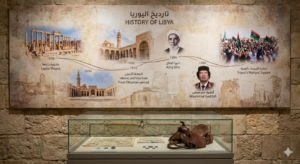
The Sands of Time: A Comprehensive History of Libya
Libya is a land defined by its duality: the Mediterranean coast, looking outward toward Europe and the Levant, and the vast, formidable Sahara, looking inward toward the heart of Africa. Its history is not merely a sequence of rulers, but a chronicle of how human civilization has attempted to master one of the most inhospitable environments on Earth. From the “Green Sahara” of prehistory to the fragmented political landscape of the 21st century, Libya has served as a crossroads, a prize of empires, and a crucible of resistance.
I. Prehistory: The Green Sahara and the Dawn of Art
Long before the concept of “Libya” existed, the land was a savannah teeming with life. Between 8000 BCE and 2000 BCE, during the Neolithic Subpluvial period (often called the “Green Sahara”), the desert was lush with rivers, lakes, and forests.
The Rock Art of Tadrart Acacus
The primary record of this lost world is preserved in the Tadrart Acacus mountains in southwestern Libya. Thousands of rock paintings and carvings depict a radical transformation of the environment. Early images show elephants, giraffes, rhinoceroses, and crocodiles—creatures that require abundant water and vegetation. Later images, dating to around 4000 BCE, shift to pastoral scenes of cattle herding, indicating the domestication of animals. As the climate began to dry around 2000 BCE, the art shifts again, depicting camels and horses, signaling the desertification that would come to define the region.
These early inhabitants were the ancestors of the Berbers (Amazigh), the indigenous people of North Africa who would remain the demographic backbone of the region through millennia of foreign conquests.
II. The Ancients: The Tripartite Division
Historically, the territory of modern Libya was never a single unified political entity. It was comprised of three distinct regions, each with a unique trajectory: Tripolitania in the west, Cyrenaica in the east, and the Fezzan in the desert south.
1. The Phoenicians in Tripolitania
In the early 1st millennium BCE, Phoenician traders from Tyre (modern Lebanon) established trading posts along the western coast to facilitate their maritime commerce. The most significant of these were Oea (modern Tripoli), Labdah (Leptis Magna), and Sabratha. Together, these three cities formed the Tripolis (Three Cities), giving the region the name Tripolitania. These cities became wealthy outlets for trans-Saharan trade, shipping gold, ivory, and slaves from the interior to the Mediterranean world.
2. The Greeks in Cyrenaica
While Phoenicians settled the west, Greeks colonized the east. In 631 BCE, colonists from the island of Thera founded the city of Cyrene in the fertile Green Mountain (Jebel Akhdar) region. Cyrene became a center of Hellenic culture and philosophy, famous for its export of silphium, a medicinal plant that was so valuable it was stamped on their coins (and eventually harvested to extinction). The Greeks established five major cities—Cyrene, Apollonia, Ptolemais, Taucheira, and Berenice (Benghazi)—known collectively as the Pentapolis.
3. The Garamantes of the Fezzan
Perhaps the most remarkable ancient civilization in Libya was the indigenous Garamantes empire in the Fezzan. For centuries, Roman historians dismissed them as barbaric nomads, but modern archaeology has revealed a sophisticated urban civilization centered at their capital, Garama (modern Germa).
The Garamantes mastered the desert by constructing foggaras—vast underground networks of tunnels that tapped into ancient fossil water aquifers. This technology allowed them to cultivate wheat, grapes, and figs in the middle of the Sahara. They controlled the trans-Saharan trade routes, using horse-drawn chariots to traverse the desert, and built a state that lasted from 500 BCE to 700 CE. Their decline came only when the fossil water tables dropped below the reach of their technology, causing their cities to wither back into the sands.
III. The Roman Era: The Golden Age of Integration
Rome eventually absorbed both the Greek east and the Punic west, though the regions retained their distinct cultural identities (Latin in Tripolitania, Greek in Cyrenaica).
The Severan Dynasty and Leptis Magna
Libya reached the apex of its ancient prosperity under Septimius Severus (r. 193–211 CE), the first African-born Roman Emperor. Born in Leptis Magna, Severus lavished his hometown with imperial patronage. He commissioned a massive expansion of the city, building a new forum, a basilica, and a colonnaded street that rivaled Rome itself.
During this period, the coastal plains were the “breadbasket of Rome,” producing immense quantities of olive oil and grain. The Romans also fortified the frontier with the Limes Tripolitanus, a line of forts designed to protect the fertile coast from desert nomads.
The Byzantine Interlude
As the Roman Empire crumbled, the Vandals—a Germanic tribe—swept through North Africa in the 5th century CE, dismantling Roman administration. Although the Byzantine Empire under Justinian reconquered the coast in 533 CE, they never fully restored the region’s former glory. The interior drifted out of imperial control, and the coastal cities became fortified outposts in a hostile land.
IV. In the History of Libya the Islamic Conquest and Arabization
The single most transformative event in Libyan history began in 642 CE. Arab armies, led by Amr ibn al-As, marched into Cyrenaica after conquering Egypt. The Byzantine garrisons, unpopular and overextended, offered little resistance.
The Shift to Islam
The conquest brought Islam to the Berbers, though the conversion was gradual and often contested. For centuries, the region was ruled by a succession of dynasties: the Umayyads in Damascus, the Abbasids in Baghdad, and later the Fatimids in Cairo.
The Hilalian Invasion (11th Century)
While the initial conquest brought the religion of Islam, the demographic “Arabization” of Libya occurred later. In the 11th century, the Fatimid rulers of Egypt punished their rebellious Zirid vassals in North Africa by unleashing the Banu Hilal and Banu Sulaym Bedouin tribes. These Arab nomads migrated westward in massive numbers, displacing Berber farmers and turning agricultural land into pasture. This migration cemented the Arabic language and Bedouin culture as the dominant forces in Libya, pushing Berber culture into the mountain enclaves where it survives today.
V. The Ottoman Rule and the Karamanli Dynasty
In 1551, the Ottoman Empire captured Tripoli from the Knights of St. John (who had briefly held it for Spain). This marked the beginning of nominally Ottoman rule, which would last until 1911. However, Istanbul’s control was often loose.
The Karamanli Dynasty (1711–1835)
In 1711, Ahmed Karamanli, a Turkish cavalry officer, seized power in Tripoli and established a hereditary dynasty that ruled as a semi-independent state. The Karamanlis built Tripoli into a formidable naval power, relying heavily on state-sponsored piracy (corsairing). European nations and the young United States paid “tribute” to Tripoli to ensure safe passage for their merchant ships.
The Barbary Wars
When the United States refused to increase tribute payments in 1801, Yusuf Karamanli declared war, leading to the First Barbary War. This conflict saw the USS Philadelphia run aground in Tripoli harbor and subsequently burned by US Marines in a daring raid. The war ended with a treaty, but it signaled the beginning of the end for the corsair economy.
In 1835, amid civil strife and economic decline, the Ottoman Empire reasserted direct control, ending the Karamanli dynasty. The second Ottoman period was marked by the rise of the Sanusi order in Cyrenaica—a Sufi religious movement that sought to purify Islam and unite the desert tribes. The Sanusis would become the backbone of Libyan resistance against foreign invaders.
VI. The Italian Colonization (1911–1943)
As the “Scramble for Africa” reached its conclusion, Italy sought its own “place in the sun.” In 1911, Italy declared war on the Ottoman Empire and invaded Libya.
The Invasion and Resistance
The Italians easily captured the coastal cities, but the interior proved unconquerable. For twenty years, the Libyans fought a fierce guerrilla war. In Tripolitania, resistance was fragmented, but in Cyrenaica, the Sanusi order organized a cohesive defense.
The Lion of the Desert: Omar al-Mukhtar
The symbol of this resistance was Omar al-Mukhtar, a Quranic teacher turned guerrilla leader. Using the rough terrain of the Green Mountain, Mukhtar’s light cavalry ambushed Italian columns and vanished before air power could be brought to bear.
To break the resistance, the Fascist regime in Italy, led by Benito Mussolini, adopted brutal tactics. They erected a 300-kilometer barbed-wire fence along the Egyptian border to cut off rebel supplies and forcibly relocated the entire population of the Jebel Akhdar—over 100,000 men, women, and children—into desert concentration camps. Starvation and disease killed nearly half of the detainees. Deprived of his support base, Omar al-Mukhtar was captured in 1931 and hanged before his followers at the age of 73.
The Fourth Shore
With the resistance crushed, Italy declared Libya its “Fourth Shore” (Quarta Sponda). They invested heavily in infrastructure, building the Litoranea Balbo (the coastal highway) and encouraging mass Italian immigration. By 1939, Italians made up over 12% of the population.
VII. World War II and Independence
Libya was a major theater of World War II, with the British Eighth Army and the German Afrika Korps (under Rommel) seesawing across the desert in battles like Tobruk and Gazala. By 1943, the Axis forces were expelled.
Post-war Libya was poor, illiterate, and devastated. The UN debated its fate, eventually deciding on independence. On December 24, 1951, the United Kingdom of Libya was proclaimed, with the head of the Sanusi order, Idris al-Senussi, crowned as King Idris I.
The Oil Boom
At independence, Libya was one of the poorest nations in the world, its primary export being scrap metal from WWII battlefields. This changed forever in 1959 with the discovery of massive oil reserves at Zelten. The “sweet” Libyan crude (low sulfur, easy to refine) transformed the economy overnight. However, the wealth was concentrated in the hands of the elite, and King Idris’s pro-Western stance (hosting US and British airbases) grew increasingly unpopular amid the rise of Arab nationalism.
VIII. In the History of Libya the Gaddafi Era (1969–2011)
On September 1, 1969, a group of young officers led by a 27-year-old signals captain named Muammar Gaddafi staged a bloodless coup while King Idris was abroad.
The Jamahiriya
Gaddafi dismantled the monarchy and established the Libyan Arab Republic. Ideologically, he espoused a mix of Arab nationalism, socialism, and Islam. In 1977, he proclaimed the Jamahiriya (“State of the Masses”), ostensibly a direct democracy where citizens ruled through local “People’s Committees.” In reality, power remained firmly with Gaddafi and his “Revolutionary Committees.”
Gaddafi codified his philosophy in The Green Book, which rejected both capitalism and communism. He used Libya’s oil wealth to fund massive infrastructure projects, including the Great Man-Made River, a colossal engineering feat that piped fossil water from the southern aquifers to the coastal cities. Literacy and life expectancy soared, but political dissent was ruthlessly crushed.
The Pariah State
Foreign policy under Gaddafi was erratic and aggressive. He supported revolutionary movements worldwide, from the IRA to the PLO. Relations with the West deteriorated, culminating in the 1986 US bombing of Tripoli and Benghazi (Operation El Dorado Canyon) and the 1988 bombing of Pan Am Flight 103 over Lockerbie, Scotland. UN sanctions turned Libya into an international pariah.
Rehabilitation
In the early 2000s, seeing the fate of Saddam Hussein, Gaddafi pivoted. He renounced his weapons of mass destruction program, paid compensation for Lockerbie, and cooperated with the West on counter-terrorism and migration control. Sanctions were lifted, and Western leaders visited Tripoli. However, domestic grievances—corruption, unemployment, and lack of freedom—continued to fester.
IX. History of Libya of the 2011 Revolution
In February 2011, inspired by the Arab Spring in Tunisia and Egypt, protests erupted in Benghazi. When Gaddafi’s forces responded with live ammunition, the protests mutated into an armed rebellion.
Gaddafi vowed to hunt down the “rats” of Benghazi “house by house.” Fearing a massacre, the UN Security Council authorized a “no-fly zone.” NATO launched an air campaign that destroyed the Libyan government’s command structure and armor.
After six months of civil war, rebel forces captured Tripoli in August 2011. Gaddafi fled to his hometown of Sirte, where he was captured and killed by rebels on October 20, 2011.
X. The Post-Revolution Chaos (2011–Present)
The fall of Gaddafi left a power vacuum that no single entity could fill. The state collapsed into a patchwork of fiefdoms ruled by powerful city-based militias (misratans, Zintanis) and tribal alliances.
The East-West Split (2014–2020)
By 2014, the country had split into two rival governments:
-
The West (Tripoli): The Government of National Accord (GNA), recognized by the UN and supported by Turkey and Qatar.
-
The East (Tobruk/Benghazi): The House of Representatives, allied with General Khalifa Haftar and his Libyan National Army (LNA), supported by Egypt, the UAE, Russia, and France.
Haftar launched “Operation Dignity” to purge Islamists from the east, eventually controlling most of the country’s oil fields. In 2019, he launched an offensive to capture Tripoli. The siege lasted over a year but collapsed in 2020 after Turkey intervened militarily on behalf of the Tripoli government.
The Current Stasis
Since a ceasefire in October 2020, Libya has remained in a fragile deadlock. A Government of National Unity (GNU) was formed to lead the country to elections, but the vote scheduled for December 2021 was indefinitely postponed due to disagreements over the legal framework.
As of 2025, the country remains effectively divided. The east is dominated by the Haftar family and the House of Representatives, while the west is a complex web of militias and political factions nominally under the GNU. Meanwhile, foreign powers (Turkey, Russia, Egypt) maintain military presences, and the economy remains hostage to the periodic blockades of oil facilities.
Conclusion
The History of Libya is a testament to resilience. From the Garamantes mining water from the rock to the Sanusis resisting Italian armor, the people of this land have consistently defied the odds. Today, Libya stands at yet another crossroads, struggling to forge a national identity that can reconcile its ancient tribal divisions with the demands of a modern state.
_____________________________________________________________________________________
Visit : www.dkbtech.com , www.allcircular.com