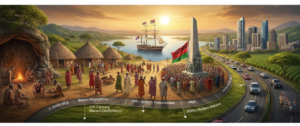
The History of Malawi—one of Africa’s most culturally rich and historically complex nations—requires a journey from the deep archaeological past to the vibrant, democratic present. Known today as “The Warm Heart of Africa,” Malawi’s story is one of migration, empire-building, colonial resistance, and a long struggle for democratic maturity.
1. The Deep Past: Early Inhabitants and Stone Age Origins
The history of Malawi does not begin with the written records of explorers, but with the footprints of the Akafula (or Abathwa), a hunter-gatherer people who inhabited the region for millennia. Archaeological evidence at sites like the Chongoni Rock Art Area—now a UNESCO World Heritage site—reveals a culture that dates back to the Late Stone Age.
These early inhabitants were eventually superseded by waves of Bantu-speaking migrations that moved southward from West-Central Africa. By the 4th century CE, iron-working communities began to settle around the shores of Lake Malawi (then known to locals as Lake Nyasa). These migrants brought with them revolutionary technologies:
-
Iron Smelting: Allowing for better tools and weaponry.
-
Settled Agriculture: Moving away from nomadic gathering toward the cultivation of sorghum and millet.
-
Pottery: Specific styles like the Nkope and Kwale traditions help historians trace these early movements.
2. The Rise of the Maravi Empire (15th – 18th Century)
The name “Malawi” is a modern derivation of Maravi, a powerful confederacy that emerged around the 15th century. Founded by the Phiri clan of the Chewa people, the Maravi Empire was a sophisticated political entity that, at its peak, stretched across modern-day Malawi, Mozambique, and Zambia.
The Kalonga Dynasty
The empire was ruled by a paramount chief known as the Kalonga. From their capital at Mankhamba, the Kalongas administered a vast network of sub-chiefs. The Maravi were renowned for:
-
Trade Networks: They traded ivory, iron, and cloth with Portuguese and Swahili-Arab merchants on the East African coast.
-
Religious Structure: A fascinating duality of power existed where the Kalonga held secular authority, while ritual authority (especially rain-making) often resided with priestesses like the Makewana.
By the 18th century, the Maravi Empire began to fragment. Internal succession disputes and the external pressure of the growing Indian Ocean Slave Trade weakened central authority, leading to the rise of decentralized ethnic groups such as the Yao, Ngoni, and Tumbuka.
3. The 19th Century: Invasions and the “Scramble”
The 1800s were a century of profound upheaval. Two major groups migrated into the region:
-
The Yao: Moving in from the east, they became key middlemen in the Swahili-Arab slave trade.
-
The Ngoni: Fleeing the “Mfecane” (upheaval) in Southern Africa, these Zulu-offshoot warriors brought a militaristic culture that transformed the local social landscape.
David Livingstone and the Missionary Arrival
In 1859, the Scottish explorer David Livingstone reached Lake Nyasa. Horrified by the devastation of the slave trade, he called for the “Three Cs”: Christianity, Commerce, and Civilization.
His plea led to the establishment of the Free Church of Scotland and the Universities’ Mission to Central Africa (UMCA). These missions, particularly at Blantyre (founded in 1876) and Livingstonia, became the bedrock of modern education and healthcare in Malawi, but they also paved the way for British political intervention.
4. The Colonial Era: Nyasaland (1891–1964)
To prevent Portuguese expansion from Mozambique and German expansion from Tanganyika, the British declared a protectorate over the “Shire Highlands” in 1889, expanding it to the British Central Africa Protectorate in 1891 (renamed Nyasaland in 1907).
Resistance and the Chilembwe Uprising
Colonial rule was often exploitative, particularly through the Thangata system, a form of forced labor on European-owned estates. This sparked early nationalist resistance. In 1915, Reverend John Chilembwe, an American-educated preacher, led an armed uprising against colonial injustices. Though the revolt was suppressed and Chilembwe killed, he remains a foundational hero of Malawian independence.
5. Independence and the Banda Era (1964–1994)
After World War II, the push for self-rule intensified. The Nyasaland African Congress (NAC), led by the charismatic Dr. Hastings Kamuzu Banda, fiercely opposed the British-imposed Federation of Rhodesia and Nyasaland.
On July 6, 1964, Malawi gained independence. Two years later, it became a republic with Dr. Banda as President. His 30-year rule was a study in contradictions:
-
Stability: Malawi avoided the civil wars that plagued its neighbors.
-
Autocracy: Banda declared himself “President for Life” in 1971. He suppressed dissent through a network of spies and the “Malawi Young Pioneers.”
-
Conservatism: He enforced strict dress codes (no long hair for men, no trousers for women) and maintained controversial diplomatic ties with apartheid South Africa.
6. Democracy and the Modern Era (1994–Present)
Under pressure from Western donors and internal protests led by the Catholic Church and underground activists, a referendum in 1993 ended one-party rule. In 1994, Bakili Muluzi defeated Banda in the first multi-party elections.
Since then, Malawi has navigated the challenges of a young democracy:
-
Peaceful Transitions: The country has seen several peaceful changes of power, including the presidency of Joyce Banda (Malawi’s first female president) and the landmark 2020 election of Lazarus Chakwera, which followed a historic court-ordered annulment of a fraudulent vote.
-
Economic Resilience: Despite being landlocked and reliant on tobacco exports, Malawi continues to strive for food security and infrastructure development under the “Malawi 2063” vision.
| Period | Key Feature | Major Figures/Groups |
| Pre-1500 | Early Bantu Migrations | Akafula, Bantu Farmers |
| 1500–1700 | Maravi Empire | The Kalonga, Chewa People |
| 1850–1890 | Missionary & Explorer Era | David Livingstone, The Yao |
| 1891–1964 | British Colonial Rule | John Chilembwe, Harry Johnston |
| 1964–1994 | One-Party State | Dr. Hastings Kamuzu Banda |
| 1994–Today | Multiparty Democracy | Bakili Muluzi, Lazarus Chakwera |
________________________________________________________________________________________
Visit: www.dkbtech.com, www.allcircular.com