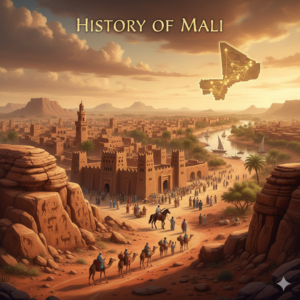
The history of Mali is a profound epic of rising and falling empires, golden ages of scholarship, and a modern struggle for sovereignty and stability. Once the center of the wealthiest civilization on Earth, the region has transitioned through the splendors of the medieval era, the hardships of colonial rule, and a complex post-colonial identity.
1. The Dawn of the Great Empires
Long before the modern nation-state, the territory of Mali was the heart of West African civilization. Its geography—defined by the Niger River and its proximity to the Sahara—made it a natural bridge for trade.
The Ghana Empire (c. 700–1200)
While not named “Mali,” the Ghana Empire (or Wagadu) laid the foundation. It grew wealthy by controlling the trans-Saharan trade in gold and salt. By the 11th century, Almoravid invasions and internal fractures weakened Ghana, creating a power vacuum that smaller kingdoms, such as the Sosso and the Mandinka, fought to fill.
The Rise of the Mali Empire (c. 1230)
The true “History of Mali” begins with the legendary Sundiata Keita, the “Lion King.” After defeating the Sosso king Soumaoro Kanté at the Battle of Kirina in 1235, Sundiata established the Mali Empire. He codified the Kouroukan Fouga, one of the world’s earliest constitutions, which outlined human rights and social organization.
2. The Golden Age of the Mansen
Under the Keita dynasty, Mali became a global superpower. Its wealth was so immense that it influenced the economies of distant Mediterranean and European nations.
Mansa Musa I: The Richest Man in History
The most famous ruler, Mansa Musa I (r. 1312–1337), transformed Mali into a center of Islamic culture. His 1324 pilgrimage to Mecca is legendary: he traveled with thousands of attendants and so much gold that his spending caused a decade-long inflation crisis in Cairo.
-
Timbuktu: Musa turned Timbuktu into a global hub for learning. The University of Sankore housed thousands of manuscripts, attracting scholars from across the Muslim world.
-
Architecture: The Great Mosque of Djenné and the Djinguereber Mosque in Timbuktu remain iconic symbols of Sudano-Sahelian architecture.
The Songhai Empire (1464–1591)
As the Mali Empire weakened due to succession disputes, the Songhai Empire, led by Sunni Ali and later Askia Muhammad, rose to prominence. Centered in Gao, it eventually eclipsed Mali in size and military might, continuing the tradition of trade and Islamic scholarship until it was defeated by a Moroccan invasion in 1591.
3. The Colonial Interlude
After the fall of the great empires, the region fractured into smaller kingdoms like the Bambara Empire (Ségou) and the Theocratic State of Macina.
French Sudan
In the late 19th century, during the “Scramble for Africa,” France began its military expansion into the region. Despite fierce resistance from leaders like Samory Touré, the French established “French Sudan” (Soudan Français) by 1892. Colonial rule was characterized by:
-
Forced Labor: To build railways and infrastructure.
-
Economic Shift: Focus on export crops like cotton and peanuts.
-
Direct Rule: Destruction of traditional political structures in favor of French administration.
4. Modern Independence and Challenges
Mali gained its independence in 1960, initially as part of the short-lived Mali Federation with Senegal, before becoming a fully sovereign republic under Modibo Keita.
Post-Independence Politics:
| Period | Leadership/Event | Key Characteristics |
| 1960–1968 | Modibo Keita | Socialist policies, Pan-Africanism, and a break from French influence. |
| 1968–1991 | Moussa Traoré | Military coup followed by 23 years of authoritarian rule; ended by the “March Revolution.” |
| 1992–2012 | Democratic Era | Multi-party elections; Alpha Konaré and Amadou Toumani Touré (ATT). |
| 2012–Present | Instability | Tuareg rebellions, Islamist insurgencies, and multiple military coups (2012, 2020, 2021). |
Current Context
In the 2020s, Mali has undergone a significant geopolitical shift. The military junta, led by Assimi Goïta, has distanced the country from France and Western partners, opting for closer security ties with Russia (Africa Corps/Wagner Group). The nation continues to struggle with a complex insurgency in the north and center, while striving to maintain its rich cultural heritage.
Summary of Historical Eras
-
Empire Building: Ghana, Mali, and Songhai (c. 700–1591).
-
Fracture & Jihads: Small kingdoms and Islamic states (1600–1890).
-
Colonization: French Sudan (1892–1960).
-
Sovereignty: Republic of Mali (1960–Present).
_________________________________________________________________________________________
Visit: www.dkbtech.com , www.allcircular.com