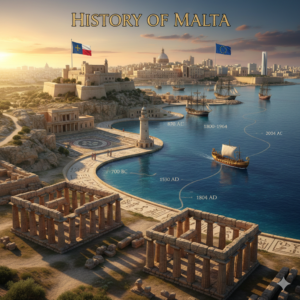
1. The Prehistoric Foundations (5900 BC – 2500 BC)
Malta’s history begins not with Mediterranean sailors, but with Neolithic farmers who likely crossed the 90-mile channel from Sicily.
The history of Malta is rich and varied, encompassing various civilizations throughout the ages.
-
The Għar Dalam Phase: The earliest evidence of human habitation is found in the Għar Dalam cave. These early settlers brought livestock and seeds, establishing a stable agricultural society.
-
The Temple Builders: Malta is home to the oldest free-standing stone structures in the world—predating the Pyramids of Giza and Stonehenge.
The history of Malta showcases its development through ancient civilizations, marking its significance in the Mediterranean.
-
Ġgantija and Ħaġar Qim: These megalithic complexes suggest a sophisticated, peaceful society with a complex understanding of astronomy and religion, likely centered around a “Fertility Goddess.”
-
-
The Mysterious Disappearance: Around 2500 BC, this advanced temple culture abruptly vanished. Whether due to famine, disease, or social collapse, the islands remained sparsely populated until the Bronze Age.
2. The Phoenician and Roman Eras (800 BC – 455 AD)
A Brief Overview of the History of Malta
Because of its central location, Malta became the “Jewel of the Mediterranean” for seafaring empires.
This strategic importance in the history of Malta is evident as it became a central point for trade and cultural exchange.
- The captivating history of Malta offers a glimpse into the lives of those who have inhabited these islands.
The Phoenicians: Around 800 BC, the Phoenicians used Malta as a vital stop on their trade routes. They named the main island Malat (“Safe Haven”).
-
Carthage and Rome: Control shifted to Carthage and then to Rome during the Second Punic War (218 BC). Under Roman rule, Malta (known as Melite) became a Municipium, prospering through the production of honey and fine linen.
-
The Shipwreck of St. Paul (60 AD): According to the Acts of the Apostles, St. Paul was shipwrecked on the islands while being taken to Rome. This event is credited with introducing Christianity to Malta, a faith that remains central to Maltese identity today.
This event marked a pivotal moment in the history of Malta, as it introduced Christianity and shaped its cultural identity.
3. Medieval Malta: Arabs, Normans, and Aragonese (870 – 1530)
-
The Arab Period: In 870 AD, North African Aghlabids conquered the islands. This era profoundly shaped the Maltese Language, which remains a Semitic tongue at its core (the only one written in the Latin alphabet). They introduced citrus, cotton, and advanced irrigation.
-
The Norman Conquest: In 1091, Count Roger I of Sicily took Malta, re-incorporating it into Christian Europe.
-
Feudalism: For the next few centuries, Malta was passed between various European dynasties (Swabians, Angevins, and Aragonese). It was a period of constant threat from Barbary corsairs (pirates) and relative poverty for the local population.
4. The Era of the Knights of St. John (1530 – 1798)
Throughout the history of Malta, the Knights of St. John played a crucial role in its defense and development.
This is perhaps the most iconic period of Maltese history. In 1530, Holy Roman Emperor Charles V gave Malta to the Order of St. John (the Knights Hospitaller) in exchange for the annual tribute of a single falcon.
The Great Siege of 1565
The Ottoman Empire, led by Suleiman the Magnificent, sought to wipe out the Knights and use Malta as a stepping stone to invade Southern Europe.
-
The Conflict: 48,000 Ottoman soldiers faced roughly 6,000 defenders (Knights and Maltese locals).
-
The Victory: Against all odds, the Knights held out through a brutal summer. The victory turned the Knights into heroes of Christendom and led to the building of the fortified city of Valletta, named after Grandmaster Jean de Valette.
The Knights spent the next two centuries transforming Malta into a baroque masterpiece, building hospitals, palaces, and the stunning St. John’s Co-Cathedral.
The transformation during this time is a significant chapter in the history of Malta, reflecting its resilience and adaptability.
5. Napoleon and the British Protectorate (1798 – 1964)
-
The French Interlude: In 1798, Napoleon Bonaparte captured Malta on his way to Egypt. He abolished the Knights but alienated the locals by looting churches. The Maltese revolted and asked the British for help.
-
The British Empire: The British stayed for 164 years. Malta became a vital naval base, the “unsinkable aircraft carrier” of the Mediterranean.
The history of Malta during British rule involved substantial changes that shaped its modern identity.
World War II: The Second Great Siege
During WWII, Malta was one of the most heavily bombed places on Earth. The population faced near-starvation during the Axis blockade.
-
The George Cross: In 1942, King George VI awarded the George Cross to the entire island of Malta to “bear witness to a heroism and devotion that will long be famous in history.” It remains on the national flag today.
6. Independence and the Modern Republic (1964 – Present)
The latter part of the history of Malta is characterized by its journey toward independence and democratic governance.
-
Independence (1964): Malta gained independence from Britain but remained a constitutional monarchy with the Queen as Head of State.
-
The Republic (1974): Malta became a republic, officially cutting its final monarchical ties.
-
European Union (2004): Malta joined the EU, followed by the adoption of the Euro in 2008.
Today, Malta is a thriving hub for finance, iGaming, and tourism, maintaining its unique identity as a crossroads of European, African, and Middle Eastern influences.
Today, the history of Malta continues to evolve, blending tradition with modernity in a unique cultural tapestry.
_________________________________________________________________________________________
In conclusion, the history of Malta is a testament to its enduring spirit and the diverse influences that have shaped it.
Visit: www.dkbtech.com , www.allcircular.com
For more insights into the history of Malta, visit our website for detailed articles and resources.