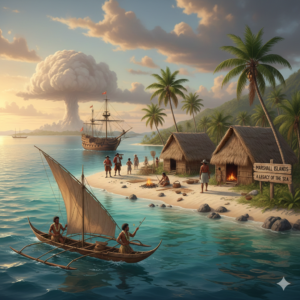
The history of the Marshall Islands is a saga of incredible human navigation, colonial tug-of-war, and a mid-20th-century trauma that redefined the nation’s identity and its relationship with the world.
1. The Dawn: Austronesian Voyagers (c. 2000 BCE – 1500 CE)
The story begins with the bwebwenato (oral traditions) of the Marshallese people. Long before European instruments existed, Marshallese navigators were perhaps the most skilled in the world.
-
Settlement: Around 3,000 to 4,000 years ago, Austronesian explorers traveled from Southeast Asia in outrigger canoes (proas).
-
Navigation Science: They developed stick charts (rebbelib and mattang), which were sophisticated maps made of coconut fronds and shells. These did not map distance, but rather the patterns of ocean swells and wave reflections caused by islands.
-
Social Structure: Ancient Marshallese society was organized into matrilineal clans (jowi). Land ownership was—and remains—the most sacred aspect of life, passed down from mother to child.
2. The Era of First Contact (1520s – 1880s)
The islands remained largely isolated from the West until the “Age of Discovery.”
-
Spanish Sighting: The Spanish explorer Alonso de Salazar was the first European to sight the islands in 1526. However, Spain showed little interest in colonizing the remote atolls at that time.
-
The British Influence: It wasn’t until 1788 that Captain John Marshall, for whom the islands are named, arrived on the Scarborough.
-
Whalers and Traders: By the mid-1800s, the islands became a frequent stop for American whalers and beachcombers. This era introduced Western diseases and Christianity, with the American Board of Commissioners for Foreign Missions (ABCFM) arriving in 1857.
3. Colonial Transitions: Germany and Japan (1885 – 1944)
The late 19th and early 20th centuries saw the Marshall Islands traded between world powers.
The German Protectorate (1885–1914)
Germany established a protectorate to exploit the copra (dried coconut meat) trade. They operated through the Jaluit Gesellschaft, a trading company that effectively governed the islands.
The Japanese Mandate (1914–1944)
During World War I, Japan seized the islands from Germany. Following the war, the League of Nations granted Japan a “Class C Mandate.”
-
Colonization: Japan invested heavily in infrastructure, schools, and the fishing industry.
-
Militarization: As WWII approached, Japan began fortifying the atolls (notably Kwajalein and Eniwetok) as part of their “unsinkable aircraft carrier” strategy in the Pacific.
4. World War II and the Nuclear Era (1944 – 1958)
This is the most transformative and tragic chapter in Marshallese history.
The Battle of Kwajalein
In February 1944, U.S. forces launched a massive amphibious assault to take the islands from Japan. The fighting was brutal, resulting in a total U.S. victory and the beginning of American administration.
Nuclear Testing (1946–1958)
With the dawn of the Cold War, the U.S. selected Bikini Atoll and Enewetak Atoll for nuclear testing.
-
Operation Crossroads: In 1946, the people of Bikini were asked to leave their homes “for the good of mankind.” They have never been able to permanently return.
-
Castle Bravo (1954): The U.S. detonated its most powerful hydrogen bomb ever. A “miscalculation” in wind patterns caused radioactive fallout to rain down on the inhabited atolls of Rongelap and Utirik.
-
Impact: The testing led to severe health issues (cancers, birth defects) and permanent displacement, issues that dominate Marshallese-U.S. diplomacy today.
5. The Road to Sovereignty (1979 – Present)
Following the war, the islands were part of the Trust Territory of the Pacific Islands (TTPI), administered by the U.S.
-
Independence: In 1979, the Republic of the Marshall Islands (RMI) established its own constitution. Amata Kabua became the first president.
-
Compact of Free Association (COFA): In 1986, the RMI signed the COFA with the United States. Under this treaty:
-
The RMI is a sovereign nation.
-
The U.S. provides financial aid and defense.
-
The U.S. maintains the Ronald Reagan Ballistic Missile Defense Test Site on Kwajalein.
-
Marshallese citizens can live and work in the U.S. without visas.
-
6. Modern Challenges: Climate and Justice
Today, the Marshall Islands faces two existential threats:
-
Climate Change: As a nation of low-lying coral atolls (averaging only 2 meters above sea level), rising tides threaten to submerge the islands entirely by the end of the century.
-
Nuclear Legacy: The “Runit Dome” on Enewetak, which holds radioactive waste, is at risk of leaking due to rising sea levels and structural decay.
Despite these challenges, the Marshallese people remain a resilient “Legacy of the Sea,” leading the world in climate change advocacy on the international stage.
________________________________________________________________________________________
Visit : www.dkbtech.com , www.allcircular.com