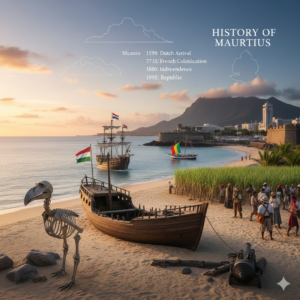
“History of Mauritius,” I have structured this overview into the key eras that shaped the island from a volcanic wasteland into a modern republic.
1. The Pre-Colonial Era: The Isolated Sanctuary
Mauritius began as a product of fire. Formed by volcanic activity approximately 8 million years ago, the island remained an isolated ecosystem in the vast Indian Ocean. Unlike many landmasses, it had no indigenous human population.
-
Flora and Fauna: Without human interference, unique species evolved, most famously the Dodo, a flightless bird that thrived in the absence of natural predators.
-
The Early Seafarers: While the island was uninhabited, it was not unknown. Arab and Malay sailors likely visited as early as the 10th century. Arab maps referred to the island as Dina Arobi (Abandoned Island).
2. The Dutch Period (1598–1710): A Struggle for Survival
The first official claim came from the Dutch. In 1598, a fleet commanded by Admiral Wybrand van Warwyck landed and named the island Mauritius in honor of Prince Maurice of Nassau.
-
Exploitation: The Dutch viewed Mauritius as a stopover for the Dutch East India Company (VOC). They introduced sugarcane, domestic animals, and deer.
-
Ecological Impact: This era saw the tragic extinction of the Dodo and the heavy logging of ebony forests.
-
Abandonment: Plagued by cyclones, droughts, and infestations of rats and monkeys, the Dutch finally abandoned the island in 1710.
3. The French Era (1715–1810): Isle de France
n 1715, the French took possession, renaming it Isle de France. This period transformed the island from a rugged outpost into a thriving colony.
-
Mahé de La Bourdonnais: Often called the “father of the nation,” Governor La Bourdonnais arrived in 1735. He turned Port Louis into a major naval base and shipyard and built the Government House.
-
Slavery and Sugar: The French established a plantation economy. Thousands of enslaved people were brought from Madagascar and East Africa to work the sugar fields under brutal conditions.
-
The Napoleonic Wars: During the 18th century, the island became a base for French corsairs (pirates) who raided British trade ships, eventually leading to the British invasion.
4. The British Era (1810–1968): Reform and Transition
Following the Battle of Grand Port, the British captured the island in 1810. They agreed to respect the local laws, customs, and French language—a reason why Mauritian culture remains so deeply influenced by France today.
-
Abolition of Slavery (1835): The British abolished slavery, but this created a labor shortage for the sugar barons.
-
The Great Experiment: To replace slave labor, the British introduced Indentured Labour. Over half a million people arrived from India through Aapravasi Ghat. This fundamentally shifted the island’s demographics, making Indo-Mauritians the majority population.
-
The Rise of Nationalism: The 20th century saw the birth of the Labour Party and the struggle for workers’ rights, led by figures like Maurice Curé and later Sir Seewoosagur Ramgoolam.
5. Independence and the Modern Republic (1968–Present)
On March 12, 1968, Mauritius became an independent state within the Commonwealth, with Sir Seewoosagur Ramgoolam as its first Prime Minister.
-
Economic Miracle: At independence, many predicted Mauritius would fail due to its reliance on sugar. Instead, the country diversified into textiles, tourism, and financial services.
-
The Republic: In 1992, Mauritius officially became a Republic.
-
Today: It stands as one of Africa’s most stable democracies and a high-income economy, celebrated for its “rainbow nation” where Hindus, Muslims, Christians, and Sino-Mauritians coexist.
Key Historical Milestones:
| Year | Event | Significance |
| 1598 | Dutch Landing | First formal naming and settlement. |
| 1735 | Arrival of La Bourdonnais | Infrastructure and naval development. |
| 1835 | Abolition of Slavery | Shift to Indentured Labour system. |
| 1968 | Independence | Birth of the modern Mauritian state. |
| 1992 | Republic Status | Final step in constitutional sovereignty. |
_________________________________________________________________________________________
Visit: www.dkbtech.com, www.allcircular.com