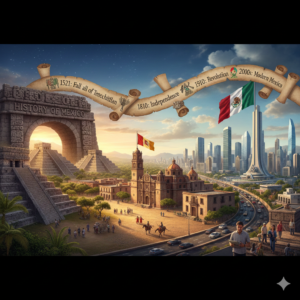
1. The Dawn of Mesoamerica (1500 BCE – 900 CE)
The history of Mexico does not begin with the Spanish, but with thousands of years of sophisticated indigenous civilizations. These cultures developed complex mathematics, the concept of zero, and incredibly accurate calendars.
-
The Olmecs (The “Mother Culture”): In the tropical lowlands of Veracruz and Tabasco, the Olmecs built the first great cities. They are famous for their colossal stone heads and for establishing the trade routes and religious motifs (like the feathered serpent) that would influence all later groups.
-
Teotihuacán: North of modern-day Mexico City, this became one of the largest cities in the world by 500 CE. Its Pyramid of the Sun and Pyramid of the Moon remain architectural marvels.
-
The Maya: In the south and the Yucatán Peninsula, the Maya mastered astronomy and hieroglyphic writing. Cities like Chichén Itzá and Palenque flourished, though many were mysteriously abandoned before the Spanish arrived.
2. The Rise and Fall of the Aztecs (1325 – 1521)
The Mexica (Aztecs) were latecomers to the Valley of Mexico. Legend says they settled where they saw an eagle perched on a cactus eating a snake—the image on the Mexican flag today.
-
Tenochtitlan: They built a massive “floating city” on Lake Texcoco. By the early 1500s, it was cleaner and larger than London or Paris.
-
The Conquest: In 1519, Hernán Cortés arrived with roughly 500 men. Through a combination of superior weaponry (steel and gunpowder), strategic alliances with indigenous enemies of the Aztecs (like the Tlaxcalans), and the devastating spread of smallpox, the empire fell in 1521.
3. The Colonial Era: New Spain (1521 – 1810)
For 300 years, Mexico was the “crown jewel” of the Spanish Empire.
-
Castas and Culture: A rigid social hierarchy emerged based on race: Peninsulares (Spanish-born), Criollos (Spanish descent born in Mexico), Mestizos (mixed indigenous and Spanish), and the indigenous population.
-
Religion: The Catholic Church became the dominant social force, often blending European traditions with local ones (Syncretism).
4. The Struggle for Independence (1810 – 1821)
On September 16, 1810, Father Miguel Hidalgo issued the Grito de Dolores, a call to arms against Spanish rule.
-
The Outcome: After a bloody decade of fighting, Mexico gained independence in 1821. However, the new nation was fragile, bankrupt, and politically divided between Liberals (who wanted a democracy) and Conservatives (who wanted a monarchy).
5. A Century of Turmoil (1821 – 1910)
This period was defined by foreign intervention and the loss of territory.
-
Texas and the Mexican-American War: Following the secession of Texas, the U.S. invaded Mexico in 1846. The resulting Treaty of Guadalupe Hidalgo forced Mexico to cede half its territory (California, Arizona, New Mexico, etc.) to the U.S.
-
The French Intervention: In the 1860s, France invaded and installed Maximilian I as Emperor. He was eventually executed, and the liberal hero Benito Juárez restored the republic.
-
The Porfiriato: General Porfirio Díaz ruled for over 30 years. He modernized the country with railroads and industry, but at the cost of extreme inequality and the oppression of the working class.
6. The Mexican Revolution (1910 – 1920)
The 20th century was birthed in fire. Figures like Emiliano Zapata (fighting for land reform in the south) and Pancho Villa (leading the cavalry in the north) rose up against Díaz.
-
The Result: A new Constitution was written in 1917, emphasizing labor rights, land redistribution, and secular education.
7. Modern Mexico (1920 – Present)
-
The PRI Era: For 71 years, the Institutional Revolutionary Party (PRI) held power in a “perfect dictatorship,” providing stability but often through corruption and repression.
-
Economic Shifts: The 1994 NAFTA agreement integrated Mexico’s economy with the U.S. and Canada, turning it into a global manufacturing hub.
-
Today: Mexico faces challenges involving the drug war and migration, yet it remains the world’s largest Spanish-speaking country with a vibrant, influential cultural output in film, art, and gastronomy.
______________________________________________________________________________________
Visit : www.dkbtech.com, www.allcircular.com