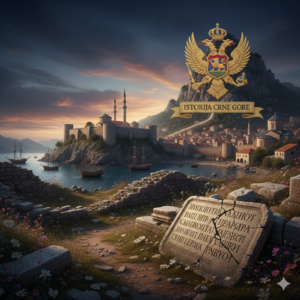
The history of Montenegro is a saga of survival. For centuries, this small, mountainous region served as a “citadel of liberty,” remaining a pocket of Christian resistance while the surrounding Balkans fell under Ottoman rule.
Ancient Foundations and the Arrival of Slavs
The territory of modern-day Montenegro was originally inhabited by Illyrian tribes. By the 2nd century BC, the Romans had conquered the region, incorporating it into the province of Dalmatia. The most significant Roman site from this era is Doclea (near modern Podgorica), which later gave its name to the first Slavic state in the region: Duklja.
In the 6th and 7th centuries AD, Slavic tribes migrated to the Balkans. By the 9th century, they had established the semi-independent dukedom of Duklja.
The Rise of Zeta
By the 11th century, Duklja became the kingdom of Zeta. Under the Vojislavljević dynasty, it achieved recognition from the Pope, with Mihailo Vojisavljević being titled “King of the Slavs” in 1077. However, by the late 12th century, Zeta fell under the influence of the Serbian Nemanjić dynasty, serving as a crown land for nearly two centuries.
The Crnojević Era and the “Black Mountain”
As the Nemanjić Empire crumbled in the 14th century, local noble families like the Balšići and later the Crnojevići asserted control. It was during the rule of the Crnojević family (15th century) that the name Crna Gora (Montenegro) became the standard designation for the region.
Faced with the relentless expansion of the Ottoman Empire, Ivan Crnojević moved the capital to the high mountain valley of Cetinje in 1482. He founded a monastery and a court there, establishing Cetinje as the spiritual and political heart of the nation—a status it maintains in the hearts of Montenegrins today.
The Theocracy: The Prince-Bishops (1516–1851)
In 1516, the last secular ruler abdicated, leaving the governance of Montenegro to the Metropolitans (Prince-Bishops or Vladikas) of Cetinje. This unique theocratic system lasted for over 300 years.
Because Orthodox bishops are celibate, the succession eventually became hereditary within the Petrović-Njegoš family, passing from uncle to nephew.
| Notable Ruler | Contribution |
| Danilo I | Founded the Petrović-Njegoš dynasty in 1697 and focused on tribal unity. |
| Petar I (St. Peter of Cetinje) | Defeated the Ottomans at the Battles of Martinići and Krusi (1796), effectively securing independence. |
| Petar II Petrović-Njegoš | A giant of literature and philosophy; he wrote The Mountain Wreath and modernized the state. |
The Path to Statehood (1851–1918)
In 1851, Danilo II secularized the state, becoming Prince of Montenegro. His successor, Nikola I, was one of the most influential figures in Balkan history. During his long reign (1860–1918):
-
1878: Montenegro’s full independence was formally recognized by the Great Powers at the Congress of Berlin.
-
1910: Montenegro was proclaimed a Kingdom.
-
The “Father-in-law of Europe”: Nikola married his daughters into the royal houses of Russia, Italy, and Serbia, gaining significant diplomatic leverage.
The Yugoslav Century
After World War I, the Kingdom of Montenegro was controversially absorbed into the Kingdom of Serbs, Croats, and Slovenes (later Yugoslavia). King Nikola died in exile.
Following World War II, Montenegro became one of the six constituent republics of the Socialist Federal Republic of Yugoslavia under Josip Broz Tito. This era brought rapid industrialization and modernization, and the capital was renamed Titograd (now Podgorica).
The Breakup and 2006 Referendum
When Yugoslavia began to dissolve in the 1990s, Montenegro initially remained in a federation with Serbia. However, a growing desire for sovereignty led to a peaceful independence referendum on May 21, 2006.
-
55.5% of voters chose independence.
-
On June 3, 2006, Montenegro officially declared itself an independent and sovereign state.
Modern Montenegro
Since 2006, Montenegro has focused on Euro-Atlantic integration. It joined NATO in 2017 and is currently a leading candidate for membership in the European Union. Today, it is known for its stunning Adriatic coastline, rugged mountains, and its unique position as a multicultural bridge in the Balkans.
_______________________________________________________________________________________
Visit: www.dkbtech.com, www.allcircular.com