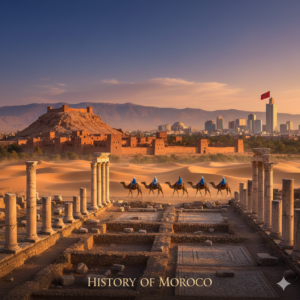
The History of Morocco, we must travel from the prehistoric Saharan beginnings to the modern constitutional monarchy. Morocco’s story is one of resilience, where indigenous Berber (Amazigh) roots have intertwined with Arab, Islamic, and European influences to create a unique cultural tapestry.
1. Ancient Foundations and Berber Roots (Pre-7th Century)
The recorded history of Morocco begins with the Berbers (Imazighen), the “free people” who have inhabited North Africa for millennia. Long before external empires arrived, Berber kingdoms like Mauretania thrived, led by kings such as Baga and Juba II.
-
The Phoenicians & Carthaginians: Around the 8th century BCE, Phoenician traders established outposts like Lixus and Mogador (modern-day Essaouira). Carthage eventually dominated these coastal areas, integrating them into a Mediterranean trade network.
-
Roman Mauretania: In 42 CE, Rome annexed the kingdom. Cities like Volubilis became prosperous centers of olive oil production and Roman culture. However, the Romans mostly controlled the coastal plains, while Berber tribes in the mountains remained largely autonomous.
-
Vandals & Byzantines: Following Rome’s decline, the Germanic Vandals and later the Byzantine Empire held brief sway over parts of the coast before the seismic shift of the Islamic conquest.
2. The Rise of Islamic Dynasties
The arrival of Islam in the late 7th century transformed Morocco’s identity forever.
-
The Idrisids (788–974): Founded by Idris I, a descendant of the Prophet Muhammad fleeing the Abbasid Caliphate. He founded Fez, which became the spiritual and intellectual heart of Morocco. This era marked the birth of the first unified Moroccan state.
-
The Almoravids (1040–1147): A group of Saharan Berber nomads who founded Marrakech. Under leaders like Yusuf ibn Tashfin, they built an empire stretching from the Senegal River to Al-Andalus (Spain).
-
The Almohads (1147–1269): Replacing the Almoravids, they were known for their strict religious doctrine and magnificent architecture, such as the Koutoubia Mosque and the Giralda in Seville.
-
The Marinids & Saadians: The Marinids (1248–1465) were patrons of art and education in Fez. Later, the Saadi Dynasty (1549–1659) rose to fame by defeating the Portuguese at the Battle of the Three Kings (1578) and amassing wealth from the gold of Timbuktu.
3. The Alaouite Dynasty and Colonial Pressure
The Alaouite Dynasty, which still reigns today, took power in the mid-17th century. Sultan Moulay Ismail (1672–1727) is legendary for centralizing the state and building the monumental city of Meknes.
By the 19th century, European industrial powers turned their eyes toward Morocco. Despite efforts to modernize, the country was eventually divided by the Treaty of Fez in 1912 into:
-
A French Protectorate (central and southern regions).
-
A Spanish Protectorate (northern Rif and southern Ifni).
-
The International Zone of Tangier.
4. The Struggle for Independence and Modernity
The resistance against colonial rule was fierce, most notably in the Rif War led by Abd el-Krim. After WWII, the nationalist movement grew, led by the Istiqlal Party and Sultan Mohammed V.
-
Independence (1956): France and Spain recognized Moroccan sovereignty, and Mohammed V returned from exile as a national hero.
-
Reign of Hassan II (1961–1999): A period of consolidation and sometimes political tension, marked by the Green March in 1975 to assert claim over Western Sahara.
-
The Era of Mohammed VI (1999–Present): The current King has overseen significant social reforms (such as the Moudawana family code), infrastructure development, and a focus on renewable energy, positioning Morocco as a bridge between Africa and Europe.
Key Historical Sites in Morocco
| Site | Dynasty/Era | Significance |
| Volubilis | Roman/Berber | Best preserved Roman ruins in North Africa. |
| Al-Qarawiyyin | Idrisid | Founded in 859, often cited as the world’s oldest university. |
| Hassan Tower | Almohad | Iconic minaret in Rabat, intended to be the world’s largest mosque. |
| Saadian Tombs | Saadi | Masterpieces of Moroccan-Andalusian craftsmanship in Marrakech. |
_______________________________________________
Visit : www.dkbtech.com, www.allcircular.com