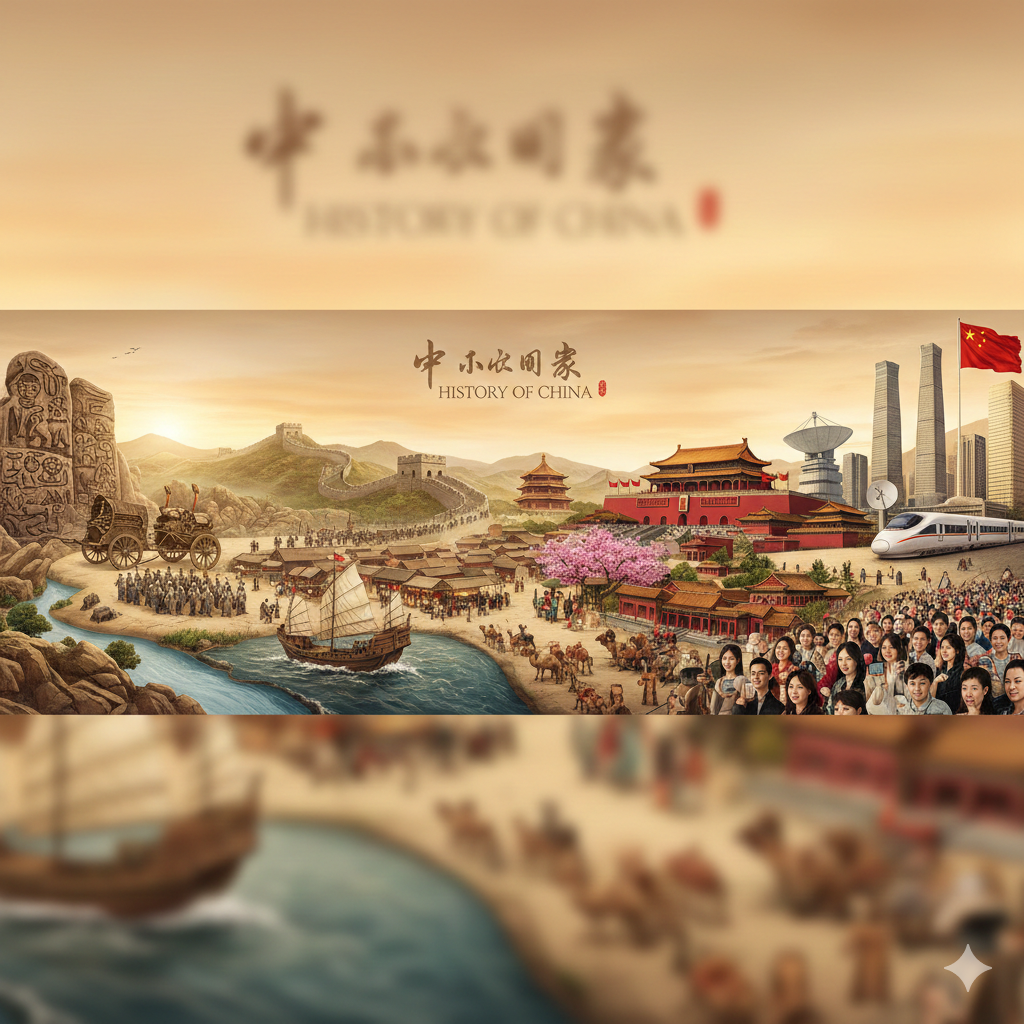
The history of China, one of the world’s oldest continuous civilizations, spans nearly 5,000 years, marked by a recurring cycle of unification and fragmentation, profound cultural development, and the rise and fall of powerful dynasties. This vast history is generally divided into three major eras: Pre-imperial China, Imperial China, and Modern China
Pre-Imperial China (c. 2100 BC – 221 BC)
The origins of Chinese civilization lie in the basins of the Yellow River (Huang He) and the Yangtze River. This formative period saw the shift from Neolithic cultures to the earliest dynastic states, laying the philosophical and governmental groundwork for the imperial era.
The Legendary Start and the Bronze Age Dynasties
-
- Xia Dynasty (c. 2100 – 1600 BC): While traditionally considered the first dynasty, documented evidence is sparse, leading some scholars to view it as quasi-legendary. It is associated with Yu the Great, who is credited with controlling the Great Flood and establishing hereditary rule, marking the beginning of the dynastic system.
-
- Shang Dynasty (c. 1600 – 1046 BC): The earliest dynasty supported by substantial archaeological evidence, the Shang saw advancements in mathematics, astronomy, and art. They are most famous for their elaborate bronze casting and the development of the Oracle Bone Script, the earliest known form of Chinese writing, used for divination.
Zhou Dynasty (c. 1046 – 256 BC): The longest-lasting dynasty, the Zhou justified their overthrow of the Shang through the concept of the Mandate of Heaven (Tianzi), an ideology that held that a ruler’s legitimacy came from the divine, but only so long as he ruled wisely and justly. This concept became a fundamental principle of Chinese governance for millennia. The Zhou period is divided into two main parts:
-
- Western Zhou: A relatively centralized feudal system.
-
- Eastern Zhou: Marked by a weakened central authority and descent into chaos, leading to two pivotal sub-periods.
The Axial Age and Philosophical Flourishing
The latter part of the Zhou era, known as the Eastern Zhou, was a time of intense political strife but brilliant philosophical development—the Chinese Axial Age.
-
- Spring and Autumn Period (c. 771 – 476 BC): The Zhou king’s authority declined, and hundreds of smaller states began fighting for regional supremacy.
-
- Warring States Period (c. 476 – 221 BC): The number of states consolidated into seven major powers that engaged in brutal conflict. This period spurred the development of key Chinese philosophies as thinkers sought solutions to societal disorder:
-
- Confucianism: Founded by Confucius (Kong Fuzi), it emphasized social harmony through proper relationships, filial piety (xiao), and respect for authority. It advocated for moral and educated rulers and officials (junzi).
-
- Daoism (Taoism): Attributed to Laozi, it championed living in harmony with the Dao (The Way), stressing simplicity, non-action (wuwei), and naturalness.
-
- Legalism: Advocated by figures like Han Fei, it stressed strict adherence to codified laws, centralized power, and harsh punishments to maintain order, regardless of the ruler’s personal virtue.
-
- Warring States Period (c. 476 – 221 BC): The number of states consolidated into seven major powers that engaged in brutal conflict. This period spurred the development of key Chinese philosophies as thinkers sought solutions to societal disorder:
History of China Imperial China (221 BC – AD 1912)
This era began with the unification of China under a single emperor, establishing a centralized, bureaucratic system that lasted for over two millennia.
Unification and Classical Empires
-
- Qin Dynasty (221 – 206 BC): The short but transformative dynasty founded by Qin Shi Huangdi (First Emperor). He crushed the remaining Warring States and unified China, initiating a highly centralized, legalist state. He standardized writing, weights, measures, and currency; began the consolidation of earlier state walls into the Great Wall; and commissioned the Terracotta Army for his mausoleum. His rule was characterized by ruthlessness, including the burning of non-Legalist texts and the suppression of scholars.
-
- Han Dynasty (206 BC – AD 220): Following the Qin’s collapse, the Han established an enduring imperial system. They largely abandoned Legalism in favor of Confucianism as the official state ideology, introducing civil service examinations to recruit officials based on merit (in theory). The Han expanded the empire’s territory, opened the Silk Road trade routes to the West, and saw great technological advancements, including the widespread use of paper. The decline was marked by internal strife, the rise of powerful regional warlords, and eventually, fragmentation into the Three Kingdoms Period.
The Age of Disunity and Reunification
Following the Han, China endured a long period of division, cultural exchange, and shifting capitals.
-
- Three Kingdoms, Jin, and Northern/Southern Dynasties (AD 220 – 589): This tumultuous period saw significant political fragmentation. Buddhism, which had entered China via the Silk Road, spread widely and took root, profoundly influencing Chinese culture and thought alongside Confucianism and Daoism.
-
- Sui Dynasty (AD 581 – 618): Briefly reunified China, most notably by completing the Grand Canal, a massive engineering project connecting the Yellow and Yangtze river systems, which facilitated trade and military movements.
The Golden Ages and Neo-Confucianism
-
- Tang Dynasty (AD 618 – 907): Often regarded as a Golden Age of cosmopolitan culture, territorial expansion, and a stable government based on the mature civil service examination system. The capital, Chang’an (modern Xi’an), was the world’s largest city and a hub of international trade and culture. Poetry and Buddhism flourished, though Buddhism faced persecution later in the dynasty.
-
- Song Dynasty (AD 960 – 1279): Despite losing territory to northern nomadic groups, the Song era was a period of revolutionary technological and economic advancement. Key inventions included gunpowder, the compass, and printing (movable type). The economy was monetized, and maritime trade flourished. Neo-Confucianism became the dominant state philosophy, reasserting Confucian principles with metaphysical additions to counter Buddhist influence.
-
- Yuan Dynasty (AD 1279 – 1368): Established by the Mongols under Kublai Khan, the Yuan was China’s first non-Han dynasty to rule the entire country. The Mongols maintained the capital at Dadu (modern Beijing) and facilitated massive expansion of trade across Eurasia, notably visited by Marco Polo.
The Last Dynasties
-
- Ming Dynasty (AD 1368 – 1644): The Ming restored Han Chinese rule after overthrowing the Mongols. They are known for rebuilding the Great Wall, establishing the Forbidden City in Beijing, launching the massive naval expeditions led by Zheng He, and overseeing a period of economic prosperity and cultural vibrancy, including the flourishing of novels and ceramics (e.g., blue-and-white porcelain).
-
- Qing Dynasty (AD 1644 – 1912): The final imperial dynasty, established by the Manchus from the northeast. The Qing greatly expanded China’s territory to its modern extent and initially enjoyed a long period of peace and prosperity. However, by the 19th century, the Qing government faced crippling internal rebellion (like the Taiping Rebellion) and increasing pressure from Western powers seeking trade and concessions. The Opium Wars (1839–42 and 1856–60), resulting in defeat by the British, marked the start of China’s “Century of Humiliation” and the erosion of imperial authority through “unequal treaties.” The dynasty ultimately collapsed following the Xinhai Revolution in 1911.
Modern China (AD 1912 – Present)
The fall of the Qing ushered in a chaotic transition to a modern nation-state.
Republic and Conflict
-
- The Republic of China (1912 – 1949): The republic was declared with Sun Yat-sen as its first provisional president, leading the Kuomintang (KMT) or Nationalist Party. The country quickly fragmented into the Warlord Era. After Sun Yat-sen’s death, Chiang Kai-shek took leadership of the KMT and launched the Northern Expedition to reunify the country. The period was dominated by the escalating conflict between the KMT and the newly formed Chinese Communist Party (CCP), led by figures like Mao Zedong.
-
- Sino-Japanese War and Civil War (1937 – 1949): A brutal full-scale war against Imperial Japan temporarily forced the KMT and CCP into a reluctant “United Front.” After Japan’s defeat in 1945, the Chinese Civil War resumed. Years of corruption and economic instability eroded public support for the KMT.
The People’s Republic of China (1949 – Present)
-
- Establishment of the PRC (1949): The CCP defeated the KMT, forcing Chiang Kai-shek and the Nationalist government to retreat to the island of Taiwan. On October 1, 1949, Mao Zedong proclaimed the establishment of the People’s Republic of China in Beijing.
-
- Maoist Era (1949 – 1976): Mao implemented radical socio-economic campaigns:
-
- The Great Leap Forward (1958–1962) aimed to rapidly industrialize the country through collectivization and communal farming but resulted in one of the deadliest famines in human history.
-
- The Cultural Revolution (1966–1976) was a decade of political purges and social upheaval, aimed at rooting out “bourgeois” elements and consolidating Mao’s power, leading to widespread chaos and destruction of cultural heritage.
-
- Maoist Era (1949 – 1976): Mao implemented radical socio-economic campaigns:
-
- Reform and Opening Up (1978 – Present): After Mao’s death, Deng Xiaoping emerged as the paramount leader, initiating the policy of “Reform and Opening Up.” This shift introduced market-based economic reforms (“Socialism with Chinese Characteristics”) while maintaining the CCP’s political control. China experienced spectacular economic growth, transforming it from an agrarian society into a major global industrial and economic power. Key moments include the Tiananmen Square protests in 1989 and the handover of Hong Kong in 1997.
The history of China is a continuous epic of rise, fall, rediscovery, and reinvention, demonstrating an unparalleled ability to assimilate invaders and adapt philosophical and technological innovations to maintain a distinct and resilient cultural identity.
Visit www.dkbtech.com