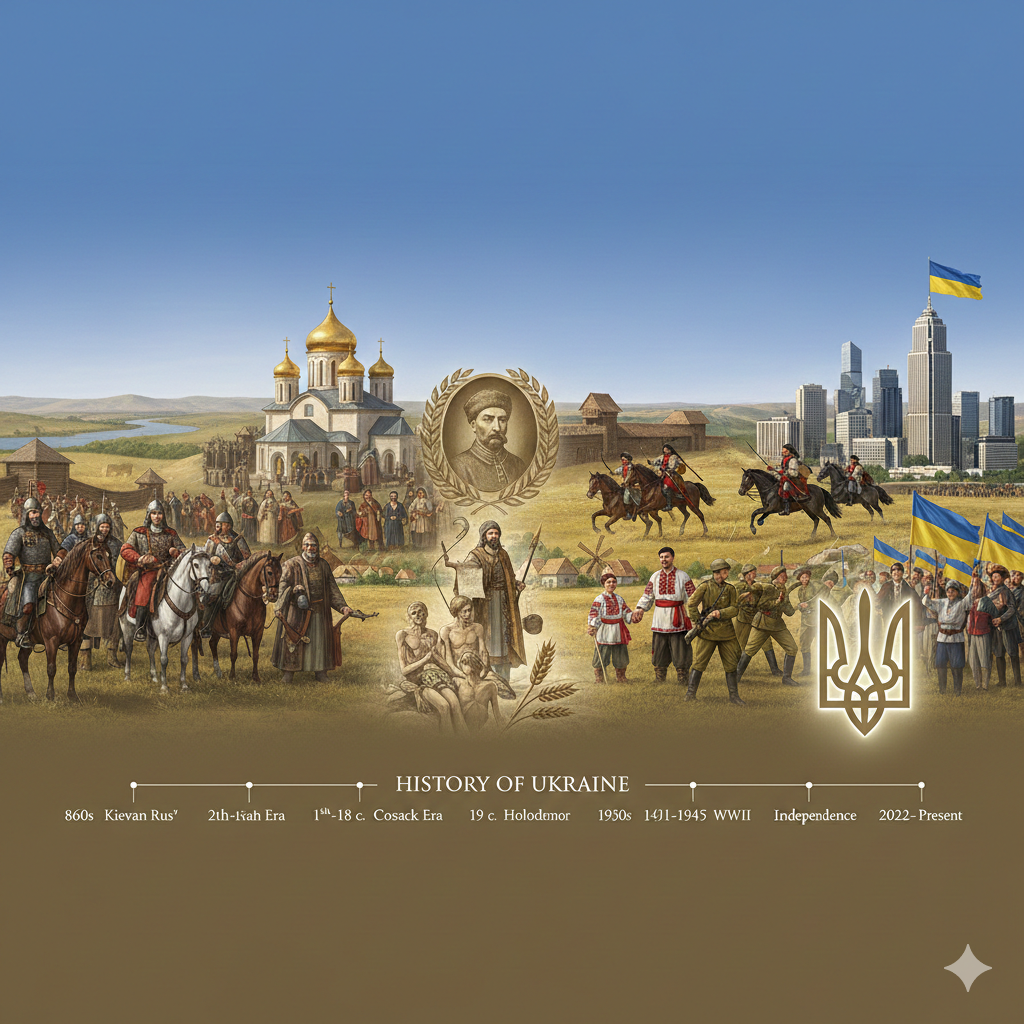
 The History of Ukraine: A Chronicle of Resilience
The history of Ukraine is one of continuous struggle for statehood on a geographically contested and fertile land, often serving as a gateway between Europe and Eurasia. The national narrative is not a straight line but a complex tapestry woven with threads of glorious independence, foreign domination, cultural renaissance, and immense human suffering.
Early Roots and the Golden Age of Kyivan Rus’ (c. 9th–13th Centuries)
The earliest foundations of Ukrainian history are traced to the Pontic Steppe, a region that was home to ancient nomadic peoples like the Scythians and Sarmatians, and later became the ancestral home of the East Slavs.
The Formation of the First State
The first major East Slavic state, Kyivan Rus’ (Kyiv is the Ukrainian spelling of Kiev), emerged in the late 9th century.
-
- Establishment: The state was founded around the city of Kyiv on the Dnieper River, a crucial artery for the trade route “from the Varangians to the Greeks” (Scandinavia to Byzantium).
-
- The Rurikids: The first ruling dynasty, the Rurikids, are traditionally said to have originated with Scandinavian warriors (Varangians or Norsemen) who integrated with the local Slavic populace, establishing control over various tribes.
-
- Christianization (988 CE): The most defining event was the adoption of Orthodox Christianity by Prince Volodymyr the Great (Volodymyr I) in 988 CE. This act tied Rus’ culturally and religiously to the Byzantine Empire, providing a common written language (Church Slavonic) and a unifying ideology, profoundly shaping Ukrainian, Russian, and Belarusian identity.
The Golden Age
The state reached its zenith under Volodymyr’s son, Yaroslav the Wise (r. 1019–1054).
-
- Power and Culture: Kyiv became one of the largest and most politically influential cities in medieval Europe, known for magnificent churches like Saint Sophia Cathedral. Yaroslav codified laws in the Russkaya Pravda and established dynastic ties across Europe through strategic marriages.
-
- Fragmentation: After Yaroslav’s death, the system of succession and internal feuds among the Rurikid princes led to the gradual fragmentation of Rus’ into rival principalities, weakening the central authority of Kyiv.
The Mongol Invasion (13th Century)
In 1240, the Mongol Golden Horde, led by Batu Khan, destroyed Kyiv, marking the definitive end of the classic Kyivan Rus’ era. While the central lands of Rus’ were devastated and subject to Mongol authority, the western successor state, the Kingdom of Galicia-Volhynia (Ruthenia), briefly continued the Rus’ tradition, maintaining a separate political and cultural center until the 14th century.
Foreign Domination and the Rise of the Cossacks (14th–17th Centuries)
Following the Mongol collapse, the fragmented Ukrainian lands were absorbed by powerful neighboring states.
Under Polish and Lithuanian Rule
From the 14th century, the majority of Ukrainian territory fell under the control of the Grand Duchy of Lithuania and the Kingdom of Poland.
-
- Grand Duchy of Lithuania: Initially, this was a relatively peaceful merger. Lithuanian rulers adopted the local Ruthenian language (a predecessor of modern Ukrainian and Belarusian) and legal traditions.
-
- Polish-Lithuanian Commonwealth (1569): The Union of Lublin (1569) created the massive Polish-Lithuanian Commonwealth, transferring most Ukrainian lands from Lithuania to the Crown of Poland. This brought significant challenges:
-
- Social Oppression: Ukrainian peasants were subjected to the severe economic exploitation of Polish nobility (szlachta) through the system of serfdom.
-
- Religious Tension: The expansion of Polish Catholicism led to pressures against the Orthodox Church. The Union of Brest (1596) established the Greek Catholic Church (Uniate Church), which recognized the Pope’s authority while retaining the Eastern Orthodox liturgy, further dividing the population.
-
- Polish-Lithuanian Commonwealth (1569): The Union of Lublin (1569) created the massive Polish-Lithuanian Commonwealth, transferring most Ukrainian lands from Lithuania to the Crown of Poland. This brought significant challenges:
The Cossack Phenomenon
Amidst the unsettled southern borderlands (“Ukraina“—the borderland) emerged a unique social and military force: the Cossacks (from the Turkic word for “free man” or “adventurer”).
-
- Zaporozhian Sich: The Cossacks organized themselves into semi-military, self-governing communities, most famously on the islands of the Dnieper River beyond the cataracts, known as the Zaporozhian Sich.
-
- Defenders of Orthodoxy: They were fiercely independent and became the symbolic and actual defenders of the Orthodox faith and the interests of the Ruthenian populace against the Polish nobility and the Crimean Tatars (who were clients of the Ottoman Empire).
The Cossack Hetmanate and the Ruin (17th–18th Centuries)
The Cossacks’ struggle for freedom led to a brief, semi-independent state.
The Khmelnytsky Uprising (1648)
Driven by religious, social, and national oppression, the massive Cossack revolt led by Hetman Bohdan Khmelnytsky erupted in 1648.
-
- Establishment of the Hetmanate: The uprising shattered Polish control over a large part of Ukraine, leading to the creation of the Cossack Hetmanate (or Zaporozhian Host), a semi-autonomous polity in central Ukraine.
The Treaty of Pereiaslav (1654) and “The Ruin”
Facing overwhelming pressure from the Commonwealth, Khmelnytsky sought protection. In 1654, the Hetmanate signed the Treaty of Pereiaslav with the Muscovite Tsar.
-
- Conflicting Interpretations: The agreement is one of the most contested events in the region’s history: Ukrainians viewed it as a temporary military alliance and protectorate preserving the Hetmanate’s autonomy; Moscow interpreted it as an act of subordination and permanent submission.
-
- The Ruin (1657–1686): Following Khmelnytsky’s death, the Cossack state descended into “The Ruin,” a chaotic period of internal civil wars and external intervention by Poland, Muscovy, the Ottoman Empire, and the Tatars. The result was the Truce of Andrusovo (1667), which formally divided the Hetmanate along the Dnieper River:
-
- Left-Bank Ukraine (east of the Dnieper) came under Muscovite control.
-
- Right-Bank Ukraine (west of the Dnieper) remained under Polish control.
-
- The Ruin (1657–1686): Following Khmelnytsky’s death, the Cossack state descended into “The Ruin,” a chaotic period of internal civil wars and external intervention by Poland, Muscovy, the Ottoman Empire, and the Tatars. The result was the Truce of Andrusovo (1667), which formally divided the Hetmanate along the Dnieper River:
Loss of Autonomy
In the early 18th century, the last great Cossack leader, Hetman Ivan Mazepa, attempted to reassert independence by allying with King Charles XII of Sweden against Peter the Great of Russia during the Great Northern War.
-
- Battle of Poltava (1709): Their decisive defeat at the Battle of Poltava led to the Russian Tsar’s brutal crackdown, the systematic dismantling of Cossack autonomy, and Mazepa’s flight.
-
- Imperial Absorption: The final partitions of Poland (1772, 1793, 1795) and the destruction of the Zaporozhian Sich (1775) by Catherine the Great brought nearly all of ethnic Ukrainian territory under the direct control of the Russian Empire (the majority) and the Austrian Habsburg Empire (Galicia, Bukovina, and Transcarpathia).
Imperial Rule and the National Awakening (19th Century)
Under the Russian and Austrian Empires, Ukrainians developed distinct national movements.
Under the Russian Empire
Russian imperial policy aimed at Russification and denying the existence of a distinct Ukrainian nation.
-
- Suppression of Language: Edicts like the Valuev Circular (1863) and the Ems Ukaz (1876) severely restricted and ultimately banned the publishing and performance of works in the Ukrainian language, allowing it only for private use or folklore.
-
- National Culture: Despite the ban, a Ukrainian intelligentsia, known as the Ukrainophiles, continued to develop a modern literary language, compile folklore, and promote the idea of a separate Ukrainian national identity, often revolving around the works of the national poet Taras Shevchenko.
Under the Habsburg Empire
The three major Ukrainian regions under Austrian rule—Galicia, Bukovina, and Transcarpathia—experienced a different, though still difficult, trajectory.
-
- Galicia as a “Piedmont”: The Habsburgs, in their rivalry with Russia, allowed for a greater degree of cultural autonomy. Galicia became the “Ukrainian Piedmont,” a cultural and political heartland where Ukrainian language, literature, and political parties could develop and flourish openly, providing a sanctuary for the idea of Ukrainian statehood.
Revolution, War, and the Soviet Era (1914–1991)
The collapse of the Russian and Austro-Hungarian Empires during World War I created a brief but intense window for independence.
The Struggle for Independence (1917–1921)
-
- Ukrainian People’s Republic (UNR): Following the Russian February Revolution of 1917, Ukrainians declared the Ukrainian People’s Republic (UNR).
-
- West Ukrainian People’s Republic (ZUNR): In the former Austro-Hungarian territories, the West Ukrainian People’s Republic (ZUNR) was declared in 1918.
-
- Unification and Defeat: The two republics symbolically unified in 1919, but the state was immediately plunged into a brutal War of Independence against Bolsheviks (Red Army), White Guards (Denikin’s forces), Poles, and various local forces. The UNR was ultimately defeated by the Red Army, and its territory was partitioned.
Soviet Ukraine and the Holodomor
The majority of Ukrainian territory was consolidated into the Ukrainian Soviet Socialist Republic (Ukrainian SSR), which formally joined the Soviet Union in 1922. Western parts were absorbed by Poland, Romania, and Czechoslovakia.
-
- “Ukrainization” (1920s): Initially, the Soviet government promoted a policy of Ukrainization, encouraging the development of Ukrainian language and culture, which briefly nurtured a cultural revival.
-
- The Holodomor (1932–1933): This policy was abruptly and violently reversed under Joseph Stalin. The state-mandated forced collectivization of agriculture, combined with the deliberate seizure of all grain and foodstuffs, resulted in the Holodomor (literally, “killing by hunger”). This was a man-made famine and an act of genocide that killed an estimated 3.9 million to 7 million Ukrainians, disproportionately targeting the peasantry, the backbone of Ukrainian national identity.
World War II and its Aftermath
Ukraine was a central and devastating battleground in World War II, suffering massive losses—estimated at 7 to 8 million people, including military casualties and civilian deaths.
-
- Occupation and Atrocities: The Soviet Union first occupied Western Ukraine in 1939 (per the Molotov-Ribbentrop Pact). Germany invaded in 1941. German occupation led to the Holocaust in Ukraine, including the horrific massacre at Babyn Yar near Kyiv, and systematic destruction.
-
- Territorial Unification: By the end of the war, the Ukrainian SSR’s borders were redrawn, finally uniting the majority of ethnic Ukrainian lands (including Galicia and Volhynia from Poland) under Soviet rule.
Post-War Soviet Era
-
- Stalin’s Reign of Terror: The first post-war decades saw renewed political repression, anti-nationalist purges, and the suppression of the Greek Catholic Church in Western Ukraine.
-
- The Thaw and the Dissidents: During the Khrushchev and Brezhnev eras, Soviet Ukraine grew economically but remained politically subjugated. A movement of Ukrainian dissidents (Sixtiers), artists, writers, and intellectuals, began to push for cultural and human rights.
-
- Chernobyl (1986): The nuclear disaster at the Chernobyl Power Plant was a critical event, exposing the Soviet system’s secrecy and mismanagement, fueling anti-Soviet sentiment, and contributing to the eventual drive for independence.
Independent Ukraine (1991–Present)
The final chapter of the 20th century saw the long-sought restoration of Ukrainian statehood.
The Path to Independence
As the Soviet Union began to collapse, the process toward sovereignty accelerated.
-
- Declaration of State Sovereignty (1990): The Ukrainian SSR parliament passed a declaration asserting the primacy of Ukrainian law.
-
- Declaration of Independence (August 24, 1991): Following the failed Soviet hardline coup in Moscow, the parliament declared Ukraine an independent, democratic state.
-
- The 1991 Referendum: On December 1, 1991, Ukrainians overwhelmingly confirmed this decision, with over 90% of voters across all regions (including Crimea and the Donbas) supporting independence.
Post-Soviet Challenges and Political Crises
The early years of independence were marked by severe economic contraction, the struggle against corruption, and the transition from a Soviet-style command economy to a market system. Politically, the country wrestled with defining its national identity and geopolitical orientation.
-
- Nuclear Disarmament: In 1994, Ukraine voluntarily relinquished the massive nuclear arsenal it inherited from the USSR, signing the Budapest Memorandum in exchange for security assurances from the U.S., UK, and Russia regarding its sovereignty and territorial integrity.
-
- The Orange Revolution (2004): Mass protests erupted following widespread fraud in the presidential election, leading to a rerun and establishing a precedent for civic action and democratic mobilization.
-
- The Revolution of Dignity (Euromaidan, 2013–2014): In November 2013, protests began after President Viktor Yanukovych abruptly suspended the signing of an Association Agreement with the European Union under pressure from Russia. The protests grew into a revolution after police violence, culminating in the flight of Yanukovych in February 2014.
In History of India -War and the Modern Struggle
The pro-Western shift of the Revolution of Dignity triggered a direct response from Russia.
-
- Annexation of Crimea (2014): In February–March 2014, Russian forces invaded and annexed the Crimean Peninsula.
-
- War in Donbas (2014–Present): Shortly thereafter, a conflict began in the eastern regions of Luhansk and Donetsk (Donbas), where Russia supported and armed separatist forces.
-
- Full-Scale Invasion (2022): On February 24, 2022, Russia launched a full-scale invasion of Ukraine, attacking from multiple directions and escalating the war to the largest military conflict in Europe since World War II. The war has unified the Ukrainian nation in defense of its sovereignty and democratic path, tragically continuing the long, cyclical struggle for its existence as an independent European state.
Visit : www.dkbtech.com