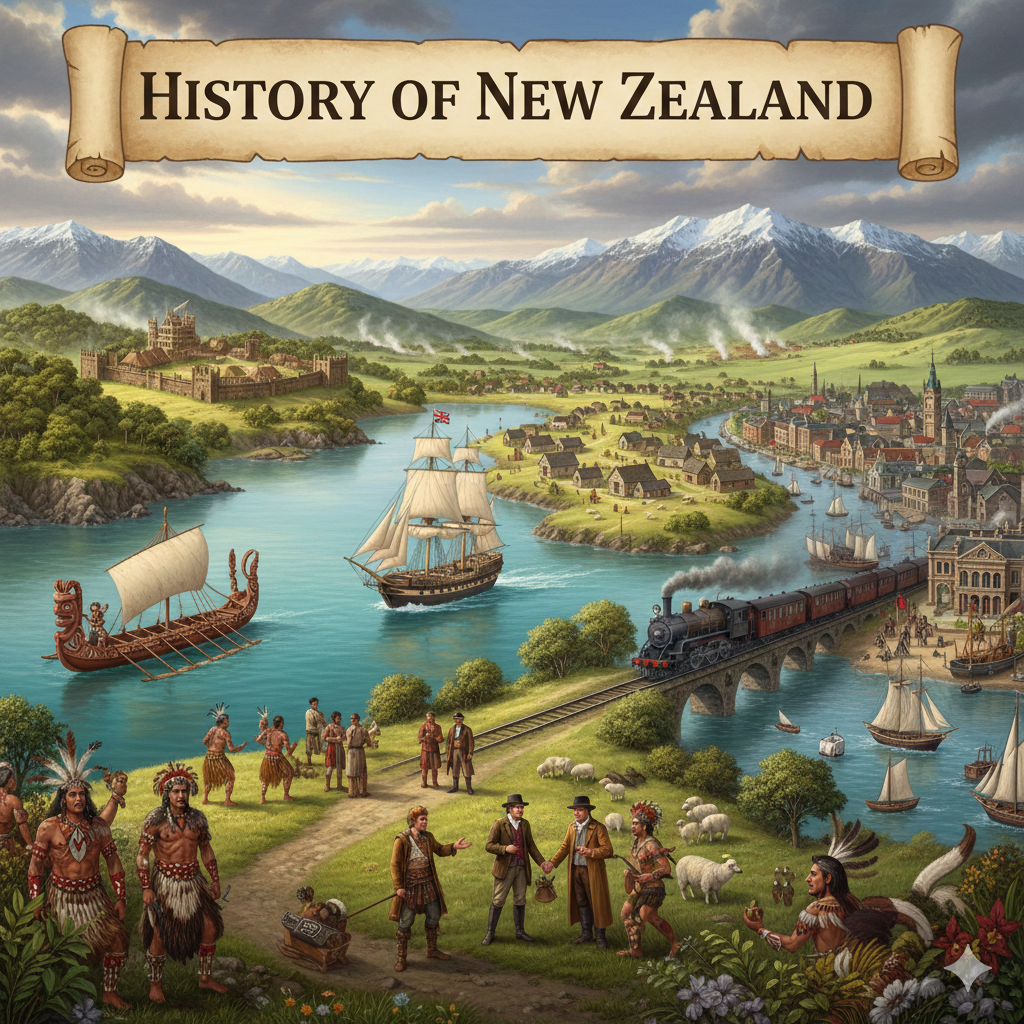
The history of Aotearoa New Zealand is a story uniquely defined by its isolation, its dramatic bicultural foundation, and its persistent, often conflicted, journey towards self-determination. Beginning as the last major landmass to be settled by humans, New Zealand’s history unfolds across two distinct, yet interwoven, narratives: the dynamic adaptation and cultural flowering of the Māori people (tangata whenua, the people of the land), and the successive waves of European contact, colonisation, and the gradual evolution into a modern, independent Pacific nation. This essay will explore the major epochs of New Zealand history, tracing the profound cultural and social transformations, the pivotal moments of conflict and collaboration, and the enduring themes of land, identity, and the ongoing quest to honour the foundational partnership established in 1840 through Te Tiriti o Waitangi (The Treaty of Waitangi).
1. Te Ao Hou: The Māori World and Great Migration (c. 1250 – 1642) is a History of New Zealand.
The first chapter of New Zealand’s history begins with the daring long-distance voyages of Polynesian navigators, often described as the greatest navigational feat in human history. Around 1250 to 1300 CE, canoes, or waka, traversed thousands of miles of open ocean from the central eastern Polynesian islands (likely the Cook Islands or Society Islands) to arrive at the shores of Aotearoa.
These early settlers, who would become known as Māori, faced a significant challenge: adapting their tropical way of life to a much colder, more diverse, and less agriculturally predictable environment. The first centuries, often termed the Archaic Period (or Moa-Hunter Period), were characterised by rapid adaptation and resource exploitation, particularly the hunting of the now-extinct giant flightless moa. Settlements were concentrated in coastal areas, particularly the warmer North Island, focusing on easily accessible resources like fish, seals, and birds. Material culture revolved around stone tools (especially jade, or pounamu), bone implements, and intricate carving.
As the large, easily exploitable resources like the moa declined, Māori society entered the Classic Period (c. 1500 – 1800). This shift was marked by increasing pressure on cultivated resources, particularly the sweet potato (kūmara), which required sophisticated storage and cultivation techniques, especially in the marginal northern climate. This period saw the crystallisation of a complex, structured, and hierarchical society. The primary social and political unit was the iwi (tribe) and its sub-tribe, the hapū. Identity, mana (prestige/authority), and land ownership were inextricably linked to genealogy (whakapapa). Chiefs (rangatira) governed with the advice of elders and relied on their mana derived from both lineage and success in war and resource management.
Life in the Classic Period was centred around the pā (fortified village), which served as a defensive structure, a food storage facility, and a central social hub. These elaborate hill forts, often incorporating terraces, palisades, and trenches, represent a high degree of sophisticated engineering and social organisation. Warfare (taua) was endemic, driven by the need to protect or acquire land, resources, and to avenge insults (utu). The development of sophisticated weaponry and martial arts, such as the use of the taiaha, reflected the importance of military prowess. Tikanga (customs and protocols) and the concept of tapu (sacredness) and noa (ordinary/profane) governed all aspects of life, ensuring a spiritual and social order deeply connected to the natural world. This established, stable, and highly adapted Polynesian culture would soon face the upheaval of European arrival.
2. In the History of New Zealand Contact, Conflict, and Musket Wars (1642 – 1840)
The period between the first European sightings and the signing of the Treaty of Waitangi was a dynamic and often brutal prelude to colonisation. The isolation of Aotearoa ended abruptly in 1642
with the arrival of Dutch explorer Abel Tasman, who, after a lethal clash with Māori near what he named Murderers’ Bay (now Golden Bay), quickly sailed away, leaving the land untouched by Europe for another 127 years.
In 1769, the arrival of Captain James Cook on the Endeavour marked the true commencement of sustained European interaction. Cook meticulously charted the coastline, established initial ethnographic accounts of Māori, and introduced European flora and fauna, fundamentally altering the trajectory of New Zealand’s natural and social history. Cook’s voyages opened the door for a steady trickle of transient European visitors: sealers, whalers, and traders. These early Europeans, often rough, poorly regulated men, established semi-permanent shore stations, initially centred around the Bay of Islands, creating the first contact zones known as ‘Beach Settlements’.
Trade became the engine of early interaction. Māori rapidly appreciated the utility of European goods, particularly metal tools, potatoes (which proved a superior staple crop to kūmara in many areas), and, most fatefully, muskets. The introduction of firearms had a devastating and transforming effect on the internal balance of power, leading to the Musket Wars (c. 1807 – 1845). Initiated by northern iwi such as Ngāpuhi, who gained early access to weapons, the wars saw immense destruction and mass migration as tribes armed themselves in a lethal arms race. The casualty rate was enormous, profoundly disrupting social structures and demography, and ultimately weakening many southern iwi just as permanent European settlement began in earnest.
Missionaries, primarily from the Church Missionary Society (CMS), arrived from 1814 onward, led by figures like Samuel Marsden. While their initial attempts at conversion were slow, they played a crucial, and often unintended, role in the colonial process. They were the first to systematically learn and transcribe te reo Māori (the Māori language), and they were instrumental in introducing literacy, European farming techniques, and, crucially, providing the first European accounts of Māori culture and society. By the 1830s, the growing number of European residents, the lawlessness of the shore settlements, and the increasing violence of the Musket Wars created a widespread perception, both in New Zealand and in Britain, that formal intervention was necessary to protect both Māori and British subjects. The Māori rangatira, recognising the need for formal control over their interaction with Pākehā (Europeans), petitioned King William IV for protection, setting the stage for the signing of the Treaty of Waitangi.
3. The Treaty and the Onset of Colonisation (1840 – 1870)
The Treaty of Waitangi, signed on February 6, 1840, is the foundational document of modern New Zealand, yet it is also the source of its deepest historical grievances. The British, motivated by a desire to regulate lawless subjects, secure trade, and pre-empt a potential French annexation, dispatched Captain William Hobson to secure sovereignty.
The Treaty was signed by over 500 Māori chiefs (rangatira) and representatives of the British Crown. However, two versions were presented: the English text and the Māori text (Te Tiriti), translated hastily by the missionary Henry Williams and his son. The discrepancy between these two texts is the core of the enduring constitutional crisis.
In the English text, Māori ceded “all the rights and powers of Sovereignty” to the Queen (Article 1). In return, they were guaranteed “full exclusive and undisturbed possession of their Lands and Estates Forests Fisheries and other properties” (Article 2) and granted the rights and privileges of British subjects (Article 3).
In Te Tiriti o Waitangi (the Māori text), the word used for sovereignty was kawanatanga (governance or governorship), a term that implied administration but not the surrender of mana (ultimate authority/sovereignty). Māori understood that they were granting the Queen the right to govern her own subjects and control commerce, while retaining tino rangatiratanga (the full chieftainship or absolute sovereignty) over their lands, resources, and people. Most rangatira signed Te Tiriti believing they were entering a power-sharing arrangement, not ceding ultimate authority.
Hobson declared British sovereignty over the entire country in May 1840. Initially, colonial control was weak, confined largely to the Bay of Islands and the newly declared capital, Auckland (moved from Russell in 1841). The mid-1840s saw increasing friction over land, notably the Wairau incident in 1843, a fatal confrontation over disputed land purchases. The subsequent decade saw the rapid arrival of organised waves of European settlers, primarily from the United Kingdom, establishing settlements like Wellington, Christchurch, and Dunedin, often with the support of the New Zealand Company, which operated on the premise of acquiring land rapidly and cheaply.
The tensions culminated in the New Zealand Wars (or Land Wars) of the 1860s. The heart of the conflict lay in the central North Island, particularly Taranaki and the Waikato region. Driven by the colonial government’s insatiable demand for land and Māori determination to retain tino rangatiratanga—epitomised by the formation of the Kīngitanga (Māori King Movement) in 1858 to unite tribes against further land loss—Governor Sir George Grey initiated military campaigns. The campaigns in Waikato (1863-1864) were particularly devastating. Following victory, the colonial government enacted the New Zealand Settlements Act, confiscating (or Raupatu) vast tracts of fertile Māori land, totalling over 1.5
million acres, as punishment. This act of confiscation was a catastrophic, generational blow to Māori society, crippling its economic and political independence and sowing the seeds of grievances that remain unresolved today. The 1867 creation of the four Māori seats in Parliament, though a political concession, did little to mitigate the trauma of land loss.
4. Provincialism, Economic Boom, and Liberal Reforms (1870 – 1914)
The late 19th century was defined by ambitious infrastructure development, political centralisation, and world-leading social reforms. Following the cessation of the major wars, the colony shifted its focus to economic development. The abolition of the highly autonomous Provincial Governments in 1876 centralised power in Wellington, largely driven by the grand vision of Premier Julius Vogel.
Vogel’s Great Public Works Policy (1870-1880) involved massive borrowing from Britain to fund infrastructure, primarily railways, roads, and telegraph lines, which were essential for opening up the interior for farming and settlement. Crucially, the policy included the promotion of large-scale, state-assisted immigration. While the policy successfully laid the physical foundations of the country, the resulting debt contributed to the Long Depression of the $1880$s, a period of economic stagnation that drove many settlers, particularly in the South Island, to seek radical political solutions.
The 1890s heralded the rise of the Liberal Party (in power 1891-1912), which institutionalised New Zealand’s reputation as a progressive social laboratory. Led initially by John Ballance and then by Richard John Seddon (known as ‘King Dick’), the Liberal Government enacted transformative legislation that fundamentally shaped New Zealand society.
The most famous reform was the granting of Women’s Suffrage in 1893, making New Zealand the first self-governing country in the world to grant all women the right to vote in parliamentary elections. This achievement was the culmination of decades of campaigning by groups like the Women’s Christian Temperance Union and led by figures such as Kate Sheppard.
Further Liberal reforms included the introduction of the Old Age Pensions Act (1898), one of the first state-funded universal pension schemes; the Industrial Conciliation and Arbitration Act (1894), which institutionalised compulsory union negotiation; and various land reforms aimed at breaking up large estates for closer settlement. This era cemented a distinct, progressive, egalitarian, and interventionist national identity, heavily reliant on the state to regulate economic life and ensure a degree of social welfare. Economically, the advent of refrigerated shipping in 1882 revolutionised New Zealand agriculture, allowing exports of frozen lamb and butter to the British market, solidifying the country’s role as Britain’s “farm.”
5. Dominion, War, and Depression (1914 – 1945)
The 20th century began with New Zealand assuming the status of a Dominion within the British Empire in 1907, signifying its growing maturity but not its full independence. The sense of being an “Outpost of Empire” reached its zenith with the outbreak of the First World War in 1914. New Zealand’s enthusiastic commitment was immediate and total.
The war experience, particularly the catastrophic Gallipoli Campaign in 1915, became the forging fire of a distinct national consciousness. The enormous casualties—2,779 New Zealanders died at Gallipoli, and over 18,000 overall—left an indelible mark on the small country, creating a national mythology of shared sacrifice, courage, and mateship. This event, shared with Australia, laid the foundation for the ANZAC identity. After the war, New Zealand received the mandate to govern Western Samoa, beginning a contentious period of colonial administration.
The interwar period was marked by economic turbulence and the political response to it. The Great Depression of the 1930s hit New Zealand hard, primarily due to the collapse of commodity prices for its agricultural exports. High unemployment and widespread poverty led to social unrest and a profound questioning of the established order, paving the way for a political revolution.
In 1935, the First Labour Government was elected under Michael Joseph Savage, initiating the construction of a comprehensive Welfare State. Drawing on the progressive foundations of the 1890s, Labour implemented the Social Security Act (1938), which provided cradle-to-grave welfare benefits, including unemployment, sickness, and family support, financed by a state-controlled health system and redistributive taxation. The government also embarked on ambitious state housing programmes and established a system of guaranteed prices for farmers, insulating them from market volatility. This system created the image of New Zealand as a highly egalitarian, prosperous, and socially secure ‘Better Britain of the South’.
The Second World War cemented New Zealand’s political transition. The country again committed fully to the Allied cause, sending forces to North Africa (the 2nd New Zealand Expeditionary Force) and the Pacific. The fall of Singapore and the advance of Japan in the Pacific in 1942 forced New Zealand to look increasingly towards the United States for security, signalling the end of a purely imperial focus and the beginning of a Pacific-oriented foreign policy.
6. The Post-War Boom and Social Change (1945 – 1970s)
The quarter-century following World War II is often referred to as New Zealand’s “Golden Age” of economic stability and social cohesion. Buoyed by high international prices for its key agricultural exports (wool, meat, and dairy) and guaranteed access to the vast British market, New Zealand enjoyed one of the world’s highest standards of living. This prosperity funded the maturation of the Welfare State, characterised by full employment, generous housing assistance, and heavily subsidised public services, leading to a period of remarkable social stability and homogeneity.
However, beneath the surface of this apparent social consensus, significant demographic and cultural shifts were occurring. The rapid urbanisation of the Māori population began in earnest. Seeking economic opportunities and better access to education and health services, Māori moved in large numbers from their traditional rural homelands (rohe) to the cities. While this migration broke down the geographical isolation that had preserved iwi structures, it also led to severe issues of cultural dislocation, poor housing, and social marginalisation in the cities, setting the stage for the Māori Renaissance of the 1970s.
The 1960s saw the first serious challenges to New Zealand’s post-war social conservatism and subservient foreign policy. A small but influential anti-nuclear movement emerged, protesting against French nuclear testing in the Pacific, an issue that would become a defining feature of New Zealand’s foreign policy. The 1951 waterfront dispute, a prolonged and bitter industrial conflict between watersiders and the National government, revealed deep class divisions that the Welfare State had seemingly masked.
Culturally, the influence of American and European trends clashed with a deep-seated New Zealand puritanism, leading to debates over censorship, liquor laws, and gender roles. Although 1972 saw the passage of the Equal Pay Act, the social and political landscape remained dominated by Pākehā men. The seeds of social protest and identity politics, spurred by growing dissatisfaction among Māori, women, and youth, were being sown, preparing the ground for the turbulent transformations of the 1970s.
7. Economic Crisis and Neoliberal Shock (1970s – 1990)
The 1970s marked the definitive end of the “Golden Age.” The economic shock began with the UK’s entry into the European Economic Community (EEC) in 1973, which abruptly terminated New Zealand’s privileged, guaranteed access to its primary export market. Simultaneously, the 1973 and 1979 oil crises plunged the country into stagflation—high inflation coupled with stagnant growth. New Zealand, heavily dependent on external trade, was forced to confront the harsh realities of its economic vulnerability.
The political response was dominated by the highly eccentric and interventionist government of Sir Robert Muldoon (National, 1975-1984. Muldoon rejected orthodox economic liberalisation, instead resorting to dramatic, ad hoc state control. His policies included strict wage and price freezes and large-scale, state-backed ‘Think Big’ industrial projects (such as petrochemical plants) aimed at achieving energy self-sufficiency and reducing import reliance. While popular with some, the policies only postponed necessary economic adjustments, accumulating massive foreign debt.
Socially, the 1970s were defined by the emergence of the Māori Renaissance and a renewed focus on the Treaty of Waitangi. The 1975 Māori Land March, led by Dame Whina Cooper, highlighted the historical injustice of land alienation. This growing political pressure led the Labour government to establish the Waitangi Tribunal in 1975. Initially limited to hearing contemporary grievances, the Tribunal’s powers were significantly extended in 1985 to investigate historical claims dating back to 1840. This institutional shift fundamentally altered the relationship between Māori and the Crown, creating the legal and political framework for the massive, ongoing process of settling historical Treaty claims.
The economic crisis culminated in the election of the Fourth Labour Government in 1984. The new government, led by Prime Minister David Lange and Treasurer Roger Douglas, immediately initiated a radical, non-consensual economic transformation known as Rogernomics. This sweeping neoliberal programme included:
-
- Floating the New Zealand dollar and removing currency controls.
-
- Eliminating most agricultural subsidies and import tariffs overnight.
-
- Massive deregulation and privatisation of state-owned enterprises (SOEs).
-
- Introducing a comprehensive Goods and Services Tax (GST) and flattening income tax rates.
This shock treatment transformed New Zealand from one of the most regulated economies in the OECD to one of the most market-driven. While it eventually improved fiscal health, it led to massive unemployment, increased inequality, and profound social dislocation, particularly affecting the working class and Māori. This ideological divide continued through the subsequent National government (known as Ruthanasia), which further cut welfare benefits and public spending.
8. The Search for a New Identity (1990 – Present)
The turbulence of the 1980s left New Zealand with a new economic structure, but also significant social scars and a deeply cynical electorate. The political system responded with the adoption of a new electoral system, Mixed-Member Proportional (MMP), introduced in 1996, replacing the old First Past the Post system. MMP fostered a multiparty environment, leading to more complex coalition governments and greater opportunities for minority representation, including Māori, women, and smaller parties like the Greens.
Internationally, New Zealand continued to forge a fiercely independent path. The 1980s saw the codification of the Nuclear Free Policy (formally the New Zealand Nuclear Free Zone, Disarmament, and Arms Control Act 1987), which led to the breakdown of the ANZUS security alliance with the United States. This move confirmed New Zealand’s identity as a small, ethically motivated nation, prioritizing peace and environmental concerns. Economically, attention shifted decisively towards Asia, with burgeoning trade relationships established with China, Japan, and South-East Asia.
The core narrative of contemporary history is the move towards genuine biculturalism and the reconciliation of the Treaty of Waitangi. The ongoing process of historical Treaty settlements has resulted in large-scale transfers of assets and cash to iwi, coupled with formal Crown apologies for historical injustices. These settlements aim to provide a foundation for Māori economic development (pūtea) and revitalisation of iwi and hapū autonomy. The revitalisation of te reo Māori and tikanga has become increasingly visible in public life, from broadcasting to government departments.
However, the quest for a modern national identity remains complex, often framed by the inherent tension between the Treaty (as a bicultural partnership) and the principles of a modern, multi-ethnic liberal democracy. Contemporary challenges include:
-
- Housing Crisis: Rapidly rising property values, especially in Auckland, have created immense affordability issues, increasing wealth disparity.
-
- Environmental Challenges: Addressing climate change and the pervasive issue of freshwater quality remains a major public policy focus.
-
- Social Equity: Efforts continue to address the intergenerational impacts of colonisation, which are reflected in disproportionate Māori statistics in health, education, and incarceration.
Modern New Zealand has emerged as a resilient, outwardly focused, and increasingly self-aware Pacific nation. Its history is a compelling case study in post-colonial state-building, driven by a continual negotiation between its Māori foundation, its British institutional heritage, and the demands of its unique geography and global position.
Conclusion
The history of Aotearoa New Zealand is a powerful narrative of migration, adaptation, and partnership, repeatedly tested by conflict and transformation. From the genius of Polynesian navigation and the establishment of a sophisticated Māori society, to the profound and violent ruptures of contact and colonisation, the arc of New Zealand’s past is defined by the enduring question of how two sovereign entities—Māori tino rangatiratanga and the Crown’s kawanatanga—can coexist under one banner. The 19th century established the political and economic architecture of a British dominion; the 20th century saw the creation and dismantling of the comprehensive Welfare State; and the 21th century is focused intently on reconciliation, environmental stewardship, and redefining a modern, independent identity in the Asia-Pacific region. The legacy of the Treaty of Waitangi remains the most vital thread, serving not merely as a document of the past, but as a living constitutional challenge that compels New Zealanders to constantly reaffirm the principles of equity, partnership, and mutual respect, thereby shaping a history that is still actively being written.
Visit : www.dkbtech.com and allcircular.com