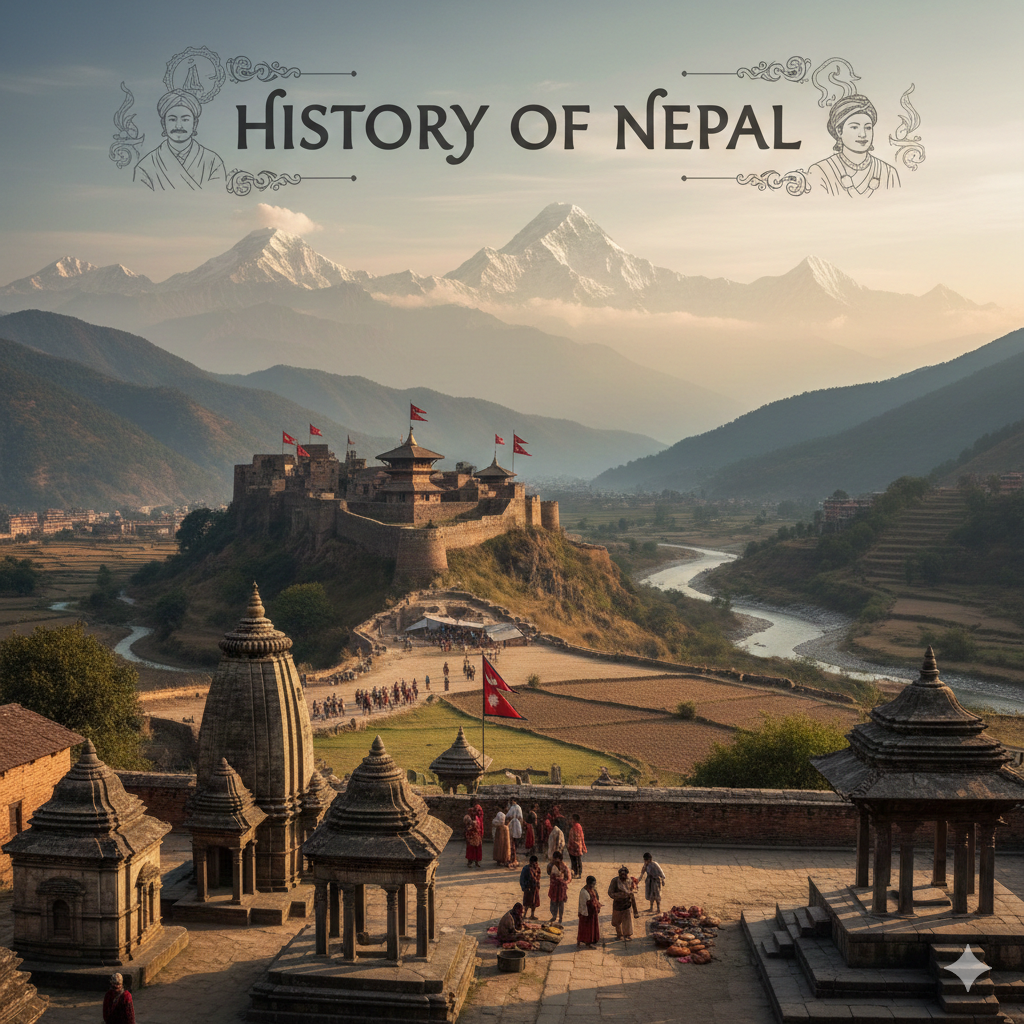
The history of Nepal is a captivating narrative spanning millennia, deeply intertwined with the Indian subcontinent and the Tibetan plateau. Situated in the Himalayan region, Nepal has served as a cultural, spiritual, and trade crossroads, resulting in a rich and diverse heritage. The country’s history can be broadly divided into ancient, medieval, and modern periods, each marked by distinct dynasties and political shifts.
 Ancient History (Prehistory to c. 879 CE)
The earliest history of Nepal is shrouded in myth and fragmented archaeological evidence.
Prehistory and the Kirat Period (c. 900 BCE – c. 300 CE)
-
- Early Settlers: The earliest inhabitants were likely the Kirat people, who are mentioned in ancient Hindu scriptures, including the Mahabharata. They are considered the first ruling dynasty of the Kathmandu Valley.
-
- Gopal and Mahispal Dynasties: According to traditional chronicles (Vamshavalis), the Gopalas (cowherd dynasty) and the Mahispalas (buffalo herder dynasty) preceded the Kirats. However, little historical evidence exists for them.
-
- The Kirat Rule: The Kirat kings ruled from their capital at Gokarna, east of present-day Kathmandu. They are credited with establishing early trade routes and an indigenous culture. The religious influence of this period saw the coexistence of animistic practices with early forms of Hinduism and Buddhism.
-
- Ashoka’s Visit: The great Indian Emperor Ashoka of the Maurya dynasty is believed to have visited the Kathmandu Valley around the 3rd century BCE, furthering the spread of Buddhism. His daughter, Charumati, is credited with founding the city of Chabahil.
-
- The Kirat Rule: The Kirat kings ruled from their capital at Gokarna, east of present-day Kathmandu. They are credited with establishing early trade routes and an indigenous culture. The religious influence of this period saw the coexistence of animistic practices with early forms of Hinduism and Buddhism.
The Licchavi Dynasty (c. 400 CE – c. 750 CE)
The Licchavi period is considered the Golden Age of Nepalese art, architecture, and political administration, marked by extensive historical records in the form of stone inscriptions.6
-
- Origin: The Licchavis are believed to have migrated from the northern plains of India (Bihar).7 They overthrew the Kirats and established a stable, prosperous kingdom.
-
- Political Structure: The government was a blend of monarchy and early forms of democracy. The king (Rājā) held supreme power, but he was advised by a council of nobles. The country was divided into administrative units called Grāma (villages) and Dranga (towns/districts).
-
- Prominent Rulers:
-
- Manadeva I (c. 464 CE): He was the first historically verifiable Licchavi ruler, known for his military conquests and issuing the earliest known Nepalese coin.
-
- Amshuverma (c. 605 – 621 CE): Although not of the main Licchavi lineage, he was a powerful Prime Minister who practically ruled the country and married his daughter, Bhrikuti, to the powerful Tibetan King Songtsen Gampo. This alliance significantly improved Nepal’s relations with Tibet. He is credited with establishing the National Calendar (the Nepal Samvat).
-
- Narendradeva (c. 640 – 680 CE): He restored the Licchavi line and solidified the kingdom.
-
- Prominent Rulers:
-
- Socio-Cultural Life: Society was organized around the Caste system, though it was less rigid than in India. The Licchavis were patrons of both Hinduism (especially Vaishnavism and Shaivism) and Buddhism. Magnificent temples and stupas were built, and Sanskrit was the court language. The Changu Narayan Temple, a UNESCO World Heritage Site, is a prime example of Licchavi architecture.
 Medieval History (c. 879 CE – 1768 CE)
The medieval period is characterized by the rise of the Malla Dynasty, economic prosperity, and the later fragmentation of the Kathmandu Valley.
The Transitional Period (c. 750 CE – 1200 CE)
This period saw the gradual decline of Licchavi power and the rise of local chiefdoms. It is also the era when the indigenous Nepalese dating system, the Nepal Sambat, was established in 879 CE by Raghava Deva.
The Malla Dynasty (c. 1200 CE – 1768 CE)
The Malla period is the cultural zenith of Nepal, renowned for its incredible urban planning, sophisticated architecture, and vibrant arts scene, especially in the Kathmandu Valley.
Early Mallas (c. 1200 – 1482 CE):
-
- Arideva Malla is considered the founder of the Malla dynasty.
-
- Jayasthiti Malla (c. 1382 – 1395 CE): A truly transformative figure. He standardized weights and measures, codified laws based on the caste system, and undertook major land reforms. He is credited with consolidating the kingdom and establishing a firm administrative structure.
-
- The Muslim Invasion: In 1349 CE, the Sultan of Bengal, Shamsuddin Ilyas Shah, invaded the Kathmandu Valley, destroying temples and structures. This attack, though short-lived, had a profound impact, forcing the Malla kings to fortify their cities.
The Fragmentation of the Malla Kingdom (The Three Kingdoms): The single Malla kingdom was formally divided in 1482 CE by the successor of Yaksha Malla, leading to the formation of three rival city-states in the Kathmandu Valley:
-
- Kathmandu (Kantipur)
-
- Lalitpur (Patan)
-
- Bhaktapur (Bhadgaon)
-
- This rivalry fueled immense artistic competition, with each city vying to outdo the others in building magnificent palaces, temples, and durbars (royal squares). This is why the UNESCO World Heritage Sites of the Kathmandu Valley are so concentrated and artistically rich.
-
- The Malla Legacy:
-
- Architecture and Art: This era produced the iconic Pagoda style of temples, intricate wood carvings, and exquisite metalwork. The Patan Durbar Square and Bhaktapur Durbar Square stand as testaments to their artistic prowess.
-
- Culture and Religion: The Mallas promoted the Newari language and culture. They were responsible for establishing many of the popular festivals and traditions still observed today, such as Indra Jatra and Kumari Jatra. They successfully synthesized Hinduism and Buddhism into a unique syncretic practice.
-
- Trade: Nepal flourished as a central point in the trans-Himalayan trade between India and Tibet, exporting spices and receiving salt, wool, and gold. This wealth underpinned their cultural achievements.
-
- The Malla Legacy:
 Modern History (1768 CE – Present)
Modern history begins with the unification of Nepal by Prithvi Narayan Shah, followed by the rise of the Rana oligarchic rule, and finally, the tumultuous journey toward democracy.
The Unification of Nepal and the Shah Dynasty (1768 CE – 1846 CE)
Nepal’s current borders and national identity are the result of the unification campaign spearheaded by the Gorkhali King, Prithvi Narayan Shah
The Unifier: Born in 1723, Prithvi Narayan Shah was the king of the small, hill-kingdom of Gorkha (west of the Valley). He envisioned a unified Nepal, believing the fragmented Malla kingdoms were vulnerable.
The Conquest: He began his conquest by blocking the trade routes to the Kathmandu Valley, weakening the Mallas economically. After a period of protracted sieges, he successfully conquered:
-
- Kirtipur (1767)
-
- Kantipur (Kathmandu) (1768), on the day of Indra Jatra, consolidating the victory.
-
- Lalitpur (Patan) (1768)
-
- Bhaktapur (1769)
Greater Nepal: Prithvi Narayan Shah continued his campaign, extending the borders east to Sikkim and west to the Kali River. He established Kathmandu as the new capital of the unified Kingdom of Nepal. His political philosophy is documented in the Divya Upadesh (Divine Counsel).
Post-Unification: The expansion continued under his successors, including Bahadur Shah (Prithvi Narayan’s youngest son, who served as Regent). This expansion brought Nepal into conflict with its powerful neighbors:
Sino-Nepalese War (1788-1792): Nepal invaded Tibet over a trade dispute, prompting intervention from the Qing Dynasty of China. Nepal was defeated and forced to sign a humiliating treaty.
Anglo-Nepalese War (1814-1816): Nepal’s continued expansion into the plains brought it into direct conflict with the British East India Company. The war ended with the Treaty of Sugauli (1816).
-
- Terms: Nepal lost vast territories (including Kumaon, Garhwal, and Sikkim) but retained its independence. A British Resident was permanently stationed in Kathmandu. This treaty defined Nepal’s modern southern and western boundaries. As a condition of the treaty, the British began recruiting Gurkhas into their army, a tradition that continues to this day.
The Rana Regime (1846 CE – 1951 CE)
The Shah dynasty was reduced to a nominal role after the Kot Massacre in 1846, which ushered in a century of autocratic rule by the Rana family.
-
- The Kot Massacre: A bloody event on September 14, 1846, triggered by the murder of a Queen’s favorite. Jang Bahadur Kunwar (later Rana) used the ensuing chaos to eliminate his political rivals, consolidate power, and declare himself Prime Minister and Maharaja of Kaski and Lamjung.
-
- The Rana Oligarchy: Jang Bahadur established a system where the position of Prime Minister was hereditary and rotated among the male members of the Rana family. The Shah kings were marginalized, becoming mere figureheads.
Modernization and Isolation:
-
- Jang Bahadur Rana traveled to Britain and France in 1850, bringing back ideas of modernization, which were implemented selectively (e.g., establishing the first legal code, the Muluki Ain, in 1854).
-
- However, the Ranas enforced a policy of strict isolation (Pardah), limiting contact with the outside world to prevent exposure to democratic ideas and revolutions. This preserved their rule but severely stunted Nepal’s development in education, infrastructure, and industry.
-
- British Alliance: The Ranas were staunch allies of the British in India, notably helping to suppress the Indian Mutiny of 1857. In return, the British restored some of the territory lost in the Sugauli Treaty (the Naya Muluk).
Decline of Rana Rule: The Rana regime became increasingly repressive and corrupt. The growth of nationalism, fueled by contact with the Indian independence movement, and internal dissent within the Rana family led to their eventual downfall.
The Dawn of Democracy and Panchayat Rule (1951 CE – 1990 CE)
The mid-20th century saw the end of the Rana regime and a struggle between royal power and democratic aspirations.
The 1951 Revolution:
-
- Inspired by the formation of the Nepali Congress Party in India and supported by King Tribhuvan (who had secretly aligned with the revolutionaries), a popular uprising began.
-
- In 1950, King Tribhuvan fled to India, creating a constitutional crisis.
-
- The revolution, supported by India, forced the Ranas to the negotiating table. The Delhi Compromise (1951) ended Rana rule, restored the Shah King to power, and established an interim government that included the Nepali Congress. This marked the beginning of multi-party democracy.
The Decade of Democracy (1951-1960): A period of political instability followed.
-
- King Mahendra succeeded Tribhuvan.
-
- Nepal held its first general election in 1959, which was overwhelmingly won by the Nepali Congress, led by Bishweshwar Prasad Koirala (B.P. Koirala), who became the first democratically elected Prime Minister.
The Panchayat System (1960-1990):
-
- In 1960, King Mahendra staged a royal coup, dismissing the elected government, imprisoning B.P. Koirala, and promulgating a new constitution that established a partyless Panchayat System.
-
- The system featured elected local and district assemblies but banned all political parties, concentrating all power in the hands of the monarch.
-
- His son, King Birendra, continued the system after Mahendra’s death in 1972, though he held a National Referendum in 1980, which narrowly voted to continue the Panchayat System with minor reforms.
The Movement for Democracy and the Civil War (1990 CE – 2008 CE)
The late 20th and early 21st centuries were defined by the struggle to establish and maintain a stable constitutional democracy.
The First People’s Movement (Jana Andolan I, 1990):
-
- Frustration over economic stagnation, corruption, and the autocratic Panchayat system led to a massive, non-violent pro-democracy movement (Jana Andolan).
-
- In 1990, King Birendra was forced to concede. He abolished the Panchayat system and agreed to a constitutional monarchy and a multi-party system. A new constitution was adopted, establishing Nepal as a constitutional monarchy.
The Maoist Insurgency (1996-2006):
-
- Following the return to democracy, a communist faction, the Communist Party of Nepal (Maoist), launched a People’s War in 1996, aiming to overthrow the monarchy and establish a communist republic.
-
- The civil war lasted for a decade, resulting in over 17,000 deaths and widespread displacement, paralyzing the nation’s development.
The Royal Massacre (2001):
-
- A catastrophic event occurred on June 1, 2001, when Crown Prince Dipendra allegedly massacred King Birendra and most of the Royal family before killing himself.
-
- This event deeply shocked the nation and irrevocably changed the political landscape. Gyanendra, Birendra’s younger brother, became the new King.
King Gyanendra’s Direct Rule: Citing the instability caused by the Maoist war, King Gyanendra gradually asserted more power, culminating in a royal coup on February 1, 2005, when he dissolved the government and assumed executive power.
The Second People’s Movement (Jana Andolan II, 2006):
-
- This move was met with unified resistance. The Seven-Party Alliance (SPA) of mainstream political parties and the Maoists (who signed a 12-point agreement) launched a massive, successful pro-democracy movement.
-
- Facing overwhelming public pressure, King Gyanendra was forced to relinquish power in April 2006, leading to the reinstatement of the Parliament.
 Federal Democratic Republic of Nepal (2008 CE – Present)
The final chapter in Nepal’s political transition saw the abolition of the monarchy and the establishment of a federal republic.
-
- End of the Monarchy:
-
- The restored Parliament stripped the King of all executive power and declared Nepal a Federal Democratic Republic in May 2008.
-
- A Constituent Assembly election was held, which the Maoists won. The Shah Dynasty, which had ruled Nepal for 240 years, officially ended.
-
- End of the Monarchy:
The New Constitution and Federalism:
-
- The process of drafting a new constitution was protracted due to deep disagreements among the political parties and ethnic groups over issues of federalism, state boundaries, and electoral systems.
-
- Finally, the Constitution of Nepal was promulgated on September 20, 2015, establishing a Federal Democratic Republic with seven provinces and a bicameral federal parliament.
-
- The constitution was met with protests in the southern Terai region, leading to a long and costly border blockade by India-aligned groups.
Contemporary Nepal:
-
- Nepal is currently navigating the challenges of implementing a complex federal structure, managing political transitions, and recovering from major natural disasters, such as the devastating 2015 Earthquake.
-
- The country’s foreign policy is focused on balancing its relationship with its two giant neighbors, India and China.
-
- Despite political hurdles, Nepal remains a nation with immense cultural richness and a strong democratic spirit, continuing its journey toward stable governance and economic development.
Visit: www.dkbtech.com and allcircular.com