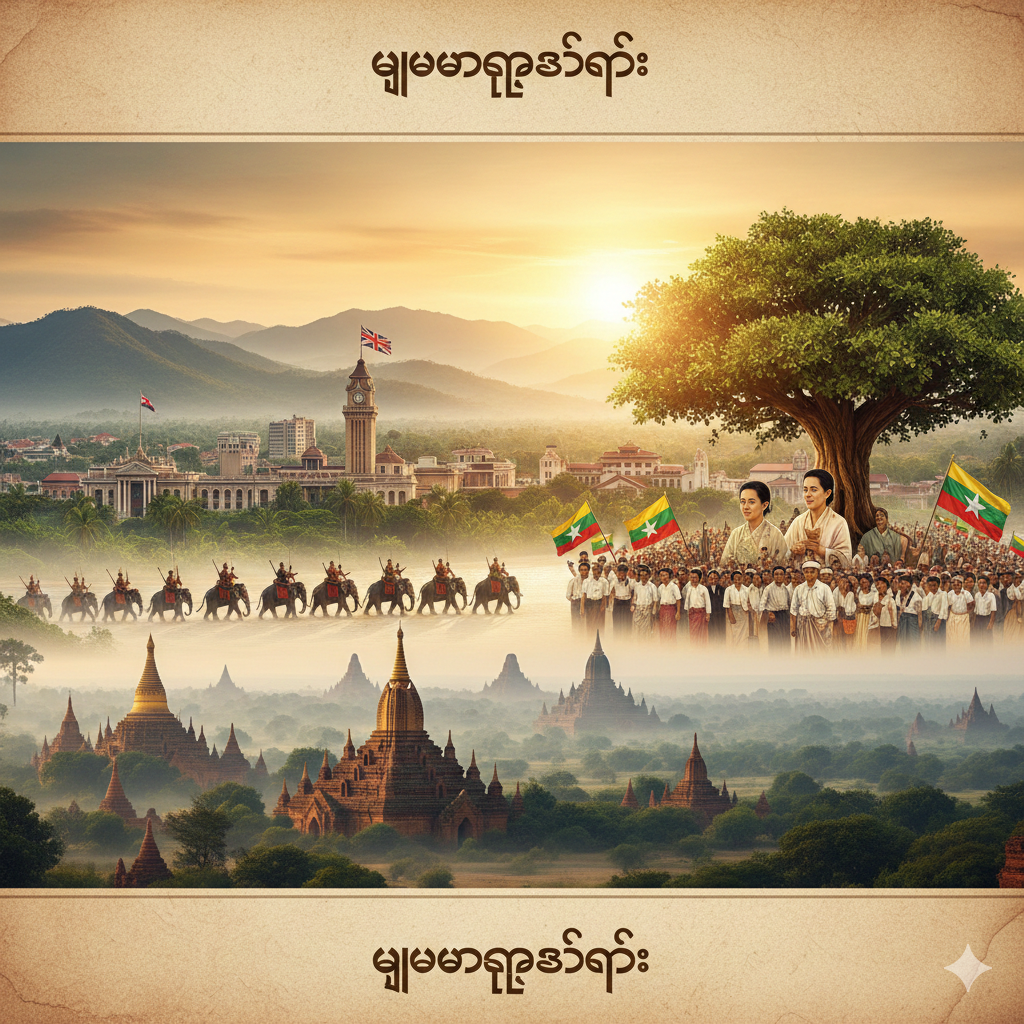
The History of Myanmar (formerly Burma) is a rich tapestry woven with threads of ancient kingdoms, colonial rule, and struggles for independence, leading to its present-day complexities.Ancient Kingdoms and Empires: The earliest known civilizations in Myanmar emerged around the 2nd century BCE, with evidence of Pyu city-states flourishing in central Myanmar. These city-states, such as Sri Ksetra and Halin, were centers of trade and culture, adopting Buddhism and developing their own scripts.
The 9th century saw the rise of the Bamar people and the establishment of the Pagan Kingdom (c. 849–1287 CE) by King Anawrahta. Pagan became a powerful empire, unifying much of present-day Myanmar and leaving behind a legacy of thousands of magnificent Buddhist temples and stupas. This period is considered a golden age of Burmese culture and religion.
After the fall of Pagan to the Mongols in 1287, Myanmar fragmented into several smaller kingdoms, including the Ava Kingdom (1364–1555) in the north and the Hanthawaddy Kingdom (1287–1539) in the south. These kingdoms often clashed, but also contributed to the diverse cultural landscape of the region.
The Taungoo Dynasty (1510–1752) eventually reunified Myanmar under kings like Tabinshwehti and Bayinnaung, expanding its influence throughout Southeast Asia. However, the dynasty faced internal strife and external pressures, leading to its decline.
The Konbaung Dynasty (1752–1885) was the last imperial dynasty of Burma. Founded by King Alaungpaya, it continued the process of reunification and engaged in wars with neighboring Siam (Thailand) and various Shan states. It was during this period that the British began to exert their influence in the region.
Colonial Rule: The 19th century marked a pivotal period with the Anglo-Burmese Wars. The First Anglo-Burmese War (1824–1826) resulted in the British annexation of Arakan and Tenasserim. The Second Anglo-Burmese War (1852) led to the annexation of Lower Burma. Finally, the Third Anglo-Burmese War (1885) saw the complete annexation of Upper Burma, ending the Konbaung Dynasty and incorporating Myanmar into the British Indian Empire.
Under British rule, Myanmar underwent significant administrative and economic changes. The British introduced a new legal system, expanded infrastructure, and promoted the cultivation of rice for export, leading to economic growth but also social disruption. Resentment against colonial rule simmered, eventually leading to the rise of nationalist movements.
Independence and Post-Colonial Challenges: The struggle for independence gained momentum in the early 20th century, led by figures like Aung San. Myanmar achieved independence from British rule on January 4, 1948, becoming the Union of Burma.
However, the post-independence period was marked by political instability, ethnic conflicts, and economic challenges. In 1962, a military coup led by General Ne Win established a one-party socialist state, isolating Myanmar from the international community for decades.
The military regime, later known as the State Law and Order Restoration Council (SLORC) and then the State Peace and Development Council (SPDC), ruled with an iron fist, suppressing dissent and human rights. Despite international sanctions and widespread condemnation, the military maintained its grip on power.
In recent years, Myanmar has seen some political reforms, including the release of political prisoners and the holding of general elections. However, the country continues to grapple with complex issues of ethnic reconciliation, democratic transition, and human rights. The 2021 military coup once again plunged the country into crisis, undoing many of the democratic gains and leading to widespread protests and renewed international concern. The future of Myanmar remains uncertain, but its people continue to strive for peace, democracy, and prosperity.
Visit : www.dkbtech.com and www.allcircular.com