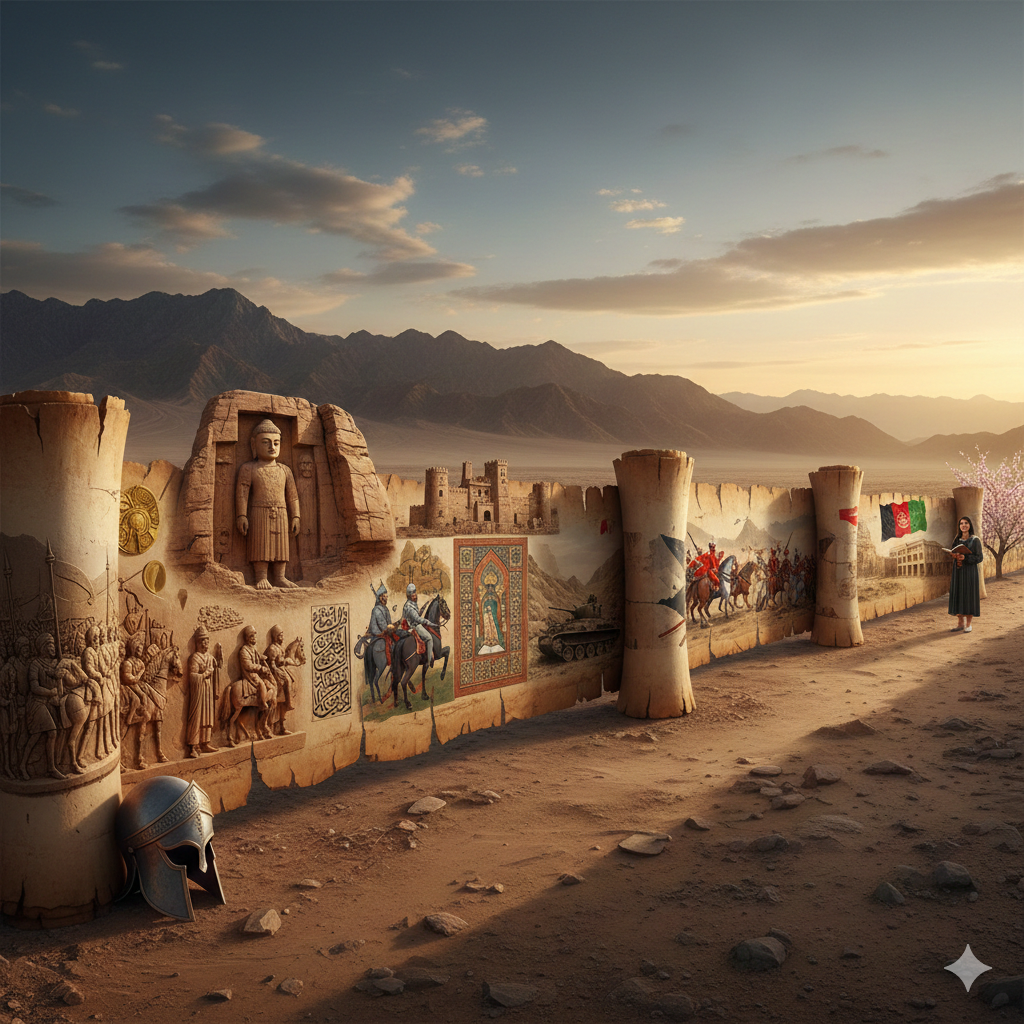
Afghanistan, often called the “Crossroads of Asia,” has a history as rich, complex, and tumultuous as any in the world. Its strategic location connecting the Middle East, Central Asia, and the Indian Subcontinent has made it a crucial hub for trade, migration, and, inevitably, conquest.
I. Ancient History: The Cradle of Civilizations (c. 3000 BCE – 651 CE)
The region that is modern Afghanistan boasts evidence of human habitation dating back 50,000 years, and one of the earliest urban civilizations, the Indus Valley Civilization, had outposts here.
A. The Bronze and Iron Ages (c. 3000 – 550 BCE)
-
- Bactria (Balkh): The northern region of Afghanistan, ancient Bactria, was a major center for the Bronze Age Oxus Civilization (also known as the Bactria-Margiana Archaeological Complex or BMAC). The city of Balkh, known as the “Mother of Cities,” is one of the oldest continually inhabited settlements in the world.
-
- Zoroastrianism: It is widely believed that the prophet Zoroaster founded the religion of Zoroastrianism in what is now Afghanistan sometime between the 18th and 6th centuries BCE. This ancient monotheistic faith had a profound influence on subsequent Persian empires.
B. The Age of Empires and Hellenistic Influence (c. 550 BCE – 651 CE)
Afghanistan’s strategic position ensured it was absorbed by every major imperial power.
-
- Achaemenid Empire (550 – 330 BCE): The area became the easternmost satrapies (provinces) of the Persian Achaemenid Empire, with major cities like Aria (Herat) and Bactra (Balkh) serving as administrative centers.
-
- Alexander the Great (330 – 323 BCE): Alexander of Macedon conquered the region, defeating the Achaemenids. He founded several cities, including Alexandria-Arachosia (modern Kandahar). This conquest initiated the Hellenistic period, which fused Greek and local cultures.
-
- Seleucid and Mauryan Empires: Following Alexander’s death, the region was governed by the Seleucid Empire. Later, the southern areas were ceded to the Indian Mauryan Empire, led by Ashoka the Great, who introduced Buddhism to the region.
-
- The Kushan Empire (c. 1st – 3rd Century CE): This was a golden age for the region. The Kushans, a nomadic group from Central Asia, established a vast empire stretching from Central Asia into northern India.
-
- Gandhara: The area became the heartland of Gandharan Buddhism, an influential school of Mahayana Buddhism famous for its Greco-Buddhist art, which depicted the Buddha in human form for the first time. The Buddhas of Bamiyan (destroyed in 2001) were a magnificent testament to this cultural synthesis.
-
- The Kushan Empire (c. 1st – 3rd Century CE): This was a golden age for the region. The Kushans, a nomadic group from Central Asia, established a vast empire stretching from Central Asia into northern India.
-
- Sasanian and Hephthalite Rule: The Sasanian Empire of Persia and the nomadic Hephthalites (White Huns) contested control over the region until the rise of Islam.
II. The Islamic Era and the Rise of Local Dynasties (651 – 1504)
The arrival of Islam marked a definitive cultural and political turning point.
A. The Islamic Conquest (7th – 10th Centuries)
-
- Arab Conquest: Arab armies conquered the Sasanian Empire, reaching modern Afghanistan by the mid-7th century. Islam was gradually adopted by the local population, but the complete Islamization of the eastern provinces took several centuries.
-
- Rise of the Saffarids and Samanids: As the power of the distant Abbasid Caliphate waned, local Persian and Turkic dynasties emerged. The Saffarids (centered in Zaranj) and the Samanids (centered in Bukhara) brought a period of cultural and administrative consolidation.
B. The Golden Age of Ghaznavids and Ghurids (10th – 13th Centuries)
-
- The Ghaznavid Empire (977 – 1186): Founded by the Turkic general Sebuktigin, the empire was centered in Ghazni (southeastern Afghanistan). Under his son, Mahmud of Ghazni, the empire became a major regional power, financing vast conquests into India. This period is a high point of Islamic Persianate culture, featuring patronage for poets like Ferdowsi.
-
- The Ghurid Dynasty (c. 1148 – 1215): Emerging from the mountainous region of Ghor, they overthrew the Ghaznavids and extended their empire west into Persia and east into northern India (establishing the foundation for the Delhi Sultanate).
C. The Mongol Cataclysm and Successor States (13th – 15th Centuries)
-
- Genghis Khan and the Mongols (1219 – 1221): The invasion by the Mongol armies of Genghis Khan was an unmitigated disaster for the region. Cities like Herat, Balkh, and Bamiyan were brutally sacked, and the sophisticated irrigation systems of the time were destroyed, leading to widespread famine and demographic decline.
-
- The Timurid Renaissance (1370 – 1506): Following the decline of the Mongol successor states, Timur (Tamerlane) established a vast Turco-Mongol empire.
-
- Herat became the capital under Timur’s son, Shah Rukh, and experienced a profound cultural and artistic Renaissance. It became one of the greatest centers of the Islamic world, famous for its architecture, painting (the Herat School of Miniatures), and scholarship.
-
- The Timurid Renaissance (1370 – 1506): Following the decline of the Mongol successor states, Timur (Tamerlane) established a vast Turco-Mongol empire.
III. The Formation of the Modern State (16th – 19th Centuries)
This period saw the consolidation of distinct political entities that would eventually coalesce into modern Afghanistan, defined by the conflict between powerful neighbors.
A. Safavid, Mughal, and Uzbek Contests (16th – 18th Centuries)
The region became a critical frontier contested by three powerful Islamic empires:
-
- The Safavid Empire (Persian, Shia) to the west.
-
- The Mughal Empire (Turco-Mongol, Sunni) to the east.
-
- The Uzbek Khanates (Turkic, Sunni) to the north.
Cities like Kandahar changed hands frequently, embodying the geographical and political fracture of the Afghan tribes.
B. The Hotaki Dynasty and National Awakening (1709 – 1738)
-
- The Mirwais Hotak Revolt: In 1709, Mirwais Hotak, a Ghilzai Pashtun leader, led a successful rebellion against the Safavid Persian governor in Kandahar. This is often cited as the first move towards Afghan independence.
-
- Invasion of Persia: Mirwais’s son, Mahmud Hotak, invaded Persia, captured its capital Isfahan, and briefly ruled as the Shah of Persia. Their dynasty was ultimately overthrown by the Persian military genius Nader Shah Afshar.
C. The Durrani Empire and the Birth of Afghanistan (1747 – 1823)
-
- Ahmad Shah Durrani (Baba): Following the assassination of Nader Shah in 1747, Ahmad Shah Durrani (formerly Abdali), a Pashtun general, was elected as the new king by a loya jirga (grand assembly) in Kandahar. He is revered as the Father of the Nation.
-
- The Durrani Empire: Ahmad Shah built a vast empire, stretching from eastern Persia to northern India and Central Asia. He moved the capital to Kabul. This marks the establishment of a unified, independent Afghan state under Pashtun leadership.
D. The Great Game and the Anglo-Afghan Wars (19th Century)
The 19th century was dominated by “The Great Game,” the intense geopolitical rivalry between the British Empire (securing its Indian colonies) and the Russian Empire (expanding into Central Asia) for influence in Afghanistan.
-
- First Anglo-Afghan War (1839 – 1842): Britain invaded to replace the ruler Dost Mohammad Khan with the supposedly more compliant Shah Shuja Durrani. The war ended in a disastrous British retreat from Kabul, a humiliating defeat that proved Afghanistan’s fierce independence.
-
- Second Anglo-Afghan War (1878 – 1880): A second British invasion resulted in the installation of Amir Abdur Rahman Khan (the “Iron Amir”) as a client ruler.
-
- The Durand Line (1893): Abdur Rahman signed an agreement with the British representative, Mortimer Durand, establishing the border between Afghanistan and British India. This border, which divided the Pashtun tribes, is today the disputed border between Afghanistan and Pakistan, a major source of regional conflict.
-
- Second Anglo-Afghan War (1878 – 1880): A second British invasion resulted in the installation of Amir Abdur Rahman Khan (the “Iron Amir”) as a client ruler.
IV. Modernization, Monarchy, and Republicanism (1901 – 1978)
A. The Path to Full Independence (1901 – 1929)
-
- Amir Habibullah Khan (1901 – 1919): Maintained strict neutrality during World War I and initiated cautious modernization, including the first schools and electric power.
-
- Third Anglo-Afghan War and Independence (1919): Habibullah’s son, Amir Amanullah Khan, declared full independence from Britain shortly after his father’s assassination. The brief war led to the Treaty of Rawalpindi, confirming Afghanistan’s sovereignty.
-
- King Amanullah Khan (1919 – 1929): He embarked on a rapid and radical modernization program—secularizing laws, banning the veil for women, and implementing a new constitution. These reforms were too fast for conservative tribal and religious leaders, leading to a successful rebellion that forced his abdication.
B. The Constitutional Monarchy (1933 – 1973)
-
- Zahir Shah’s Reign: Mohammad Zahir Shah‘s 40-year reign was a long period of relative peace and stability. The country pursued a policy of non-alignment and received aid from both the US and the USSR during the Cold War.
-
- Mohammad Daoud Khan: As Prime Minister (1953-1963), Zahir Shah’s cousin Mohammad Daoud Khan focused on economic development and strengthening the army. He also heavily promoted the Pashtunistan issue, straining relations with Pakistan.
-
- Constitutional Experiment (1964): A new constitution established a limited democracy, though the government remained largely centralized and ineffective, leading to political stagnation and rising leftist and Islamist movements.
C. The End of Monarchy (1973)
In 1973, while Zahir Shah was abroad, Daoud Khan staged a bloodless coup d’état, ending the monarchy and establishing the Republic of Afghanistan, with himself as the first President.
V. The Decades of War (1978 – Present)
The relative stability of the mid-20th century was shattered by a series of coups and foreign interventions, plunging the nation into decades of devastating conflict.
A. The Communist Coup and the Saur Revolution (1978)
-
- People’s Democratic Party of Afghanistan (PDPA): A Marxist-Leninist party, the PDPA, staged a violent coup, assassinating Daoud Khan and taking power. They declared the Democratic Republic of Afghanistan (DRA).
-
- Radical Reforms: The PDPA implemented rapid, radical Marxist and anti-religious reforms (land reform, compulsory education for girls) that were intensely unpopular and provoked immediate, widespread armed revolt by conservative, religious, and tribal leaders (Mujahideen).
B. The Soviet-Afghan War (1979 – 1989)
-
- Soviet Invasion (December 1979): To prop up the failing communist regime, the Soviet Union invaded Afghanistan.
-
- The Mujahideen: The Afghan resistance (Mujahideen, meaning ‘holy warriors’) launched a fierce jihad against the Soviet forces. They were covertly supported by the US, Pakistan, Saudi Arabia, and China, turning the conflict into a major proxy war of the Cold War.
-
- Devastation and Exodus: The war devastated the country’s infrastructure, killed an estimated 1-2 million Afghans, and forced over 6 million people to become refugees.
-
- Soviet Withdrawal (1989): Facing mounting losses and international pressure, the Soviet Union withdrew its forces. The communist regime of Mohammad Najibullah survived for three more years, but ultimately collapsed in 1992.
C. The Civil War and the Rise of the Taliban (1992 – 2001)
-
- Mujahideen Civil War (1992 – 1996): Following the collapse of the Najibullah regime, the victorious Mujahideen factions, led by commanders like Ahmad Shah Massoud, Gulbuddin Hekmatyar, and Abdul Rashid Dostum, turned on each other, fighting a brutal civil war for control of Kabul.
-
- The Rise of the Taliban: Emerging from the refugee camps in Pakistan and the religious schools (madrasas) along the border, the Taliban (meaning ‘students’) were initially welcomed by war-weary Pashtuns for promising peace and the end of corruption under a strict interpretation of Sharia law.
-
- They captured Kandahar in 1994 and Kabul in 1996, establishing the Islamic Emirate of Afghanistan.
-
- Their regime was marked by extreme social restrictions (especially against women) and the destruction of non-Islamic cultural heritage (e.g., the Bamiyan Buddhas).
-
- The Rise of the Taliban: Emerging from the refugee camps in Pakistan and the religious schools (madrasas) along the border, the Taliban (meaning ‘students’) were initially welcomed by war-weary Pashtuns for promising peace and the end of corruption under a strict interpretation of Sharia law.
D. The US-Led Intervention and the Republic (2001 – 2021)
-
- September 11 Attacks (2001): The Taliban’s refusal to hand over Osama bin Laden, the leader of the Al-Qaeda terrorist organization, led to the US-led invasion in October 2001.
-
- Overthrow and the Bonn Agreement: The Taliban regime was quickly overthrown by US and NATO forces, aided by the Northern Alliance (a coalition of anti-Taliban groups). The Bonn Agreement established an interim government.
-
- The Islamic Republic: A new constitution was adopted, and Hamid Karzai became the first democratically elected President in 2004. The country embarked on a 20-year effort to build a democratic state with a Western-backed military and government.
-
- The Insurgency: The Taliban regrouped and launched a persistent, devastating insurgency against the Afghan government and NATO forces.
E. The Return of the Taliban (2021 – Present)
-
- US/NATO Withdrawal: Following the Doha Agreement (2020) and a US decision to withdraw all forces, the Afghan National Army and government rapidly collapsed.
-
- Fall of Kabul (August 2021): The Taliban swept across the country and re-took control of Kabul, re-establishing the Islamic Emirate of Afghanistan.
-
- Current State: The new Taliban government faces massive economic, humanitarian, and political challenges, with a complete ban on women’s education and work in many sectors, and a lack of international recognition.
Conclusion
Afghanistan’s history is a relentless cycle of imperial conquest, cultural exchange, national liberation, and internal conflict. From the glorious Hellenistic-Buddhist art of Gandhara to the resilience of the Mujahideen and the aspirations of the short-lived Republic, the Afghan people have consistently shown an unbreakable spirit against foreign domination. Its past continues to shape its present, as the country struggles to find a path to lasting peace, prosperity, and self-determination at the heart of Asia.
Visit : www.dkbtech.com and allcircular.com