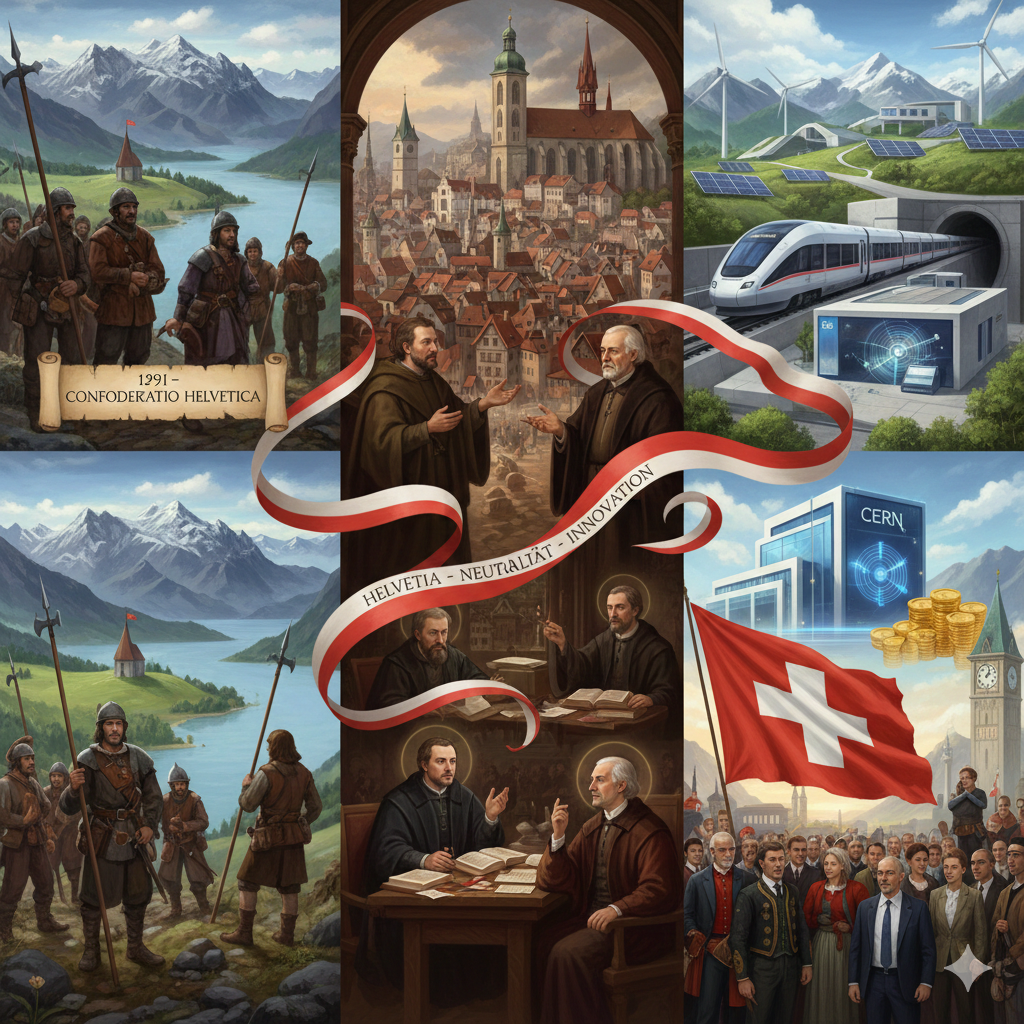
The history of Switzerland is not a narrative of royal dynasties or imperial ambition, but rather a unique story of cooperative pacts, territorial defense, and the gradual evolution of diverse peoples into a resilient, decentralized state. Situated at the geographic heart of Europe, the territory that became Switzerland was both a crucial transit route and a mountainous sanctuary. From its mythical origins in the late Middle Ages to its modern role as a global beacon of neutrality and democracy, the Swiss Confederation represents a powerful case study in the successful management of ethnic, linguistic, and religious diversity.
I. Early Inhabitants and Roman Rule (c. 500 BCE – 400 CE)
The history of the Swiss territory begins with Celtic tribes, most notably the Helvetii in the west and the Raetians in the east. The name Helvetia, still used formally today, originates from these early inhabitants.
The Romanization of Helvetia
The fate of the Helvetii was dramatically altered in 58 BCE when they attempted a mass migration westward into Gaul. Their movement was intercepted and defeated by Julius Caesar at the Battle of Bibracte. The Romans subsequently brought the region under their control, and the territory became the Roman province of Helvetia.
Roman rule, lasting nearly four centuries, brought peace (Pax Romana), infrastructure, and economic development. Major settlements, which would later become key Swiss cities, were founded or expanded, including Aventicum (Avenches, the capital of Roman Helvetia), Augusta Raurica (near Basel), and Lousonna (Lausanne). The passes through the Alps, such as the Great St. Bernard, became vital trade routes. Romanization was deep, introducing Latin, which is the root of today’s French, Italian, and Romansh languages spoken in Switzerland.
II. The Early Medieval Period and the Linguistic Divide (400 – 1000 CE)
The collapse of the Western Roman Empire in the 5th century saw the territory carved up by Germanic tribes, establishing the linguistic map that defines Switzerland today.
Germanic Settlements and the Language Border
-
- Burgundians (West): The Burgundians, a Germanic tribe, settled in the western part of the territory (modern Romandy). They adopted the existing Gallo-Roman culture and language, which evolved into today’s French.
-
- Alemanni (East): The Alemanni, another Germanic tribe, settled in the north and central regions. Unlike the Burgundians, they largely displaced the existing Roman culture, cementing the dominance of Alemannic German, the ancestor of modern Swiss German.
-
- Lombards (South): The south, today’s Ticino, was influenced by the Lombards and remained linguistically Italian.
The Röstigraben (literally, the “Rösti ditch,” referring to a Swiss-German potato dish) is the cultural and linguistic dividing line, running roughly from Basel down to the Alps, established during this period.
The Holy Roman Empire
By the 10th century, the entire Swiss territory was formally absorbed into the Holy Roman Empire. Authority was highly decentralized, held by dukes, counts, and especially powerful landowning families like the Zähringen in the west and the House of Habsburg in the north and east. The Zähringen family founded several key cities, including Bern and Fribourg.
III. The Old Swiss Confederacy: The Original Pact (1291 – 1515)
The genesis of the Swiss state lies in the strategic importance of the Alpine passes and the desire of local communities to maintain their autonomy against powerful feudal lords.
The Foundation Myth and the Perpetual Pact (1291)
The key moment in Swiss history occurred in the central Alpine region of Waldstätten (Forest Cantons): Uri, Schwyz, and Unterwalden (today split into Obwalden and Nidwalden). These three mountain communities, strategically positioned along the vital Gotthard Pass route, sought to bypass feudal obligations, especially those owed to the powerful Habsburgs, who were seeking to consolidate their landholdings.
In 1291, following the death of King Rudolph I of Habsburg, representatives of the three cantons signed the Federal Charter (Bundesbrief). This was a Perpetual Pact (Ewiger Bund) of mutual assistance and defense, primarily against external aggression, which officially marks the foundation of the Swiss Confederation. The Charter did not create a sovereign state but established a defensive league of free communities.
The popular, though apocryphal, legend of William Tell—the common man who assassinated the tyrannical Habsburg bailiff, Gessler—was later invented to dramatize and mythologize this struggle for freedom.
The Golden Age of Mercenaries and the Turning Point (1515)
Swiss military strength became legendary. From the 14th to the 16th centuries, Swiss pikemen were the most sought-after mercenaries in Europe, supplying soldiers to rulers across the continent. This wealth and military prestige reached its peak during the Burgundian Wars (1474-1477), where the Swiss defeated the forces of Charles the Bold.
The height of Swiss power coincided with its definitive end in continental warfare. In 1515, the Swiss forces were decisively defeated by the French and Venetians at the Battle of Marignano. This loss was a profound national shock and directly led to a historic shift in foreign policy: the Pact of Perpetual Peace with France (1516) and the subsequent adoption of armed neutrality—a policy of non-intervention in foreign conflicts combined with a strong defense force—a doctrine that would define the Confederation for centuries.
IV. The Reformation and Religious Division (1515 – 1798)
Switzerland became a central stage for the Protestant Reformation, which split the Confederation along religious lines, posing the greatest internal threat to its existence since 1291.
Zwingli and Calvin
The Reformation was spearheaded by two towering figures:
-
- Huldrych Zwingli (Zurich): Zwingli led the Reformation in German-speaking Switzerland, advocating for a purified, simpler form of worship. His movement quickly gained traction in the large, powerful cities of Zurich, Bern, and Basel.
-
- John Calvin (Geneva): Though not originally Swiss, Calvin established his severe, influential form of Protestantism (Calvinism) in Geneva, turning it into the “Protestant Rome” and a refuge for religious dissidents from across Europe.
The Confederation was thus split between the industrial, wealthy, reforming city-cantons and the rural, conservative, Catholic Forest Cantons.
Internal Conflict
The religious split quickly led to civil war.
-
- Kappel Wars (1531): Zwingli was killed in the Second Kappel War. These conflicts established a religious status quo where both faiths were legally recognized, but with cantons free to choose their own official religion.
-
- Peace of Westphalia (1648): Although the Swiss remained neutral during the destructive Thirty Years’ War, the peace treaties formally recognized the Swiss Confederation’s complete independence from the Holy Roman Empire, marking its transition into a truly sovereign state.
The religious tensions continued to flare up, notably in the Toggenburg War (1712), but the principle of mutual defense proved stronger than religious enmity, preventing the Confederation from dissolving entirely.
V. The Napoleonic Era and the Crisis of the Old Order (1798 – 1848)
The long stability of the Old Confederacy was violently shattered by the forces of revolutionary France.
The Helvetic Republic (1798 – 1803)
In 1798, French Revolutionary armies invaded Switzerland. The French, citing the need to “liberate” the subject territories from the ruling oligarchies (especially in Bern), dismantled the Old Confederacy. They imposed a highly centralized, unitary state known as the Helvetic Republic.
This was the first time Switzerland had a single capital (Aarau, then Lucerne) and a centralized government based on the French model. The Republic was deeply unpopular, failing to respect Swiss traditions of federalism and cantonal autonomy, and it was little more than a French puppet state, suffering continuous upheaval and economic exploitation.
The Act of Mediation and the Restoration
In 1803, Napoleon Bonaparte recognized the failure of the centralized experiment and imposed the Act of Mediation. This restored cantonal sovereignty and increased the number of cantons to nineteen, incorporating previously allied territories (like Vaud and Ticino) as full members.
After Napoleon’s final defeat, the Congress of Vienna (1815) formally restored the old aristocratic order but confirmed the inclusion of three new, diverse cantons (Valais, Neuchâtel, and Geneva), bringing the total to 22 cantons (later 25 semi-cantons). Crucially, the European powers formally recognized and guaranteed the Perpetual Neutrality of Switzerland, which has since become a cornerstone of its foreign policy.
The period following the Restoration, however, saw renewed political tensions between conservative Catholic cantons and liberal Protestant cantons demanding a modern constitution and greater civil liberties.
VI. The Birth of the Modern Federal State (1848)
The struggle between conservative federalism and liberal centralism culminated in a brief civil war that ironically led to lasting unity.
The Sonderbund War (1847)
Fearing the liberal encroachment on their sovereignty and Catholic identity, seven conservative, Catholic cantons formed a separate defensive alliance called the Sonderbund (Special League). The Federal Diet declared the Sonderbund illegal, leading to a clash.
The Sonderbund War of 1847 was short, lasting less than a month, and remarkably low in casualties (fewer than 100 dead). Led by General Guillaume-Henri Dufour, the federal army quickly defeated the Sonderbund forces.
The Federal Constitution of 1848
The liberal victors used the peace to draft a new Federal Constitution in 1848, which effectively created the modern Swiss state.
-
- Federalism and Centralization: It established a federal state, balancing a strong central government with high cantonal autonomy.
-
- Political Structure: It created a bicameral legislature, the Federal Assembly (National Council representing the people, and Council of States representing the cantons), and a seven-member executive, the Federal Council.
-
- Capital: Bern was designated the permanent federal capital.
The Constitution of 1848 was a masterpiece of compromise, securing liberal goals while respecting the conservative tradition of local sovereignty. This settlement laid the foundation for Switzerland’s unique political stability.
VII. Modern Switzerland: Neutrality and Prosperity (1848 – Present)
The new state enjoyed a long period of internal peace and prosperity, focusing on industrialization, banking, and perfecting its model of direct democracy.
Industrialization and Direct Democracy
The latter half of the 19th century saw rapid industrial growth, fueled by railway construction (most famously the Gotthard Tunnel) and the establishment of globalized industries like precision machinery, chemicals (Basel), and food (Nestlé).
The democratic structure was deepened by introducing the key instruments of Direct Democracy:
-
- Referendum: Allowing citizens to vote on laws passed by parliament.
-
- Initiative: Allowing citizens to propose constitutional amendments.
These mechanisms ensured that all major political decisions required broad consensus, reinforcing the culture of compromise known as Concordance.
The World Wars and Armed Neutrality
Switzerland maintained its strict policy of armed neutrality during both World War I and World War II, a crucial element of its national identity.
-
- World War I: Despite being surrounded by warring nations (Germany, France, Italy, Austria-Hungary), Switzerland remained intact, though it was internally stressed by the differing sympathies of its German, French, and Italian speakers.
-
- World War II: Switzerland mobilized its army, adopted a defensive strategy (Réduit national fortress), and prepared to fight any invasion, while also accepting hundreds of thousands of refugees. However, its policy was complex and controversial, involving trade with Nazi Germany and restrictive refugee policies for Jewish people. The final years of the 20th century saw extensive public and governmental efforts to confront and apologize for these difficult wartime policies.
Post-War Switzerland and Global Role
In the post-war era, Switzerland cemented its role as a stable global finance center and a host for international organizations.
-
- International Organizations: Geneva became the European headquarters for the United Nations (UN) and the base for the Red Cross (founded by Swiss humanitarian Henry Dunant in 1863), the World Trade Organization (WTO), and numerous humanitarian groups, underscoring its role as a promoter of dialogue and peace.
-
- Political Evolution: Switzerland was notably slow to grant political rights to all citizens; women gained the right to vote in federal elections only in 1971 (and in all cantons by 1990).
-
- European Relations: Despite its central location, Switzerland has maintained a deliberately independent path. It is a member of the Schengen Area (allowing free movement) and participates in bilateral treaties with the European Union, but it has repeatedly refused to join the EU, emphasizing the preservation of its direct democracy and sovereignty. Switzerland formally joined the United Nations only in 2002.
Conclusion
The history of Switzerland is a story of successful coalescence against the odds. It is the history of the Perpetual Pact—a voluntary agreement between vastly different cultures, languages, and religions to defend a common space and manage their differences through compromise and consensus. From the scattered Celtic tribes to the unified federal state, Switzerland’s success lies in its commitment to federalism, direct democracy, and armed neutrality, offering a unique and enduring model of statehood in a complex world.
Visit : www.dkbtech.com and allcircular.com