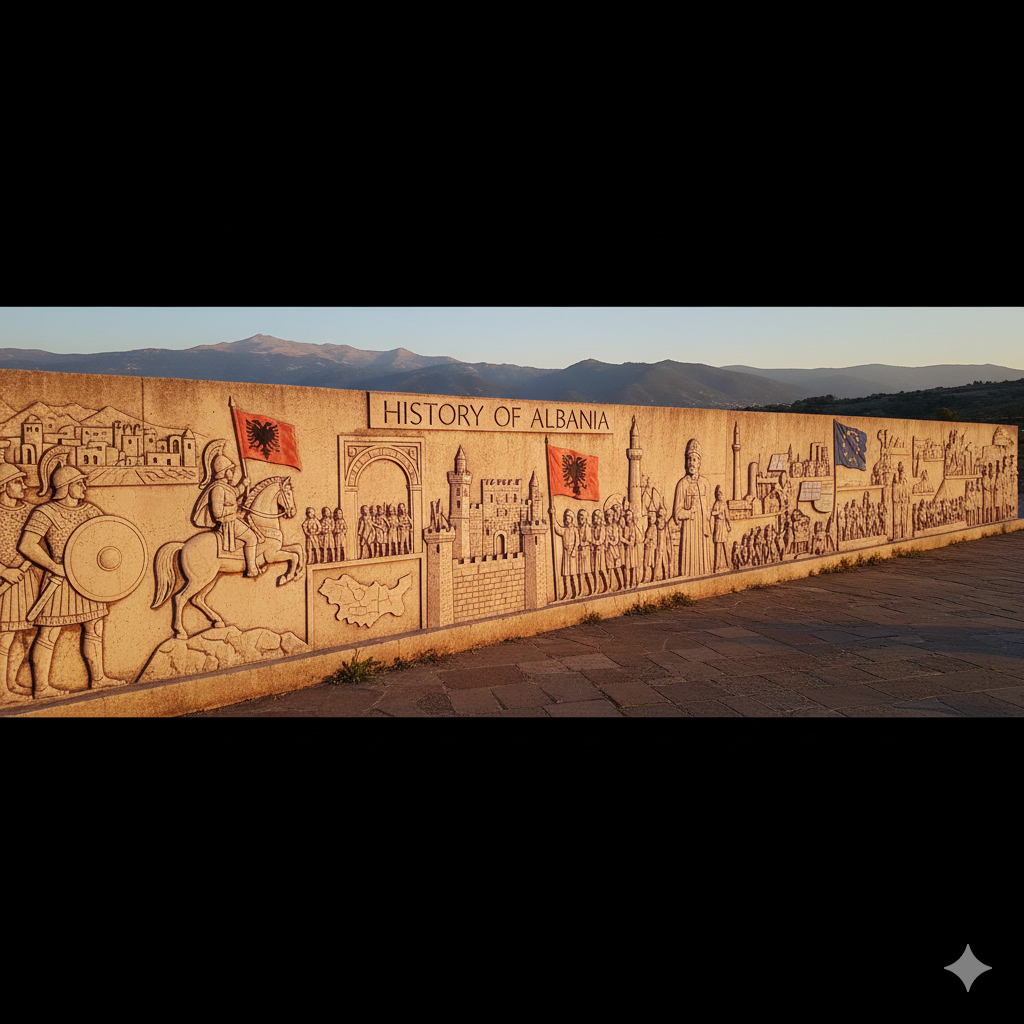
The History of Albania is a chronicle of enduring resilience, cultural continuity, and persistent struggle against foreign domination. Situated strategically on the western edge of the Balkan Peninsula, Albania—or Shqipëri (Land of the Eagles)—has been a geographical and cultural crossroads, a fate that subjected its people to the successive rules of empires and kingdoms: Roman, Byzantine, Slav, Venetian, Ottoman, and Italian. Despite this relentless external pressure, the Albanian people have maintained a distinct linguistic, cultural, and national identity, a continuity arguably traceable to their ancient forebears, the Illyrians.
I. Antiquity and the Illyrian Roots (c. 2000 BC – 395 AD)
The earliest documented inhabitants of the territory corresponding to modern Albania were the Illyrians. While the exact linguistic connection remains a subject of academic debate, the prevailing theory posits that the Albanians are the direct descendants of the Illyrians, a group of Indo-European tribes who settled the western Balkans. This deep historical link forms a cornerstone of modern Albanian national identity.
The Illyrians and Their Kingdoms
The Illyrian tribes, known to Greek and Roman writers for their martial prowess, were not a monolithic entity but a collection of distinct groups like the Taulantians, Ardiaei, and Labeates. They mastered metalworking early on, developing Bronze Age and then Iron Age cultures, with fortified settlements known as oppida on high ground.
The 3rd century BC saw the rise of significant Illyrian kingdoms, spurred by unification efforts in response to Greek and Macedonian expansion. Key figures include:
-
- King Bardyllis (4th century BC), who challenged the rising power of Macedon.
-
- King Agron and his wife, Queen Teuta (3rd century BC), who established a powerful maritime state centered around Lake Shkodra (Scodra) and extended influence over the Adriatic coast. Their naval strength led to conflicts with the rising Roman Republic.
Roman Conquest and Integration
The inevitable clash between Illyrian naval power and Roman expansion resulted in the Illyrian Wars (229–168 BC). The Romans, determined to secure their trade routes across the Adriatic, eventually defeated the last Illyrian king, Gentius, in 168 BC, effectively annexing the territory
Under Roman rule, the land that would become Albania was divided between the provinces of Dalmatia, Macedonia, and Moesia Superior. The Romans built crucial infrastructure, including the Via Egnatia, which connected the Adriatic port of Dyrrachium (Durrës) with Thessalonica and Byzantium (Constantinople), greatly enhancing the region’s strategic importance.
Roman rule brought a degree of prosperity and stability (the Pax Romana), but cultural assimilation was strongest in the coastal areas and along major trade routes. The Illyrian identity and language persisted robustly in the mountainous interior, providing the continuous substrate for the later emergence of the Albanian ethnos. Christianity was introduced during this era, becoming widely established in the coastal cities by the 4th century AD.
II. The Medieval Crucible (395 AD – 1443 AD)
The division of the Roman Empire in 395 AD placed the Albanian territories under the jurisdiction of the Eastern Roman (Byzantine) Empire. This marked the beginning of a complex medieval period defined by successive invasions, the slow emergence of a distinct Albanian identity, and the rise of local feudal lordships.
Byzantine Rule, Slavic Invasions, and the Emergence of Arbër
For the next millennium, the region remained nominally under Constantinople, though Byzantine control was often tenuous, particularly in the interior.
-
- Barbarian and Slavic Invasions (5th–7th centuries): The area suffered devastating raids by Visigoths, Huns, and Ostrogoths. More significantly, the Slavic migrations in the 6th and 7th centuries radically altered the demography of the Balkans. The original Illyrian/Roman populations were either pushed south or retreated into the heavily fortified, rugged highlands, which helped preserve their language and customs.
-
- Bulgarian and Serbian Influence: Parts of eastern Albania were incorporated into the First Bulgarian Empire in the 9th century. Later, in the 14th century, the expansion of the Serbian Empire under Stefan Dušan briefly brought much of Albania under Serbian control.
The Principality of Arbër and the Kingdom of Albania
The first definitive political entity of the Albanians in the Middle Ages was the Principality of Arbër (also known as Arbanon), which emerged toward the end of the 12th century, centered in north-central Albania.
-
- The Progon Dynasty (c. 1190): This principality, while often acknowledging Byzantine or Venetian suzerainty, was the first state governed by a succession of local, hereditary Albanian princes. It is here that the term Arbanitai (from which ‘Albanian’ is derived) is increasingly found in Byzantine records.
-
- The Angevin Kingdom of Albania (1272): Following the weakening of Byzantium after the Fourth Crusade (1204), various foreign powers—Venetians, Normans, and the Angevin kings of Naples—competed for control of the strategic coastal cities. Charles I of Anjou established the Kingdom of Albania in 1272, centered on Durrës (Dyrrachium), marking a period of Western (Catholic) influence that further fractured the region’s religious and political landscape, which already included a split between Catholicism in the North and Orthodoxy in the South.
The Feudal Lordships and the Ottoman Advance
By the 14th century, as the Serbian Empire collapsed after the death of Stefan Dušan (1355) and the Byzantine Empire faded, Albania fragmented into numerous independent feudal principalities: the Thopia, Balsha, Muzaka, and Kastrioti families. This fragmentation left the Albanian lands highly vulnerable to the looming new power from the East: the Ottoman Turks.
The first major Ottoman victory in the Balkans came at the Battle of Savra in 1385. By the early 15th century, the Ottomans had established a firm presence in central and southern Albania, demanding tribute and military service from the local lords.
III. The Scanderbeg Era and the Ottoman Yoke (1443 AD – 1912 AD)
The long period of Ottoman rule was decisively interrupted by the figure who would become Albania’s most revered national hero and symbol of resistance: Gjergj Kastrioti, known as Skanderbeg (from the Ottoman İskender Bey, or “Lord Alexander”).
Skanderbeg and the League of Lezhë (1443–1468)
Born around 1405 into the noble Kastrioti family, Gjergj was taken as a hostage to the Ottoman court in his youth, converted to Islam, and rose through the ranks of the Sultan’s army, earning the name Skanderbeg.
-
- The Revolt (1443): Following the Ottoman defeat at the Battle of Niš, Skanderbeg deserted the Ottoman army, returned to Albania, and, converting back to Christianity, captured the fortress of Krujë.
-
- The League of Lezhë (1444): Recognizing the need for unity, Skanderbeg successfully forged an alliance of Albanian princes and local chiefs known as the League of Lezhë (or Lezha). He was proclaimed Chief of the League and led a united military effort against the Ottoman armies for 25 years.
-
- The Defense of Europe: Skanderbeg’s small army, utilizing guerrilla tactics from the mountainous terrain, repeatedly routed massive Ottoman armies led by Sultans Murad II and Mehmed the Conqueror. His victories—which included the Sieges of Krujë—were pivotal in halting the Ottoman advance into Western Europe, earning him the title Athleta Christi (Champion of Christ) from the Papacy.
The Long Rule of the Ottoman Empire (1479–1912)
Skanderbeg died in 1468, and without his unifying leadership, the League quickly fractured. The Ottomans captured Krujë in 1478 and Shkodër in 1479, marking the consolidation of their rule over the entire Albanian-populated territory.
-
- Islamization and the Millet System: For over four centuries, Albania was an integral part of the Ottoman Empire. While Christian communities were initially tolerated under the Millet System, over time, a significant portion of the population, particularly the northern Ghegs and the military and administrative elites, gradually converted to Islam. This conversion was often motivated by socio-economic benefits, such as avoiding the jizya (poll tax on non-Muslims) and gaining access to higher-ranking administrative and military positions within the Ottoman system. Today, Albania stands as the only country in Europe with a Muslim-majority population whose national identity is not rooted in Islam.
-
- Rise of Albanian Pashas: In the 18th and early 19th centuries, as the central authority of the Sublime Porte weakened, semi-independent Albanian power centers emerged. The most famous were the Pashalik of Shkodra under the Bushati family in the North and the Pashalik of Yanina under Ali Pasha of Tepelenë in the South. These powerful local rulers challenged the Sultan’s centralizing reforms (Tanzimat), often ruling their territories with near-total autonomy and leveraging their Albanian troops to exert influence across the Balkans.
IV. The National Awakening (Rilindja Kombëtare) and Independence (1878–1912)
The 19th century was the era of the Albanian National Awakening (Rilindja Kombëtare), a period of intense cultural and political activity aimed at preserving Albanian identity and achieving political autonomy or independence. This movement was distinct from those of its Balkan neighbors (Greeks, Serbs, Bulgarians), which were often driven by a unified ecclesiastical structure. Albanian nationalism had to overcome profound challenges:
-
- Religious Fragmentation: The population was divided among Sunni Muslim, Bektashi Muslim, Orthodox Christian, and Roman Catholic faiths.
-
- Lack of a Unified Script: The Albanian language was written in several competing alphabets (Arabic, Greek, and Latin-based systems).
-
- Ottoman Loyalty: The Ottoman Empire often relied on the Muslim Albanian elite for administration and military service, making open rebellion more difficult.
The League of Prizren (1878)
The catalyst for the political phase of the Rilindja was the Russo-Turkish War (1877–1878) and the subsequent Congress of Berlin. The Great Powers’ decisions to carve up Ottoman territory threatened to distribute Albanian-populated lands among Serbia, Montenegro, and Greece.
-
- Formation: In response, Albanian leaders from all religious and tribal groups met in Kosovo and formed the League of Prizren (Lidhja e Prizrenit).
-
- Goals: Initially, the League’s primary goal was the defense of Albanian territories and the unification of all Albanian-populated Ottoman vilayets (provinces) into a single, autonomous province within the Ottoman Empire. The League successfully resisted the implementation of several border decisions, notably in the struggle against Montenegro over the region of Plav and Gusinje. Though ultimately suppressed by the Ottoman army in 1881, the League demonstrated the power of a unified national will and served as a foundational moment for the modern Albanian state.
Cultural and Linguistic Unification
Following the League’s suppression, the struggle shifted to the cultural front. The intellectual leaders (Rilindas) like Naim Frashëri, Sami Frashëri, and Gjergj Fishta emphasized:
-
- Language and Literature: Promoting the Albanian language (Gjuha Shqipe) and folklore as the basis of national unity, transcending religious divisions. The famous maxim became: “The religion of the Albanian is Albanism” (Feja e Shqiptarit është Shqiptaria).
-
- The Alphabet: The most crucial cultural victory was achieved at the Congress of Monastir (1908), where a unified, standardized Latin-based alphabet was adopted for the Albanian language.
Declaration of Independence (1912)
The final crisis for the Ottoman Empire arrived with the First Balkan War (1912), which saw the Balkan states (Serbia, Montenegro, Greece, and Bulgaria) launch a coordinated attack. With Serbian and Greek armies rapidly occupying Albanian-inhabited territories, the Albanian leaders realized that immediate independence was the only way to avoid partition.
On November 28, 1912, Ismail Qemali raised the Albanian flag in the city of Vlorë and declared the nation’s independence, establishing a provisional government.
V. A Troubled Sovereignty (1913–1944)
The nascent Albanian state was born into a hostile geopolitical environment, with its territory contested by its neighbors and its sovereignty dependent on the European Great Powers.
International Recognition and Border Disputes
The Conference of Ambassadors in London (1913) recognized the independence of the Principality of Albania but, under pressure from the neighboring powers, ceded nearly half of the Albanian-populated lands (including Kosovo and areas of Chameria) to Serbia, Montenegro, and Greece. This decision, driven by Great Power interests, laid the groundwork for future ethnic and geopolitical conflicts in the Balkans.
The Great Powers installed a German prince, Wilhelm of Wied, as the country’s first monarch in March 1914, but he fled just six months later amidst local revolts and the outbreak of World War I.
World War I and the Interwar Period
During World War I (1914–1918), Albania became a battleground, occupied successively by Greek, Serbian, Austro-Hungarian, Italian, and French forces. The end of the war brought renewed threats of partition, but Albanian delegates at the Paris Peace Conference successfully re-asserted their sovereignty, with the provisional government consolidating control by 1920.
The interwar period was dominated by the figure of Ahmet Zogu, a tribal leader who rose through a series of political maneuvers:
-
- The Republic (1925–1928): After seizing power in 1924, Zogu established the Albanian Republic with himself as President.
-
- The Monarchy (1928–1939): In 1928, Zogu declared himself King Zog I. His rule was characterized by a push for modernization, the establishment of a centralized state structure, and a reliance on foreign loans and influence, primarily from Fascist Italy. Zog’s government managed to introduce a constitution, build some infrastructure, and establish a national educational system, but his regime was authoritarian and economically weak.
Italian and German Occupation (1939–1944)
The inevitable culmination of Italian influence came on April 7, 1939, when Fascist Italy, led by Benito Mussolini, invaded and annexed Albania. King Zog fled, and the country was placed under an Italian puppet government.
During World War II, a strong, multi-faction resistance movement emerged:
-
- The National Liberation Movement (LNC): Communist-led, organized by Enver Hoxha.
-
- Balli Kombëtar (National Front): A non-Communist, nationalist, and often anti-monarchist group.
-
- Legality Movement: Monarchist faction supporting King Zog.
The LNC, with aid from Yugoslav partisans and eventually the Soviets, proved the most effective and ruthless. Following Italy’s surrender in 1943, German forces occupied Albania. By late 1944, as the Germans withdrew, the Communist-led LNC seized control of the country, having largely eliminated its nationalist rivals.
VI. The Communist Dictatorship (1944–1991)
The Communist era in Albania, led by the iron-fisted Enver Hoxha and the Party of Labor of Albania (PLA), was one of the longest and most repressive totalitarian regimes in European history.
The Stalinist State and Soviet Alliance (1944–1961)
-
- Establishment: In January 1946, the People’s Republic of Albania was formally declared. Hoxha quickly established a Stalinist-style state, eliminating all political opposition, nationalizing all industries, enforcing sweeping land reforms, and implementing a centrally planned economy.
-
- The Yugoslav Rift (1948): Initially a close ally of Yugoslavia under Tito, Albania became suspicious of Tito’s ambitions to dominate or annex Albania. When Yugoslavia was expelled from the Cominform in 1948, Hoxha eagerly sided with Stalin and the Soviet Union, purging all pro-Yugoslav elements.
-
- Rapid Industrialization and Social Change: The regime aggressively pursued industrialization, often at the expense of quality of life and agriculture. It also enforced mandatory primary education, greatly increasing literacy rates, and dramatically improved basic public health. However, these changes were achieved through brutal political repression carried out by the secret police, the Sigurimi.
Sino-Albanian Isolation (1961–1978) in the History of Albania
Following Stalin’s death, the Soviet Union under Nikita Khrushchev began a policy of de-Stalinization. Hoxha, a committed Stalinist, saw this as an ideological betrayal and broke with the USSR in 1961.
-
- The Chinese Alliance: Albania found a new ally in the People’s Republic of China under Mao Zedong, viewing Beijing as the last true bastion of anti-revisionist Marxism-Leninism. China provided Albania with significant economic and military aid.
-
- Cultural and Ideological Revolution: Albania underwent its own version of the Chinese Cultural Revolution in the late 1960s. Hoxha launched a ferocious campaign against bureaucracy, intellect, and religion. In 1967, Albania was famously declared the world’s first atheist state, with all mosques, churches, and religious institutions closed, destroyed, or converted to other uses. Religious practice became a crime punishable by imprisonment or death.
Total Isolation and Bunkerization (1978–1991)
The final break with its last major ally came in 1978 when Albania denounced China for engaging with the United States following the death of Mao Zedong. This left Albania in a state of total isolation from both the Western and Soviet blocs.
-
- Self-Reliance and Paranoia: Hoxha pursued a policy of complete “self-reliance,” which crippled the already weak economy. Driven by a pervasive fear of foreign invasion (by the US, NATO, the Soviet Union, or Yugoslavia), the regime diverted massive state resources into a paranoid defense program, resulting in the construction of over 750,000 concrete bunkers across the country, a physical legacy that defines the era.
-
- Hoxha’s Death and the Slow Thaw: Enver Hoxha died in 1985. His successor, Ramiz Alia, attempted a gradual, tightly controlled “thaw,” allowing some diplomatic contact with the outside world. However, the regime remained fundamentally resistant to the wave of democratic change sweeping Eastern Europe in 1989.
VII. Post-Communist Transition and the Road to Integration (1991–Present)
The collapse of communism came late to Albania, but when it did, the transition was abrupt and chaotic.
The Fall of the Regime (1990–1992)
-
- Student Protests: Inspired by events across the continent, massive student and intellectual protests erupted in Tirana in December 1990.
-
- Multi-Party System: Under intense pressure, Ramiz Alia legalized the formation of opposition parties, ending the PLA’s political monopoly. The Democratic Party (DP), led by cardiologist Sali Berisha, quickly emerged as the main opposition.
-
- The 1992 Elections: Following a tumultuous period of strikes, instability, and a massive exodus of Albanians (particularly by sea to Italy), the Democratic Party won a decisive victory in the 1992 parliamentary elections, marking the official end of the communist state. Sali Berisha became the first democratically elected President.
The Years of Chaos and Crisis (1992–2000)
The transition to a market economy proved extraordinarily difficult, hampered by a lack of democratic tradition, institutional weakness, endemic corruption, and a devastating financial collapse.
-
- The Pyramid Schemes Crisis (1997): Hundreds of thousands of Albanians invested their life savings into fraudulent pyramid investment schemes promoted by state figures. When the schemes collapsed in late 1996 and early 1997, the resulting loss of capital triggered nationwide despair and outrage.
-
- The 1997 Anarchy: The government’s inability to manage the crisis led to massive, violent protests. As security forces and the army disintegrated, weapons depots were looted, and the country descended into near-total anarchy. An international force had to be deployed to restore order, leading to the collapse of the Berisha government and new elections won by the Socialist Party (SP).
Democratic Consolidation and Euro-Atlantic Integration (2000–Present)
Since the turn of the millennium, Albania has achieved a degree of political stabilization and has committed to a policy of Euro-Atlantic Integration.
-
- Economic Reform: The economy has stabilized, transitioning to a market-based system and experiencing steady growth, largely driven by service industries, tourism, and significant remittances from the large Albanian diaspora.
-
- NATO Membership: A major foreign policy goal was realized when Albania officially joined the North Atlantic Treaty Organization (NATO) on April 1, 2009.
-
- European Union Aspirations: Albania was granted Candidate Status for accession to the European Union (EU) in 2014. The reform process, particularly judicial reform and the fight against organized crime and corruption, remains the primary focus of the political landscape under the Socialist Party, led by Prime Minister Edi Rama.
-
- The Kosovo Factor: Albania remains a steadfast advocate for the self-determination and recognition of Kosovo, the majority-Albanian territory whose independence was declared in 2008 following the Kosovo War (1998–1999). The relationship between Albania and Kosovo is crucial, defining much of Albania’s regional policy.
Conclusion
The History of Albania, is a compelling narrative of survival. From the ancient Illyrian tribes who resisted Rome to the medieval princes who fought the Ottoman Empire, and finally, to the communist leaders who sealed the country off from the world, the overriding theme is one of struggle for sovereignty and self-determination. The figure of Skanderbeg provides the eternal rallying point, symbolizing the heroic defense of national freedom.
Today, Albania is a parliamentary republic actively engaged in state-building and democratic consolidation, grappling with the complex legacy of its totalitarian past and the challenges of the present. As a NATO member and an EU candidate country, its trajectory is firmly directed toward integration with the West, seeking to finally anchor itself within the European political, economic, and security architecture after centuries spent on the periphery, or under the yoke, of foreign powers. The “Land of the Eagles” continues its long, arduous flight towards a stable and prosperous future.
Visit : www.dkbtech.com and allcircular.com