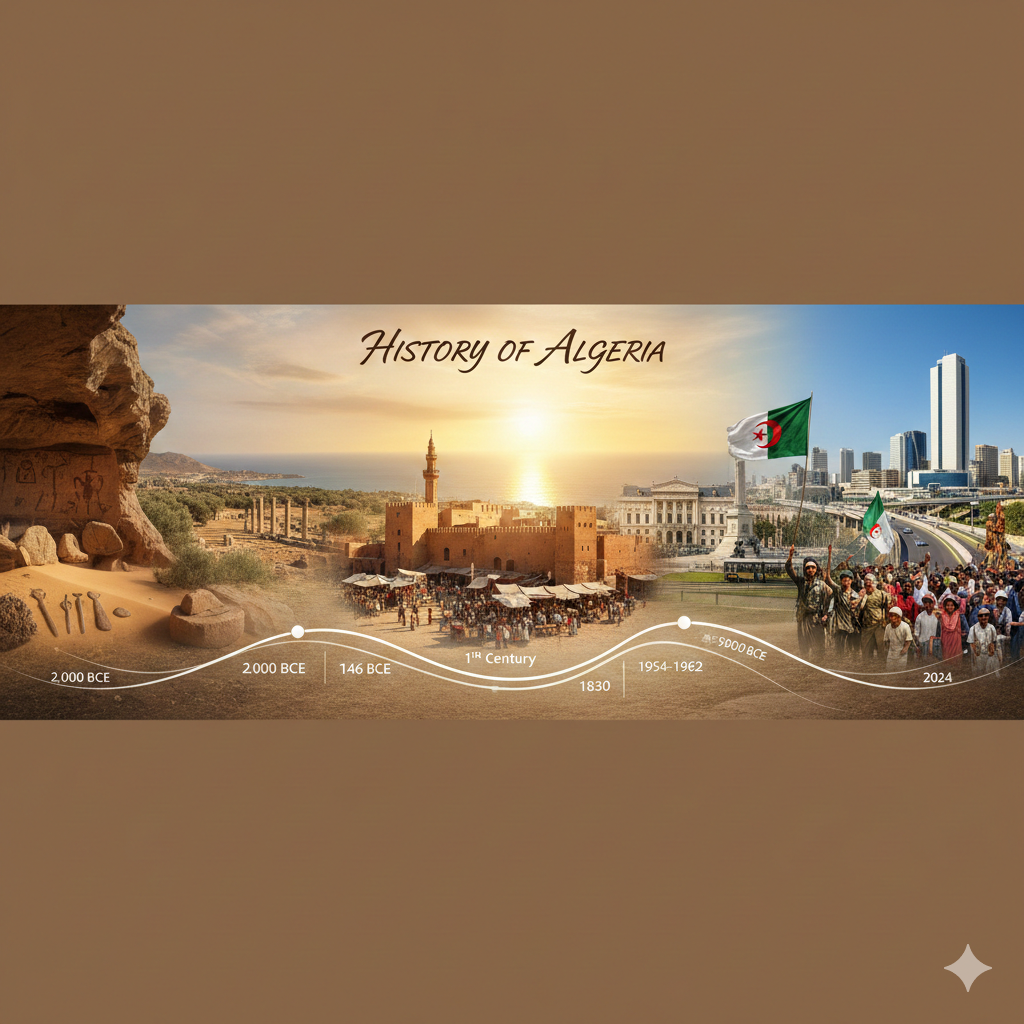
The History of Algeria is a rich tapestry, spanning millennia from prehistoric settlements to its eventual emergence as a modern nation-state. It is a story marked by indigenous resilience, the ebb and flow of great empires, cultural fusion, and a brutal struggle for independence. The land that is now Algeria has been a strategic and cultural crossroads, influenced by Phoenicians, Romans, Vandals, Byzantines, various Arab and Berber dynasties, the Ottoman Empire, and finally, French colonialism.
1. Prehistoric & Ancient Eras (Pre-2000 BCE to 7th Century CE)
A. Prehistory and the Indigenous Berbers (Amazigh)
The territory of modern Algeria has been continuously inhabited for over two million years.
-
- Early Inhabitants: Evidence of human activity, including Acheulean tools, is abundant. Neolithic art, particularly the Tassili n’Ajjer rock paintings, provides stunning documentation of climate change and the lives of prehistoric communities (c. 10,000 to 2,000 BCE), showing pastoralism, hunting, and vibrant cultural life.
-
- The Berbers (Amazigh): By the end of the second millennium BCE, the dominant cultural group were the Berbers (who call themselves Amazigh or “free people”). They are the original inhabitants of North Africa, developing into various tribes and confederations.
B. Phoenicians, Carthage, and Roman Rule
-
- Phoenician Influence (c. 12th Century BCE): The Phoenicians, primarily from Tyre, established coastal trading posts, eventually leading to the rise of Carthage (in modern Tunisia). These ports, such as Hippo Regius (Annaba) and Iol (Cherchell), facilitated trade and introduced writing and advanced metallurgy to the region.
-
- The Rise of Numidia (c. 3rd Century BCE): With the decline of Carthaginian power, the independent Berber kingdoms emerged, most notably Numidia. The most famous Numidian king was Massinissa (238–148 BCE), who unified the eastern and western tribes and established a capital at Cirta (Constantine). He allied with Rome against Carthage, fostering a sophisticated Berber state.
-
- Roman Province (146 BCE onwards): After the final defeat of Carthage, Rome gradually incorporated the region, creating the province of Mauretania Caesariensis (roughly central and western Algeria) and Numidia. Roman rule brought extensive urbanization, the construction of roads, and the establishment of major cities like Timgad and Djemila. Agriculture flourished (especially grain), making the region a key “breadbasket” of the Roman Empire.
-
- Christianity and Dissent: Christianity took root quickly. North Africa was the home of pivotal figures like St. Augustine (born in Thagaste/Souk Ahras) and was the epicenter of the Donatist schism, a major movement of religious and social protest against Roman-influenced church leadership.
C. Vandal and Byzantine Interlude (5th – 7th Centuries CE)
Roman rule ended with the Vandal invasion in the 5th century CE. The Vandals were eventually defeated by the Byzantine Empire (the Eastern Roman Empire) in the 6th century, which briefly re-established control over the coastal regions, though the Berber mountain tribes remained largely autonomous.
2. Islamic and Dynastic Era (7th Century CE to 1516)
A. The Arab Conquest and Islamization
-
- The Arrival of Islam (7th-8th Centuries): Beginning in the mid-7th century, Arab armies swept across North Africa (the Maghreb). The process was not swift, meeting fierce resistance, notably from the Berber queen Kahina of the Jerawa tribe.
-
- Cultural and Religious Transformation: By the early 8th century, the region was integrated into the Umayyad Caliphate. The Berbers rapidly adopted Islam, and many joined the conquering armies, playing a crucial role in the subsequent Islamic conquest of Spain. The Berbers adapted Islam to local traditions, notably embracing the heterodox Kharijite doctrine, which inspired several independent, early Berber states.
B. The Medieval Berber Dynasties
Algeria (known as the Central Maghreb) was ruled by a succession of powerful, independent Berber empires:
-
- The Rustamids (777-909): The first major independent Islamic state in the region, established by Kharijite Berbers, with its capital at Tihert (modern Tiaret). It was known for its piety and as a center of trans-Saharan trade.
-
- The Fatimids (909-1171): A powerful Shi’ite dynasty founded by the Kutuma Berbers. Though their center shifted to Egypt, they dominated the Central Maghreb, laying the groundwork for a vast empire.
-
- The Zirids and Hammadids (10th-12th Centuries): Berber dynasties that ruled the Central Maghreb as Fatimid viceroys before achieving independence. The Hammadids, with their capital at Qal’at Bani Hammad (a UNESCO World Heritage site), oversaw a cultural flowering.
-
- The Almoravids and Almohads (11th-13th Centuries): These empires, originating from the Western Maghreb, temporarily unified most of North Africa and Islamic Spain into a single, massive state. They promoted a more puritanical form of Islam and left a profound architectural and intellectual legacy.
-
- The Zayyanids/Kingdom of Tlemcen (1236-1554): After the collapse of the Almohad Empire, the Zayyanid dynasty established the independent Kingdom of Tlemcen in western Algeria. It became a significant regional power, prospering from trans-Saharan trade and maintaining cultural and intellectual life, though it faced constant pressure from the Marinid Sultanate of Morocco and internal conflicts.
3. The Ottoman Regency (1516-1830)
A. The Spanish Threat and the Ottoman Alliance
-
- The Reconquista and European Expansion: Following the Christian reconquest of Spain, the Spanish crown launched a series of invasions and established garrisons (presidios) along the North African coast in the early 16th century, including at Oran and Algiers, threatening the independence of the Zayyanid kingdom.
-
- The Rise of the Barbary Corsairs: Local rulers and populations appealed for Ottoman protection. The famous privateer (or “corsair”) brothers, Aruj and Khayr al-Din (Barbarossa), originally from Lesbos, arrived. They successfully drove the Spanish out of Algiers in 1516.
-
- Formal Ottoman Integration: Khayr al-Din placed the territory under the nominal sovereignty of the Ottoman Sultan, becoming the first Beylerbey (Governor-General). This established the Regency of Algiers (or Eyalet-i Cezayir).
B. Governance and Economy of the Regency
-
- The Deys and the Diwan: After the 17th century, the political structure stabilized under an elected ruler known as the Dey, who ruled with a council (Diwan) of high officials and the Ottoman Turkish military (the Ocak). While nominally an Ottoman province, the Regency was practically autonomous, managing its own foreign policy, economy, and military.
-
- The Corsair Economy: The state’s primary economic engine was corsair activity (privateering or ‘piracy’), which targeted Christian European ships. This generated immense wealth through ransoms and tributes, funding the military and state. This practice led to the Barbary Wars with the newly formed United States in the early 19th century.
-
- Cultural Hub: Algiers became a cosmopolitan port city, home to Turks, Berbers, Arabs, Andalusian refugees (Moriscos), and European captives. It was a major center for trade and scholarship.
C. The Decline of the Regency
In the late 18th and early 19th centuries, the Dey’s authority weakened, and the treasury depleted as European powers began to suppress corsair activity. The rising French interest in the Maghreb set the stage for a new and defining chapter.
4. French Colonial Rule (1830-1962)
A. The Conquest and Pacification
-
- The Casus Belli: The French invasion was precipitated by the “fly-whisk incident” of 1827, where the Dey of Algiers struck the French consul during a dispute over a long-standing debt. France used this as a pretext, and an army landed near Algiers in June 1830.
-
- The Long Conquest: The French captured Algiers quickly, but the conquest of the interior was a brutal process that lasted over 40 years.
-
- Emir Abdelkader (1832-1847): The most significant resistance leader was Emir Abdelkader, who unified tribes in western Algeria, established a state, and successfully fought the French for over fifteen years before his eventual surrender.
-
- The Policy of Assimilation and Expropriation: French policy was one of settlement and assimilation. By the 1870s, Algeria was legally declared a part of France, administered as three French départements (provinces).
-
- The Long Conquest: The French captured Algiers quickly, but the conquest of the interior was a brutal process that lasted over 40 years.
B. The Pied-Noirs and the Indigenous Algerians
-
- European Settlement (Pieds-Noirs): Hundreds of thousands of Europeans—French, Spanish, Italian, and Maltese—settled in Algeria, becoming known as Pieds-Noirs (“Black Feet”). They seized the best agricultural land, especially after the disastrous sénatus-consulte law of 1863, which restructured tribal land ownership to facilitate appropriation.
-
- Colonial Society: A stark racial and legal divide was established:
-
- European Colonists: Enjoyed full French citizenship and economic privilege.
-
- Indigenous Muslims (The Indigénat): Were governed by the Code de l’Indigénat (Indigenous Code), which stripped them of French legal rights, subjected them to arbitrary justice, denied them political representation, and restricted their education and economic opportunities.
-
- Colonial Society: A stark racial and legal divide was established:
C. The Road to Revolution (1920s-1954)
By the 20th century, various nationalist currents emerged in response to colonial oppression:
-
- The Ulama (Reformist Islam): Led by figures like Abdelhamid Ben Badis, who advocated for a distinct Algerian Islamic and Arab identity, encapsulated in the motto: “Islam is my religion; Arabic is my language; Algeria is my fatherland.”
-
- The Évolués (Integrationists): Educated Algerians who sought full equality and integration into the French system, though they often faced rejection by the colonial administration. Ferhat Abbas was a prominent figure in this moderate political wing.
-
- The Radicals/PPA (The Revolutionary Movement): Led by Messali Hadj, this movement openly demanded complete independence for an Algerian nation.
5. History of Algeria the War of Independence (1954-1962)
A. The Spark and the Early Years
-
- Founding of the FLN: In 1954, a group of young, radical nationalists, dissatisfied with the slow pace of political reform, founded the Front de Libération Nationale (FLN) and its armed wing, the Armée de Libération Nationale (ALN).
-
- November 1, 1954: The FLN launched a coordinated series of attacks across Algeria, marking the official start of the Algerian War of Independence (Guerre d’Algérie).
-
- The Brutality of the Conflict: The war was characterized by extreme violence on all sides:
-
- FLN Tactics: Included guerrilla warfare, urban terrorism, and the targeting of both French forces and indigenous “collaborators.”
-
- French Tactics: Involved massive troop deployment, counter-insurgency operations, forced displacement (regroupment camps), systematic use of torture (notably during the Battle of Algiers in 1957), and widespread extrajudicial killings.
-
- The Brutality of the Conflict: The war was characterized by extreme violence on all sides:
B. The Crisis of the French Republic
The war became a profound political crisis for France:
-
- The 1958 Crisis: The French military and Pieds-Noirs in Algiers staged a coup in May 1958, leading to the collapse of the Fourth French Republic and the return of General Charles de Gaulle to power.
-
- De Gaulle’s Shift: While initially promising to keep Algeria French, De Gaulle slowly realized the war was unwinnable. In 1959, he spoke of “self-determination,” causing a major rift with the French military and the Pied-Noirs.
-
- The OAS and the Final Push: In response, extremist Pied-Noir and French army elements formed the Organisation de l’Armée Secrète (OAS), which launched a campaign of bombings and assassinations in France and Algeria against French officials and the FLN.
C. History of Algeria Independence
-
- The Évian Accords (March 1962): Negotiations between the French government and the FLN led to a ceasefire and the signing of the Évian Accords.
-
- Referendum and Declaration: A national referendum in Algeria in July 1962 resulted in a near-unanimous vote for independence. July 5, 1962, is the official date of independence.
-
- The Exodus: The vast majority of Pieds-Noirs (about one million people) and pro-French Muslim Algerians (Harkis) fled to France in a mass, chaotic exodus. Hundreds of thousands of Harkis who remained were massacred in retribution.
6. Independent Nation (1962-Present)
A. The One-Party Socialist State (1962-1988)
-
- Ben Bella and the Single Party: Following a brief power struggle, Ahmed Ben Bella became the first president, establishing a socialist, single-party state under the FLN. The economy was based on nationalization of major industries (especially the oil and gas sector), and an anti-Western, non-aligned foreign policy.
-
- The Boumediene Era (1965-1978): Houari Boumediene overthrew Ben Bella in a bloodless coup. His rule was characterized by greater stability, increased state control over the economy, investment in heavy industry, and a strong, centralized military government. Algeria became a leading voice in the Non-Aligned Movement and a major proponent of a New International Economic Order.
B. In the History of Algeria the “Black Decade” and Political Transition (1988-2000)
-
- Economic Crisis and Riots: A sharp drop in oil prices in the mid-1980s exposed the flaws in the state-controlled economy. Public discontent over poverty and lack of political freedom led to massive riots in Algiers in October 1988.
-
- Democratic Experiment: President Chadli Bendjedid responded by introducing a new constitution that permitted multi-party politics. This led to the rapid rise of the Islamic Salvation Front (FIS).
-
- The Civil War: The FIS won a sweeping victory in the first round of parliamentary elections in December 1991. Fearing an Islamic state, the military intervened in January 1992, cancelled the elections, and forced Bendjedid to resign. This military intervention plunged Algeria into a brutal civil war (known as the Black Decade or La Décennie Noire) between the state and various armed Islamist groups, such as the GIA (Armed Islamic Group). The conflict resulted in an estimated 150,000 to 200,000 deaths.
C. The Bouteflika Era and the Hirak (1999-2019)
-
- Bouteflika’s Presidency: Abdelaziz Bouteflika was elected President in 1999. He successfully brought the civil war to an end through a policy of “national reconciliation,” granting amnesty to most combatants. The rising price of oil provided the government with vast revenue, stabilizing the economy.
-
- Stagnation and Corruption: Despite the end of the civil war, Bouteflika’s rule became characterized by political stagnation, increasing corruption, and an aging political elite.
-
- The Hirak Movement: In February 2019, Bouteflika announced his intention to seek a fifth presidential term, sparking massive, sustained, and largely peaceful protests known as the Hirak (“The Movement”). The pressure from the protests, supported by the military, forced Bouteflika to resign in April 2019.
D. Contemporary Algeria (2019-Present)
Since 2019, Algeria has been undergoing a slow political transition. The Hirak continues to push for fundamental political reform, an end to military interference in civilian life, and the eradication of systemic corruption. The country faces the ongoing challenge of diversifying its economy away from its dependence on hydrocarbons and addressing the demands of its large, young population.
Visit : dkbtech.com and allcircular.com