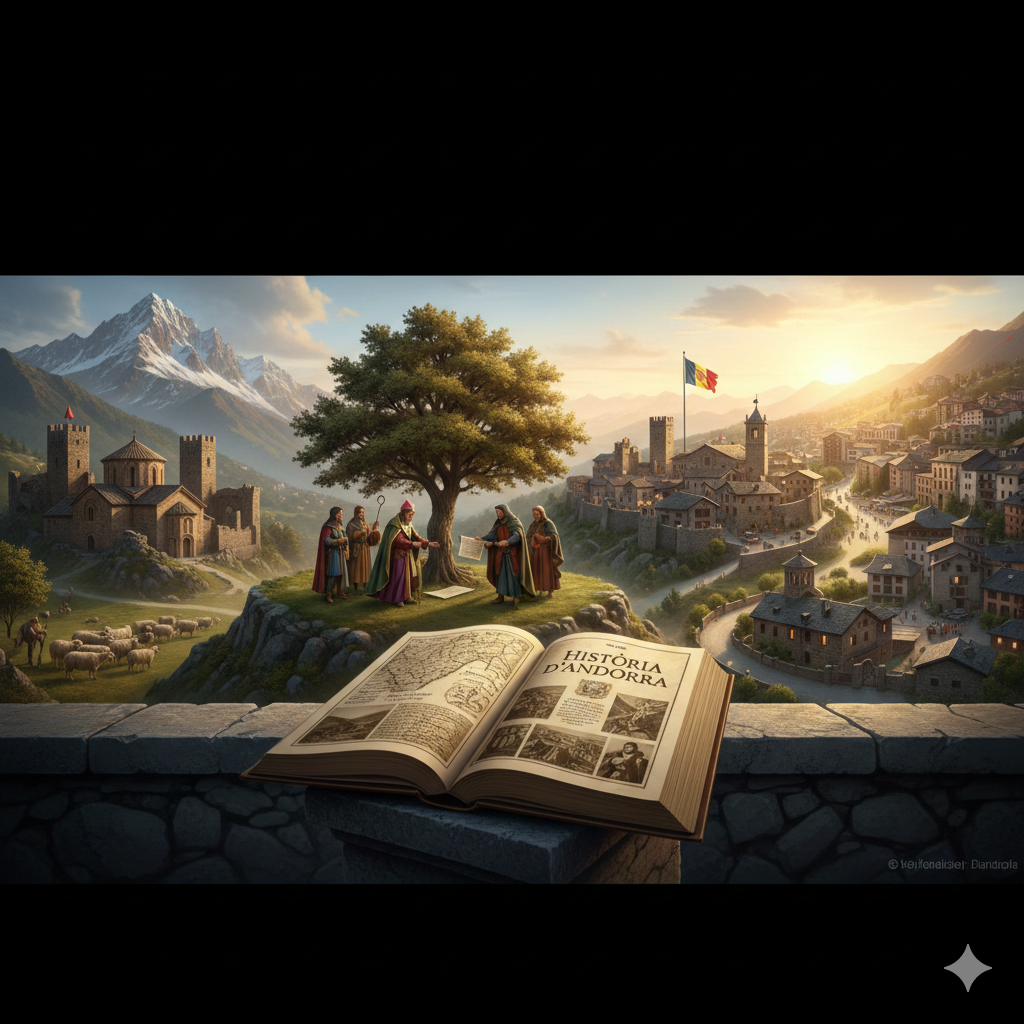
The history of the Principality of Andorra is a remarkable narrative of survival, isolation, and political evolution, spanning over a millennium. Nestled high in the eastern Pyrenees between France and Spain, this small, landlocked nation has preserved its unique feudal governing system—the co-principality—from the Middle Ages right up to its full emergence as a modern, sovereign parliamentary democracy in 1993. The story of Andorra is one of a remote mountain community resisting absorption by its giant neighbours, transitioning from a poverty-stricken agrarian society to one of the world’s most prosperous nations through commerce, tourism, and finance.
 I. Prehistory and Roman Influence
The valleys that constitute modern Andorra have been inhabited since ancient times, though their secluded location delayed significant settlement compared to the surrounding plains.
The Andosins and Early Tribes
Archaeological evidence, particularly at sites like La Balma de la Margineda in Sant Julià de Lòria, indicates human presence dating back to the Mesolithic and Neolithic periods (around 9,500 BCE), initially as seasonal hunter-gatherer camps, and later as more permanent farming settlements.
The first documented reference to the inhabitants of the region comes from the Greek historian Polybius in the 2nd century BCE. During his accounts of the Second Punic War (c. 218 BCE), Polybius mentions the Iberian tribe known as the Andosins (Andosini), who occupied the valleys and engaged in conflict with the Carthaginian army led by Hannibal as he crossed the Pyrenees. This early record confirms the existence of a distinct tribal identity in the area long before the medieval foundation.
Romanization and Visigothic Rule
The Roman Empire’s influence began to spread across the Iberian Peninsula from the 2nd century BCE, encompassing the Andorran valleys. Though never a major Roman province, the territory lay along strategic trade routes and experienced cultural and legal Romanization. The impact is still visible today, as the official language, Catalan, is a direct descendant of Vulgar Latin, and place names like Escaldes (from calidae – hot springs) suggest Roman presence. Andorra was part of the Roman province of Aquitania (and later Tarraconensis).
Following the collapse of the Western Roman Empire, the valleys fell under the sway of the Visigothic Kingdom (5th to 8th centuries). Andorra’s later legal and administrative documents, such as the Manual Digest, credit Visigothic monarchs with granting certain early charters or customary laws (Usos i Costums) to the valleys.
 II. The Medieval Birth of the Co-Principality (8th–13th Centuries)
The definitive political and territorial framework of Andorra was forged in the turbulence of the early Middle Ages, within the frontier region known as the Marca Hispanica.
Charlemagne and the Carolingian Legend
Andorran tradition often attributes the nation’s foundation to Charlemagne, the Frankish King, around 788 AD. The legend claims that Charlemagne granted the Andorran people a charter and protection in gratitude for their assistance in fighting the Islamic Moors (Saracens) during his campaign in the Iberian Peninsula. While the historical veracity of a direct charter from Charlemagne is dubious, the tale powerfully anchors Andorra’s identity to the Carolingian epoch and its role as a Christian buffer state.
A more concrete historical moment is the conquest of Barcelona in 801 by Charlemagne’s son, Louis the Pious, who established the Marca Hispanica—a military buffer zone composed of various counties between the Pyrenees and the Islamic-controlled Al-Andalus. Andorra lay in the heart of this zone.
Feudal Transition and the Bishop of Urgell
In the 9th century, the authority over the Andorran valleys was transferred to the Count of Urgell. The first unequivocal document mentioning the parishes of Andorra is the Act of Consecration of the Cathedral of Santa Maria d’Urgell (c. 839 AD), which lists the Andorran parishes as fiefs of the Counts of Urgell.
A major transfer of power occurred in 988 AD when the Count of Urgell, Borrell II, ceded the Andorran valleys and other lands to the Diocese of Urgell, headed by the Bishop of Urgell, in exchange for properties in Cerdanya. From this point forward, the Bishop of Urgell, whose seat is in La Seu d’Urgell (modern-day Spain), became the primary feudal lord of Andorra.
The Conflict and the Pareage of 1278 By the 11th century, the Bishop of Urgell, fearing military aggression from neighboring nobles, placed himself under the protection of the Lord of Caboet. Through a complex web of marriages and inheritance, the rights of the Lords of Caboet eventually passed to the Counts of Foix (a powerful noble house in Occitania, France).
This development created a dual claim to sovereignty over Andorra: the religious authority of the Bishop of Urgell and the temporal/military authority of the Count of Foix. For decades, this dispute led to sporadic armed conflict over rights, taxes, and territory.
The conflict was finally resolved in 1278 with the signing of the First Pareage (Pariatge in Catalan; Pareage in French), an agreement signed by Bishop Pere d’Urtx and Count Roger-Bernard III of Foix. This treaty established the Co-principality—a unique form of shared feudal sovereignty that has defined Andorra’s political structure ever since. The Pareage stipulated that:
-
- Sovereignty would be shared equally between the two lords.
-
- The Andorrans would pay an annual tribute, the Quèstia, which alternated between the two co-princes.
-
- The co-princes would appoint their respective representatives (the Veguers) to administer justice and government.
This agreement guaranteed Andorra’s territorial integrity and political independence, as neither co-prince could claim exclusive control or allow the other to absorb it.
 III. From Feudalism to the Old Regime (14th–19th Centuries)
Having secured its border and legal status, the subsequent centuries were characterized by internal self-governance and enduring isolation.
The Birth of the Parliament
To manage the tribute to the co-princes and resolve local disputes, the Andorran people created their own representative body. In 1419, the Council of the Earth (Consell de la Terra) was established in Andorra la Vella. This body, the direct precursor to the modern General Council, is considered one of Europe’s oldest continuous parliaments.
The Council’s historical headquarters, the Casa de la Vall (House of the Valley), was purchased in 1702 and served as the parliament building until 2011. Its design, with a granite structure and defensive tower, symbolized the resilience and isolation of the Andorran government.
The Succession of the Co-Princes
The French line of the co-principality underwent a significant transition in the 16th century:
-
- The title of Count of Foix passed through inheritance to the Kings of Navarre.
-
- In 1589, Henry III of Navarre ascended to the French throne as King Henry IV of France.
-
- In 1607, Henry IV issued an edict formally transferring the co-prince title from the Count of Foix to the person of the King of France.
Following the French Revolution (1789), the French monarchy was abolished, and with it, the office of the co-prince. However, Napoleon Bonaparte, after initial attempts at annexation, restored the French co-prince title in 1806, recognizing Andorra as a living museum of feudalism that was useful as a neutral intermediary. The title was subsequently passed to the President of the French Republic, where it remains today.
The Spanish line has remained continuous with the Bishop of Urgell.
The Age of Isolation and Agrarian Life
From the 17th century through the 19th century, Andorra experienced a period of profound isolation and stagnation. Its economy was almost entirely based on subsistence agriculture (cereals, potatoes, tobacco) and livestock rearing (sheep, cattle). The lack of roads, harsh winters, and distance from major markets kept the population small and often impoverished.
-
- Manufacturing: The only significant industrial activity was the operation of small Catalan forges to smelt locally mined iron ore, such as the Rossell Forge (Farga Rossell).
-
- Smuggling: The difference in tax and customs duties between France and Spain, particularly for tobacco, made smuggling a traditional and necessary supplement to the meager agrarian economy.
The Reform of 1866
Social discontent over the lack of political rights for common citizens and the domination of the few aristocratic families (like the Rossell and Areny families) eventually led to political change. The key figure in this era was Guillem d’Areny-Plandolit, an influential entrepreneur and politician.
In 1866, he championed the New Reform (Nova Reforma), which was approved by the co-princes. This was Andorra’s first major constitutional change since the Pareage:
-
- It expanded the electoral franchise, though still heavily restricted, by creating the new General Council of 24 members.
-
- It granted the Council the power to elect a Síndic General (President of the Council) to serve as the chief executive.
-
- It aimed to provide greater political stability and reduce the power of the most aristocratic families.
Despite this reform, Andorra remained a poor, remote, and socially conservative nation well into the 20th century.
 IV. The Tumultuous 20th Century: Opening to the World
The 20th century brought rapid, irreversible changes that pulled Andorra out of its feudal slumber, driven primarily by infrastructure development and the two World Wars.
The Early 20th Century and External Interference
-
- World War I (1914–1918): Andorra is often cited as having technically declared war on Imperial Germany in 1914 but not having participated in the conflict, nor having been invited to the Versailles Peace Conference in 1919. This led to a historical anecdote that Andorra remained technically at war with Germany until a formal peace declaration in 1957.
-
- Infrastructure: The construction of the first proper road linking the country to the Spanish border (1913) and the French border (1933) began to dismantle the centuries of geographical isolation, opening the door for tourism and external trade.
-
- Electrification: The most profound economic catalyst was the 1934 construction of the F.H.A.S.A. (Forces Hidroelèctriques d’Andorra, S.A.) hydroelectric power plant at Lake Engolasters. This project required Spanish and French labour, capital, and engineering, bringing the first wave of foreign immigration and modern business practices.
The Boris Skossyreff Affair (1934)
This strange episode highlighted Andorra’s internal political fragility. Russian adventurer Boris Skossyreff traveled to Andorra, claiming to have a mandate from the French royal family (or sometimes the Bishop of Urgell) to modernize the state. He charmed local leaders, proposed himself as a sovereign monarch, King Boris I, and even issued a proclamation declaring a constitution, guaranteed rights, and a reformed tax regime.
His “reign” lasted only 12 days before he declared war on the Bishop of Urgell for refusing to accept his proposals. Spanish Civil Guard police, acting on behalf of the Bishop, quickly arrested him and expelled him from the country, restoring the co-principality’s feudal status quo.
The Spanish Civil War and World War II
Andorra’s neutrality during both major global conflicts proved beneficial, though challenging.
-
- Spanish Civil War (1936–1939): Due to the political instability in Spain and the anti-clerical violence against the Bishop of Urgell, France sent a detachment of Gendarmerie to Andorra in 1936 to maintain order and prevent encroachment by either the Republican or Francoist forces. The French detachment remained until 1940.
-
- World War II (1939–1945): Andorra remained officially neutral. Its mountain passes became a vital, though perilous, smuggling route for goods between France and Spain, and crucially, for the French Resistance to smuggle downed Allied airmen and refugees out of occupied France into neutral Spain.
The Economic Transformation (1950s–1980s)
The post-war era saw an economic boom unparalleled in Andorran history, effectively lifting the country from poverty to affluence. This transformation was driven by three main sectors:
-
- Tourism: The development of ski resorts (beginning with the first lift in 1957) and the country’s picturesque mountain scenery attracted millions of visitors annually.
-
- Retail and Commerce: Its status as a duty-free haven (low taxes and near-zero customs duties) made it a retail magnet for goods like tobacco, alcohol, electronics, and gasoline, attracting day-trippers from France and Spain.
-
- Financial Services: The creation of banks and a financial sector, initially benefiting from strict banking secrecy laws, established Andorra as an international commercial centre.
This rapid economic growth, however, brought severe social and political challenges:
-
- Immigration: The booming economy required labor, leading to massive immigration, primarily from Spain, Portugal, and France. By the 1980s, native Andorrans became a minority in their own country (a situation that continues today).
-
- Political Structure: The medieval, restricted political system was totally inadequate for managing a modern, complex, and internationalized economy.
 V. The Modern State: The Constitution of 1993
The imperative to formalize its international status and establish a clear separation of powers led Andorra down the path of a written constitution.
The Demand for Sovereignty
Throughout the 1980s, the need to adapt to European trends, engage in international trade, and shed the image of an anachronistic, feudal tax haven became undeniable. Andorra began to seek formal recognition of its sovereignty from its co-princes and the international community.
Key negotiations were held to transition from the power-sharing arrangement of the 1278 Pareage to a modern constitutional system where sovereignty was vested in the Andorran people (Poble Andorrà).
The Constitution of 1993
On March 14, 1993, the new Constitution of the Principality of Andorra was approved by popular referendum (74.2% support). It formally entered into force on April 28, 1993, marking the official end of the feudal political system and the birth of a fully sovereign, modern state.
The key features of the Constitution include:
-
- Sovereignty: Declares Andorra an independent, democratic, and social State of Law.
-
- The Co-Princes: Retained as the two Heads of State with limited, ceremonial powers. Their main residual powers are the right to appoint members of the High Council of Justice and the right to approve international treaties that affect internal security, defence, and territorial integrity (they do not have a veto over the government’s legislative acts).
-
- Executive Power: Vested in the Head of Government (Cap de Govern), elected by the General Council.
-
- Legislative Power: Vested in the General Council of the Valleys (Consell General), a unicameral parliament.
-
- Judicial Independence: A fully independent judicial branch was established.
-
- Human Rights: The Constitution enshrines a full array of fundamental rights and freedoms, including the abolition of the death penalty.
International Integration
The constitutional act immediately paved the way for Andorra’s integration into the international community, finally shaking off its status as a historical anomaly.
-
- United Nations (UN): Andorra joined the UN on July 28, 1993.
-
- Council of Europe: Andorra became a member in 1994.
-
- European Union (EU) Relations: While not a full member, Andorra joined the EU Customs Union in 1990, adopted the Euro as its national currency, and has worked to harmonize its legal and financial regulations with the EU.
 VI. Andorra in the 21st Century
The modern history of Andorra is dominated by its efforts to normalize its financial sector and secure its unique cultural identity.
The End of Banking Secrecy
Under increasing pressure from international bodies, particularly the Organisation for Economic Co-operation and Development (OECD) and the European Union, to combat tax evasion and money laundering, Andorra has moved away from its model as a classic tax haven.
-
- Financial Reforms: Since the late 2000s, Andorra has undertaken significant legislative and fiscal reforms, including signing agreements to exchange tax information.
-
- Taxation: The nation introduced its first corporate income tax (2012) and personal income tax (2015), fundamentally shifting its economic model towards international transparency and compliance.
Identity and Culture
Despite the demographic dominance of foreign residents, the country has vigorously asserted its Catalan identity. Catalan is affirmed as the sole official language of the state in the Constitution, and cultural institutions actively promote the distinct traditions, language, and Romanesque architectural heritage of the Principality.
From its ancient origins as the home of the Andosins to its singular feudal creation via the Pareage, and finally to its 1993 constitutional sovereignty, the history of Andorra is a testament to the endurance of a mountain people and the strategic value of their isolated home.
The History of Andorra, in its full context, offers a profound example of how small states can survive and thrive through geopolitical maneuvering and a stubborn dedication to a unique, self-governing identity.
Visit : www.dkbtech.com and www.allcircular.com