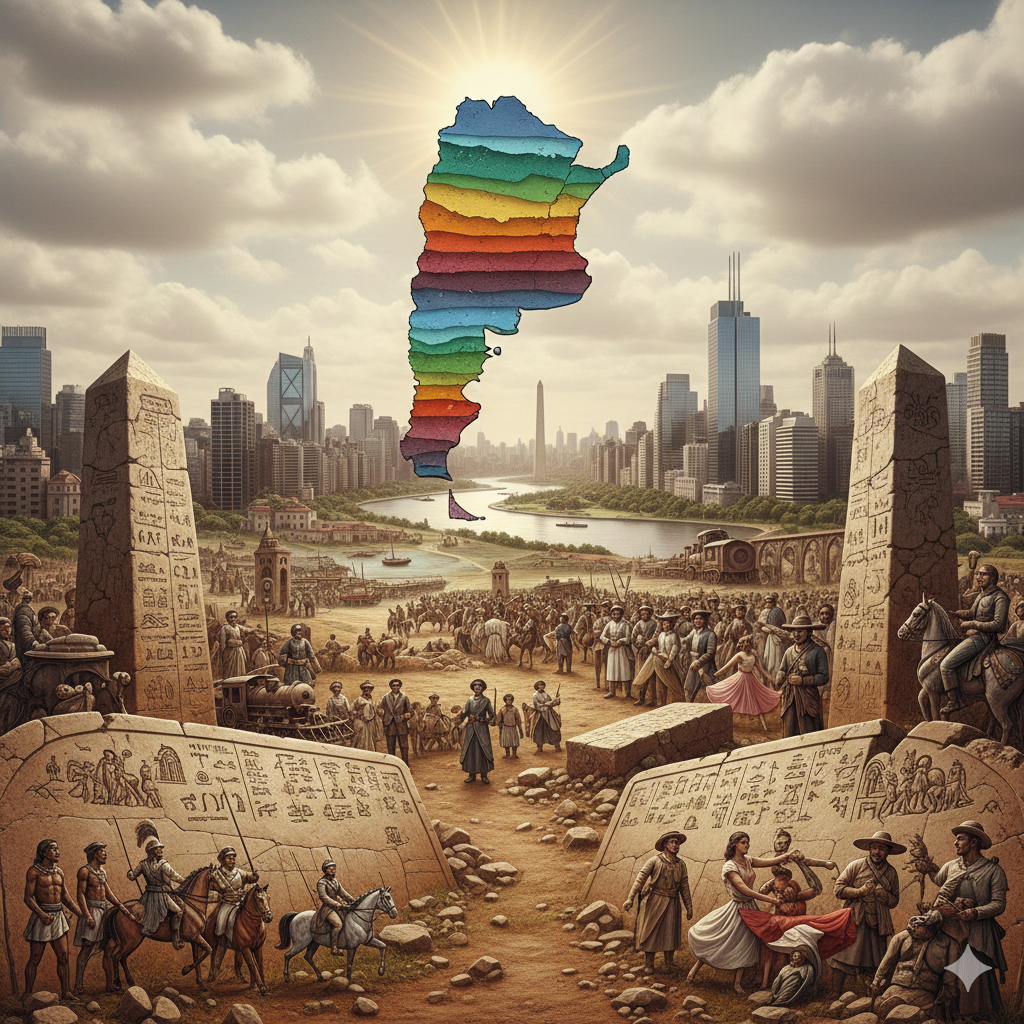
The History of Argentina is a complex and dramatic narrative of indigenous cultures, European conquest, a spirited fight for independence, protracted civil wars, massive immigration, economic booms and busts, and a recurring cycle of democracy and military intervention. From the vast, sparsely populated lands of the Viceroyalty of the Río de la Plata to the modern, often turbulent republic, Argentina’s journey is one of immense potential and political volatility.
I. The Pre-Columbian Era (c. 10,000 BCE – 16th Century)
Long before the arrival of Europeans, the territory that is now Argentina was home to diverse indigenous groups adapted to its varied geography, from the high Andes to the Pampas and Patagonia.
-
- Northwest Region: This area, connected culturally to the Andean civilizations, saw the most complex pre-Columbian societies. The Diaguita (or Calchaquí) people of the valleys had advanced agricultural practices, including terrace farming, and fiercely resisted Inca and, later, Spanish domination. The Inca Empire briefly extended its influence into the far northwest around the 15th century.
-
- Central and Northeast: The Comechingón and Sanavirón inhabited the area around Córdoba, living in semi-subterranean homes and practicing agriculture. The Guaraní people, primarily in the northeast (Misiones), were known for their slash-and-burn agriculture and sophisticated pottery.
-
- Pampas and Patagonia: The vast plains of the Pampas and the cold south were populated by nomadic hunter-gatherers, most notably the Mapuche (or Araucanians, who migrated from Chile) and the Tehuelche. Their survival depended on hunting guanaco and rhea, and their traditional lifestyle was transformed by the later introduction of the horse by the Spanish.
II. Spanish Colonial Rule (16th Century – 1810)
The Spanish exploration of the Argentine coast began in 1516 with Juan Díaz de Solís. However, the region initially held little appeal compared to the gold-rich territories of Peru and Mexico.
A. Initial Settlements and the Viceroyalty (1536 – 1776)
-
- Early Attempts: The first attempt to found a permanent settlement, Buenos Aires, in 1536 by Pedro de Mendoza, failed due to indigenous resistance and lack of resources.
-
- The Andean Route: Permanent colonization instead came from the north and west, led by settlers moving from Peru and Chile. Major cities like Santiago del Estero (1553), Tucumán (1565), and Córdoba (1573) were founded inland.
-
- Refoundation of Buenos Aires: Juan de Garay successfully re-established Buenos Aires in 1580. Initially, it was a minor port, often neglected by the Crown and dependent on contraband trade, as all official commerce had to pass through Lima.
-
- The Viceroyalty of the Río de la Plata (1776): As a result of Bourbon Reforms aimed at improving administration and defense (especially against British and Portuguese expansion), King Charles III elevated the region into the Viceroyalty of the Río de la Plata. This was a pivotal moment, as it designated Buenos Aires as the administrative capital of a vast, new entity encompassing modern Argentina, Uruguay, Paraguay, and Bolivia. This shift instantly transformed the small port city into an administrative, military, and commercial hub, laying the foundation for its future dominance.
B. Cracks in the System (1806 – 1810)
-
- The British Invasions (1806-1807): Two British attempts to seize Buenos Aires during the Napoleonic Wars were repelled not by the regular Spanish forces, but by hastily organized local militias composed of criollos (Spanish-descended people born in the Americas). The successful defense dramatically boosted criollo confidence and demonstrated the vulnerability of the Spanish administration, directly weakening the Viceroy’s authority.
-
- The Napoleonic Crisis (1808): Napoleon’s invasion of Spain and the dethronement of King Ferdinand VII created a political vacuum in the colonies. Local elites argued that sovereignty reverted to the people in the absence of a legitimate king, an argument used to justify self-governance.
III. The Path to Independence (1810 – 1829)
The desire for self-determination, fueled by Enlightenment ideas and the precedent of the American Revolution, culminated in a drawn-out struggle for independence.
A. The May Revolution and the Juntas (1810 – 1816)
-
- May Revolution (May 25, 1810): Following news of the final collapse of Spanish resistance in Spain, the criollo leaders in Buenos Aires overthrew the Viceroy and established the Primera Junta (First Governing Junta). While ostensibly governing in the name of the imprisoned King Ferdinand, the act was a clear move towards self-rule and is celebrated as Argentina’s Independence Day.
-
- Internal Conflicts: The Junta’s authority was immediately challenged by:
-
- Royalist Forces: Especially in Upper Peru (Bolivia) and Córdoba.
-
- Regionalism: Provinces (the Provincias Unidas del Río de la Plata) feared the centralizing power of Buenos Aires. Key figures like José Gervasio Artigas in the Banda Oriental (Uruguay) emerged, advocating for a federalist system.
-
- Internal Conflicts: The Junta’s authority was immediately challenged by:
B. The Declaration and Wars of Independence (1816 – 1824)
-
- The Congress of Tucumán (1816): With the Spanish King restored and attempting to reclaim the colonies, the leaders realized the need for a definitive break. On July 9, 1816, the Congress of Tucumán formally declared the independence of the United Provinces of South America.
-
- The Liberators: José de San Martín: The most critical figure in securing independence was General José de San Martín . Recognizing that the Spanish stronghold in Peru threatened the revolution, he planned a daring campaign. In 1817, his Army of the Andes crossed the treacherous mountains, defeated the Spanish in Chile (with the help of Bernardo O’Higgins), and then proceeded by sea to liberate Peru in 1821. His military prowess was decisive in the independence of not just Argentina, but the continent’s southern half.
C. Anarchy and the Rise of Caudillos (1820 – 1829)
The euphoria of independence quickly gave way to political chaos. Attempts to establish a centralized, monarchical, or unitary republic failed. The provinces splintered, leading to the “Anarchy of the Year XX” (1820). This era saw the rise of the caudillos—provincial strongmen, charismatic military leaders who commanded loyalty and governed their territories essentially as independent states (e.g., Facundo Quiroga in La Rioja).
IV. Nation-Building, Caudillos, and the Age of Rosas (1829 – 1862)
The middle decades of the 19th century were defined by a tense struggle between the Unitarians (centralized government from Buenos Aires) and the Federalists (provincial autonomy).
A. The Rule of Juan Manuel de Rosas (1829 – 1852)
-
- The Federalist Dictator: The most powerful caudillo to emerge was Juan Manuel de Rosas, a wealthy rancher and master politician. He governed the Buenos Aires province almost continuously from 1829 to 1852. While a Federalist, he concentrated immense personal power, imposing a unitary rule under the Federalist banner.
-
- Order and Terror: Rosas brought a semblance of stability and order after years of chaos. He was a champion of national sovereignty, successfully defending the nation against French and Anglo-French blockades. However, his regime was a totalitarian police state, employing the Mazorca (a secret police) to enforce political conformity and terrorize opponents.
-
- The Fall of Rosas: Rosas’s control was ultimately broken by an alliance of dissatisfied Federalists and Unitarians. In 1852, General Justo José de Urquiza, the governor of Entre Ríos, defeated Rosas at the Battle of Caseros, forcing the dictator into exile.
B. The Constitution and National Unification (1853 – 1862)
-
- The 1853 Constitution: Urquiza immediately convened a Constituent Assembly which drafted the Argentine Constitution of 1853 . Based on the principles of the U.S. Constitution (federalism, republicanism, checks and balances) and inspired by the ideas of Juan Bautista Alberdi (author of Bases and Points of Departure for the Political Organization of the Argentine Republic), it established a federal republic.
-
- Buenos Aires Secession: The province of Buenos Aires, which benefited from controlling the port’s customs duties, refused to join the new Argentine Confederation, fearing the division of its wealth.
-
- Reunification: After years of tension and minor conflicts, the Confederation (led by Urquiza) and the State of Buenos Aires (led by Bartolomé Mitre) finally fought the Battle of Pavón (1861). Mitre’s victory led to Buenos Aires rejoining the Confederation, but on its terms. In 1862, Bartolomé Mitre became the first constitutional president of the unified Argentine Republic, marking the definitive end of the civil wars.
V. The Liberal Oligarchy and the ‘Golden Age’ (1862 – 1916)
The period between 1862 and 1916 is often called the ‘Golden Age’ or the Era of the Conservative Oligarchy. Led by presidents like Mitre, Domingo F. Sarmiento, Nicolás Avellaneda, and Julio Argentino Roca, this era established the foundations of the modern Argentine state and witnessed explosive economic growth.
A. State Consolidation and Modernization (1862 – 1880)
-
- Presidencies of Mitre, Sarmiento, and Avellaneda: These leaders focused on creating a modern nation:
-
- Education: Sarmiento was a tireless advocate for public education, dramatically increasing literacy rates.
-
- Infrastructure: A vast network of British-financed railroads was laid, primarily connecting the Pampas to the port of Buenos Aires.
-
- The Capital: In 1880, Buenos Aires was federalized and designated the permanent capital, a crucial step in cementing national unity.
-
- Presidencies of Mitre, Sarmiento, and Avellaneda: These leaders focused on creating a modern nation:
B. The Conquest of the Desert and Economic Boom (1880 – 1916)
-
- The Conquest of the Desert (1878-1884): Under General Julio Argentino Roca, the military systematically subjugated or exterminated the indigenous populations of the Pampas and Patagonia to claim the fertile land for ranching and agriculture. While brutal and controversial, this campaign opened millions of hectares for export production.
-
- The Export Economy: Argentina became the “granary of the world” and the “jewel in the crown” of the British informal empire. The economy was built on the export of raw materials: wheat, corn, and refrigerated beef (following the invention of refrigerated shipping).
-
- Mass Immigration: To populate the vast territories and provide labor, the government actively encouraged immigration. Between 1870 and 1930, over six million immigrants arrived, primarily from Italy and Spain, but also from France, Germany, and the Middle East. This influx utterly transformed the population, culture, and social fabric of Argentina, particularly Buenos Aires. The population exploded from 1.1 million in 1850 to 7.9 million in 1914.
C. The Régimen and Democratic Reform
-
- The Conservative Oligarchy (The Régimen): Political power remained concentrated in the hands of a small, conservative elite (la oligarquía). They governed through limited suffrage and widespread electoral fraud to maintain their control.
-
- The Rise of the Radicals: Opposition coalesced around the Unión Cívica Radical (UCR), a middle-class-based party demanding clean elections. Led by Hipólito Yrigoyen, the UCR resorted to revolutionary action several times to force change.
-
- The Sáenz Peña Law (1912): Fearful of social unrest and revolution, the conservative government of Roque Sáenz Peña enacted an electoral law establishing universal, secret, and compulsory male suffrage. This marked a pivotal moment, effectively ending the conservative Régimen and opening the door to true political competition.
VI. The Radical Era and the ‘Infamous Decade’ (1916 – 1943)
The new electoral law brought the UCR to power, but the economic stresses of World War I and the Great Depression eventually destabilized the political system.
A. Radical Rule (1916 – 1930)
-
- Hipólito Yrigoyen’s Presidencies (1916-1922 and 1928-1930): Yrigoyen, a charismatic and enigmatic leader, became the first president elected by mass suffrage. His rule emphasized national economic interests, labor rights, and a foreign policy of neutrality. However, his rule was often criticized as populist and inefficient, relying on patronage and personal charisma.
-
- Social Unrest: The period saw increased labor activity, culminating in the Semana Trágica (Tragic Week) of 1919 and the mass killings of striking workers in Patagonia (the Patagonia Rebelde).
B. The First Coup and the ‘Infamous Decade’ (1930 – 1943)
-
- The Coup of 1930: The Great Depression devastated Argentina’s export-based economy, leading to widespread social unrest and criticism of Yrigoyen. On September 6, 1930, a military coup led by General José Félix Uriburu overthrew Yrigoyen—the first successful military intervention in Argentine constitutional history.
-
- The ‘Infamous Decade’ (Década Infame): This period was characterized by restored conservative rule, systematic electoral fraud (el fraude patriótico), and a closer relationship with Great Britain (e.g., the Roca-Runciman Treaty). While politically corrupt, the decade saw the beginnings of Import-Substituting Industrialization (ISI), as Argentina was forced to produce locally what it could no longer import due to the global economic crisis.
VII. The Rise and Era of Peronism (1943 – 1955)
The military coup of 1943 brought a little-known colonel, Juan Domingo Perón, to prominence. His political movement would fundamentally redefine Argentine politics.
A. Juan Perón’s Ascent (1943 – 1946)
-
- Labor Secretary: As Secretary of Labor and Welfare, Perón forged an unprecedented alliance with the industrial working class (descamisados or “shirtless ones”). He instituted massive social and labor reforms, including mandatory severance pay, pension schemes, minimum wages, and collective bargaining rights.
-
- October 17, 1945: Fearing his power, military rivals jailed Perón. In response, massive demonstrations of loyal workers flooded the Plaza de Mayo, demanding his release. This iconic event solidified Perón’s relationship with the working class and paved his way to the presidency.
B. The First Perón Presidency (1946 – 1955)
-
- The Three Flags: Perón articulated his political doctrine—Justicialism (or Peronism)—based on the “Three Flags”:
-
- Social Justice: Redistributing wealth and empowering workers.
-
- Economic Independence: Nationalization of the Central Bank, railways, and utilities; paying off foreign debt; and fostering state-led industrial growth.
-
- Political Sovereignty: Non-alignment (the “Third Position”) between the US and the Soviet Union.
-
- The Three Flags: Perón articulated his political doctrine—Justicialism (or Peronism)—based on the “Three Flags”:
-
- Eva Perón (Evita): His second wife, María Eva Duarte de Perón , became a legendary figure. She headed the powerful Eva Perón Foundation, which distributed immense aid and built hospitals and schools, championing the rights of the poor and, critically, fighting for female suffrage (achieved in 1947). Her death in 1952 was a profound moment of national mourning.
-
- The Fall of Perón: By the early 1950s, the economic boom faltered, and Perón’s increasingly autocratic rule alienated the Church, the military, and the upper classes. In September 1955, the Revolución Libertadora military coup overthrew him, forcing Perón into 18 years of exile.
VIII. Instability, Conflict, and the ‘Dirty War’ (1955 – 1983)
The period following Perón’s first exile was characterized by chronic political instability, with the military constantly intervening to suppress Peronism or to address economic crises.
A. Proscribed Peronism and Civilian/Military Seesaw (1955 – 1973)
-
- Political Exclusion: The military and successive civilian governments kept the Peronist party proscribed (forbidden to run in elections) for nearly two decades. This led to a deeply polarized political landscape and ineffective governments.
-
- Economic Drift: The inability to sustain coherent, long-term economic policies resulted in chronic inflation, debt, and stop-go economic cycles.
-
- The Rise of Armed Groups: The political violence escalated with the emergence of leftist and rightist guerrilla movements. The most prominent was the left-wing Peronist group Montoneros, who sought Perón’s return to establish a socialist-Peronist state.
B. The Return of Perón and the Trienio (1973 – 1976)
-
- Perón’s Return: After years of negotiation, the military allowed a Peronist stand-in to win the 1973 election. Perón returned in triumph, winning the subsequent special election with his third wife, Isabel Martínez de Perón, as his vice president.
-
- Internal Warfare: The return of Perón did not unify the movement; instead, it exacerbated the conflict between the Peronist Left (Montoneros) and the Peronist Right (led by his advisor José López Rega). Perón quickly sided with the right, expelling the Montoneros from the Plaza de Mayo.
-
- Perón’s Death and Isabel’s Presidency: Perón died in July 1974. His wife, Isabel Perón, became the first female president in the world. Her weak, chaotic, and increasingly violent government (dominated by the right-wing death squad, the Argentine Anticommunist Alliance – AAA) was unable to control the economic collapse and the escalating terrorist/counter-terrorist violence.
C. The Last Military Dictatorship and the ‘Dirty War’ (1976 – 1983)
-
- The Coup of 1976: On March 24, 1976, the military overthrew Isabel Perón, installing a brutal junta headed by General Jorge Rafael Videla.
-
- The Process of National Reorganization (El Proceso): The junta launched a massive, coordinated campaign of state terrorism known as the Guerra Sucia (Dirty War). Their stated aim was to “cleanse” the nation of all leftist, subversive, and Peronist elements.
-
- Human Rights Atrocities: The military systematically abducted, tortured, and murdered an estimated 9,000 to 30,000 people (known as the desaparecidos, or ‘disappeared’). The victims were primarily students, union activists, journalists, and anyone deemed an opponent. Institutions like the Mothers of the Plaza de Mayo emerged to protest the disappearances and demand accountability.
-
- The Falklands/Malvinas War (1982): Seeking to distract from the economic failure and loss of popular support, the junta, led by General Leopoldo Galtieri, invaded the British-held Falkland Islands (Islas Malvinas) in April 1982. The disastrous military defeat in June of that year utterly destroyed the military’s credibility and authority, forcing them to call elections.
IX. The Return to Democracy and Modern Argentina (1983 – Present)
The humiliation of the Malvinas War paved the way for a definitive return to constitutional democracy.
A. The Consolidation of Democracy (1983 – 1999)
-
- Raúl Alfonsín (UCR, 1983-1989): The first democratically elected president after the dictatorship, Alfonsín prioritized human rights. He established the National Commission on the Disappearance of Persons (CONADEP) and successfully put the leaders of the juntas on trial in the landmark Trial of the Juntas (1985) . However, he struggled with hyperinflation and the threat of military uprisings, leading to early resignation.
-
- Carlos Menem (Peronist, 1989-1999): Menem, a Peronist, dramatically shifted the party’s platform. He stabilized the currency with the Convertibility Plan (pegging the Peso to the US dollar), privatized state-owned enterprises, and embraced neoliberal reforms. While reducing inflation, his policies led to increased unemployment and corruption.
B. The Crisis of 2001 and the Kirchner Era (2001 – 2015)
-
- The 2001 Crisis: The Convertibility Plan collapsed under the weight of debt and recession. By December 2001, massive popular protests led to the resignation of President Fernando de la Rúa, followed by five presidents in two weeks, and the largest sovereign debt default in history. The cry ¡Que se vayan todos! (“They all must go!”) captured the complete disillusionment with the political class.
-
- The Kirchners: Following a brief stabilization period, Néstor Kirchner (Peronist, 2003-2007) took office. He oversaw an economic recovery fueled by high commodity prices, dramatically restructured the national debt, and nullified the amnesty laws protecting Dirty War perpetrators, reopening human rights trials. His wife, Cristina Fernández de Kirchner (Peronist, 2007-2015), succeeded him, maintaining the state-interventionist model. The Kirchner years were marked by economic growth but also by high inflation, political polarization, and allegations of corruption.
C. Recent History (2015 – Present)
-
- Mauricio Macri (Republican Proposal, 2015-2019): Macri became the first non-Peronist president in 16 years. He sought to re-integrate Argentina into the global economy through market-oriented reforms, lifting capital controls, and securing a large IMF loan, but failed to contain inflation and his party lost the subsequent election.
-
- Alberto Fernández (Peronist, 2019-2023): Facing the challenges of a massive national debt and the COVID-19 pandemic, the Peronist government struggled with economic stagnation and rising poverty, continuing the country’s cycle of high inflation and political gridlock.
-
- Javier Milei (Libertarian, 2023 – Present): Running on a radical platform of dollarization, deep spending cuts, and deregulation, Milei won a stunning victory in late 2023, signaling a profound break from decades of Peronist and UCR dominance and an uncertain, new chapter in Argentina’s turbulent history.
 Conclusion
The history of Argentina is a fascinating story of contrasts: a nation built on immense wealth that struggles with chronic economic instability; a country of deep democratic convictions that has repeatedly fallen victim to authoritarianism; and a land of immigrants that has forged a uniquely cosmopolitan national identity. From the cattle-driven plains of the caudillos to the modern, crisis-prone metropolis of Buenos Aires, the Argentine dream—of stability, prosperity, and justice—remains an ongoing and passionately contested project.
Visit : www.dkbtech.com and www.allcircular.com