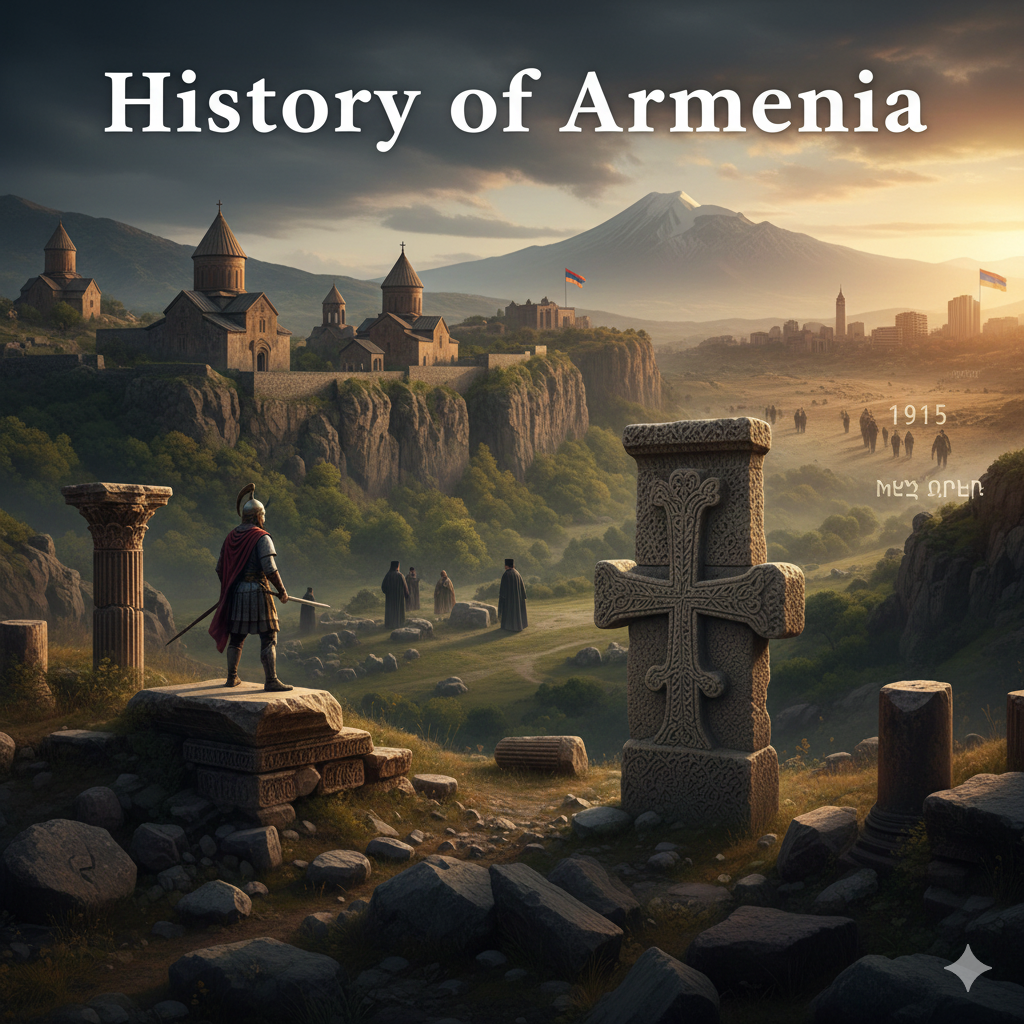
The History of Armenia is a profound and turbulent epic, spanning over three millennia and set in the strategic and often contested highlands of Western Asia. Situated at the crossroads of East and West, its people, known to themselves as Hay, have endured a cycle of independent kingdoms, foreign conquest, cultural flowering, and immense tragedy. This is the story of a nation that was the first to adopt Christianity as its state religion and whose enduring cultural and national identity has survived despite the loss of its historic homeland and one of the most devastating events of the 20th century.
I. Antiquity and the Birth of a Nation (Pre-History of Armenia – 301 CE)
A. Pre-Armenian Roots and the Kingdom of Urartu
The Armenian Highlands, centered around Mount Ararat, have been continuously inhabited since the Neolithic Era, evidenced by sites like the Areni-1 cave complex. The ancestors of the modern Armenians emerged from a blend of indigenous populations and migratory groups speaking Indo-European languages.
-
- Proto-Armenians: The people who contributed to the Armenian ethnogenesis are often associated with Bronze Age confederations like Hayasa-Azzi and Nairi, mentioned in Hittite and Assyrian sources, respectively. The Armenians refer to their land as Hayastan (Land of Hayk), tracing their legendary patriarch, Hayk, back to these ancestral tribes.
-
- The Kingdom of Urartu (9th–6th Century BCE): Before the full emergence of the Armenian kingdom, the powerful Kingdom of Urartu (Assyrian for Ararat) flourished. Its capital, Tushpa (modern Van), dominated the region. Urartu’s cuneiform script and engineering achievements, such as sophisticated irrigation systems, left an indelible mark. Notably, the Urartian King Argishti I founded the fortress of Erebuni in 782 BCE, which is the site of modern-day Yerevan, making it one of the world’s oldest continuously inhabited cities. The Urartian state eventually succumbed to the combined forces of the Medes and Scythian/Cimmerian raids around 585 BCE.
B. The Orontid and Artaxiad Dynasties (585 BCE – 1 CE)
Following the fall of Urartu, a new political entity arose—the Satrapy of Armenia, ruled by the Orontid Dynasty (Yervanduni). Initially a satrapy of the Median and then the vast Achaemenid (Persian) Empire, Armenia is first explicitly mentioned as Armina in the Behistun Inscription of Darius I (c. 520 BCE).
-
- The Artaxiad Golden Age: With the collapse of Alexander the Great’s successor states (the Seleucid Empire), the satrapies of Greater and Lesser Armenia became independent kingdoms in 190 BCE. Under King Artaxias I (Artashes I), the Artaxiad Dynasty was founded, beginning a period of cultural Hellenization and territorial expansion.
-
- Tigranes the Great (95–55 BCE): The zenith of this period was reached under Tigranes II, known as Tigranes the Great. His empire stretched from the Caspian Sea to the Mediterranean, encompassing parts of the Levant, Cappadocia, and Atropatene. He styled himself “King of Kings” and built a new capital, Tigranocerta. For a brief time, Armenia was one of the most formidable powers in the East, directly challenging the burgeoning Roman Republic.
-
- Roman Conflict: This power brought Armenia into direct conflict with Rome. The Roman general Lucullus defeated Tigranes in 69 BCE, and Pompey the Great finalized the subjugation in 66 BCE. While Tigranes was allowed to continue as a client king until his death, Armenia spent the next few centuries as a perpetually contested buffer state between the Roman (and later Byzantine) and Parthian (and later Sasanian Persian) Empires.
C. The Arsacid Dynasty and the Adoption of Christianity (1–428 CE)
The Arsacid Dynasty of Armenia, founded in 53 CE, was a cadet branch of the ruling Parthian family, a compromise that Rome eventually accepted with the Treaty of Rhandeia in 63 CE: the king would be a Parthian prince, but his appointment must be approved by Rome.
-
- The Great Conversion (301 CE): The most consequential event in History of Armenian occurred during the reign of King Tiridates III (Trdat III). Following his conversion by Saint Gregory the Illuminator, Tiridates declared Christianity as the state religion in 301 CE. This act makes the Kingdom of Armenia the first nation in the world to officially adopt Christianity, two decades before the Roman Empire under Constantine the Great. This decision profoundly shaped the Armenian people’s unique cultural, political, and national identity, permanently setting them apart from their largely Zoroastrian or, later, Muslim neighbors.
-
- The Golden Age of Armenian Literature (5th Century): To safeguard the Christian faith and national identity, the scholar-monk Mesrop Mashtots invented the Armenian Alphabet in 405 CE. This momentous invention not only facilitated the translation of the Bible (which Armenians call the “Mother of all Translations”) but also sparked a “Golden Age” of Armenian literature, theology, and historiography, cementing a distinct national culture just as the kingdom itself was coming to an end.
-
- Partition and the End of the Arsacid Monarchy (428 CE): The competing influence of the Roman and Persian Empires finally led to the partition of Armenia in 387 CE. The eastern, larger part became a Persian dependency ruled by a governor (marzpan). In 428 CE, with the deposition of the last Arsacid king, the ancient monarchy was abolished, and Armenia entered a period of foreign rule that would last for over four centuries.
II. Medieval Resilience and the Second Kingdom (428 CE – 1375 CE)
A. The Marzpanate Period and the Battle of Avarayr
Under the Sasanian Persian Marzpanate (governorship), Persian rulers attempted to forcibly impose Zoroastrianism on the Christian Armenian populace.
-
- Battle of Avarayr (451 CE): Under the leadership of the commander Vartan Mamikonian, the Armenian army revolted against the Persian attempts at forced conversion. Though militarily defeated at the Battle of Avarayr, the sacrifice of Vartan and his companions proved so spiritually resonant that the Persians eventually relented. The subsequent Treaty of Nvarsak (484 CE) secured the right of Armenians to freely practice Christianity and maintain autonomy under Armenian princes, a pivotal victory for the preservation of the national faith.
B. The Bagratid Kingdom (885–1045 CE)
After the Arab conquest of the region in the 7th century, Armenia became a province of the Caliphate. However, the rise of the influential Bagratuni noble family, who had skillfully navigated relations with the Caliphate, led to a second flowering of Armenian independence.
-
- The Re-establishment of Monarchy: In 885 CE, the Abbasid Caliph recognized Ashot I Bagratuni as King of Armenia, founding the Bagratid Kingdom. With its capital at Ani (the “City of 1001 Churches”), this kingdom ushered in a new era of artistic, economic, and architectural brilliance. Ani became a major trading center on the Silk Road and a hub of Christian culture.
-
- Decline and Fragmentation: Internal feuds and the growing power of the neighboring Byzantine Empire gradually weakened the Bagratid state. The Byzantine annexation of the kingdom in 1045, just as the first waves of Seljuk Turks were arriving, proved a fatal geopolitical misstep, removing the buffer state and opening the door to the devastating Turkish invasions.
C. The Armenian Kingdom of Cilicia (1080–1375 CE)
Following the Seljuk conquest of the Armenian Highlands, a massive wave of Armenians migrated south and west. A new independent Armenian state, the Armenian Kingdom of Cilicia (Lesser Armenia), was established on the Mediterranean coast.
-
- A Crusader State Ally: Situated strategically on the coast, Cilician Armenia became an essential ally of the European Crusader States. Its political, military, and economic structure was significantly influenced by Western European feudalism and culture. The Cilician period saw a flourishing of Armenian miniature painting, coinage, and close diplomatic ties with Europe.
-
- Final Fall: The kingdom eventually succumbed to the superior forces of the Mamluks of Egypt, with its final capital, Sis, falling in 1375. The fall of Cilicia marked the end of Armenian independent sovereignty for nearly five centuries. The head of the Armenian Church in Cilicia, the Catholicosate of the Great House of Cilicia, continued to survive, becoming a separate, co-existing See alongside the original See of the Catholicos of All Armenians at Holy Etchmiadzin.
III. Centuries of Foreign Domination (14th – 19th Century)
A. Ottoman and Persian Rule
From the 14th to the 19th centuries, the historic Armenian homeland was partitioned and re-partitioned between two powerful empires: the Ottoman Empire in the west and the successive Persian Empires (Safavid, Afsharid, Qajar) in the east.
-
- Western Armenia (Ottoman Rule): Under Ottoman rule, Armenians, as non-Muslim subjects, were organized into a Millet (autonomous religious community) but were considered second-class citizens, subjected to discriminatory laws and heavy taxation. Known as Gheyr-i Müslim (non-Muslim), they were often subjected to sporadic, but devastating, attacks and massacres, particularly in the more remote areas.
-
- Eastern Armenia (Persian and Russian Rule): The eastern parts of the homeland, including the capital Yerevan, remained under Persian control. In the early 19th century, the expansion of the Russian Empire brought it into direct conflict with Persia and the Ottomans. Following the Russo-Persian Wars, significant portions of Eastern Armenia were annexed by Russia via the treaties of Gulistan (1813) and Turkmenchay (1828). This new Russian dominion became a safe haven and a new intellectual center for the Armenian people.
B. The Armenian Question and the Dawn of National Revival
The second half of the 19th century saw a stirring of national consciousness among Armenians, a phenomenon common to many minority groups in the declining Ottoman Empire. This period, known as the Zartonk (Awakening), was fueled by European-educated Armenian intellectuals.
-
- The Hamidian Massacres (1894–1896): As the “Armenian Question” (the issue of Armenian rights and protection in the Ottoman Empire) gained international attention, Sultan Abdul Hamid II responded with brutal repression. The widespread, state-sponsored Hamidian Massacres resulted in the killing of an estimated 100,000 to 300,000 Armenians. These atrocities served as a grim foreshadowing of the catastrophe to come.
-
- The Young Turk Revolution: The 1908 Young Turk Revolution initially brought a brief moment of hope for equality, which was quickly extinguished by the Adana Massacre of 1909, where over 20,000 Armenians were killed by Ottoman mobs. By the time the Ottoman Empire entered World War I, the ruling Committee of Union and Progress (CUP) had fully embraced a radical, pan-Turkic ideology that viewed the Christian Armenian population as an existential internal threat.
IV. The 20th Century: Genocide and Soviet Rule (1915–1991)
A. The Armenian Genocide (1915–1923)
The darkest chapter in History of Armenia unfolded during World War I. Fearing that Armenians would side with Russia, the Young Turk regime decided to eradicate the Armenian presence from the empire.
-
- Systematic Elimination: The genocide began on April 24, 1915, with the mass arrest and execution of hundreds of Armenian intellectuals, community leaders, and clergy in Constantinople. This was followed by the disarming and murder of Armenian soldiers serving in the Ottoman army, and then the systematic deportation of the remaining civilian population from the historic Armenian provinces of Eastern Anatolia.
-
- Death Marches and Mass Killings: Men, women, and children were forced on grueling death marches through the Mesopotamian desert to concentration camps in the Syrian desert, primarily at Deir ez-Zor. Along the way, they were subjected to mass shootings, starvation, exposure, rape, and intentional dehydration by accompanying military forces and irregular chete militias.
-
- The Toll: By 1923, an estimated 1.5 million Armenians perished. The Armenian population of its historic homeland in Anatolia was virtually eliminated. Millions more were forced into a global diaspora, forever changing the demographic and geographic landscape of the Armenian nation. The event is widely recognized by historians as the first modern genocide.
B. The First Republic of History of Armenia (1918–1920)
Amidst the chaos of the Ottoman defeat and the Russian Revolution, a small portion of historic Eastern Armenia achieved a brief period of independence.
-
- Declaration and Survival: On May 28, 1918, the Democratic Republic of Armenia (DRA) was declared in the former Russian provinces. The newly formed state immediately faced existential threats from the invading Ottoman army. The decisive victories at the battles of Sardarabad, Bash Abaran, and Karakilisa in May 1918 allowed the DRA to survive and negotiate the Treaty of Batum.
-
- Collapse: The Republic was short-lived. Following the Ottoman defeat, the country was devastated and faced new conflict with its neighbors, including Georgia and Azerbaijan, over disputed territories like Nagorno-Karabakh (Artsakh). Cornered by a Turkish invasion from the west and the advancing Red Army from the north, the republic collapsed.
C. Soviet Armenia (1920–1991)
In December 1920, the DRA was incorporated into the Soviet Union, first as part of the Transcaucasian Soviet Federative Socialist Republic (1922–1936), and then as the Armenian Soviet Socialist Republic (ASSR).
-
- A New State: Though independence was lost, the Soviet period brought a period of peace, modernization, and cultural development within the confines of Soviet control. Education, infrastructure, and industry expanded. The capital, Yerevan, was rebuilt according to a new master plan.
-
- The Karabakh Issue: The Bolsheviks made a critical decision in 1921 to transfer the region of Nagorno-Karabakh (Artsakh), which was overwhelmingly Armenian-populated, to the jurisdiction of Soviet Azerbaijan. This territorial decision would sow the seeds for the future conflict between the two nations.
-
- The Diaspora’s Growth: Throughout the Soviet period, the vast Armenian Diaspora—a living monument to the Genocide—grew and flourished, preserving the language and culture in communities across the Middle East, Europe, and the Americas, and keeping the dream of a free Armenia alive.
V. Independent Armenia and the Modern Era (1991 – Present)
A. Re-Independence and the First Karabakh War
The collapse of the Soviet Union created the opportunity for a third Armenian republic.
-
- Declaration of Independence: On September 21, 1991, Armenia held a referendum and declared full independence, establishing the Republic of Armenia.
-
- The Nagorno-Karabakh Conflict: Simultaneous with independence, the Armenians of Nagorno-Karabakh demanded unification with Armenia, leading to war with newly independent Azerbaijan (1992–1994). The conflict resulted in an Armenian victory, securing control over Nagorno-Karabakh and surrounding territories, and was concluded with the Bishkek Protocol ceasefire in 1994.
B. The Modern Republic
The post-Soviet transition proved challenging. Armenia had to navigate its isolation, its closed borders with Turkey and Azerbaijan, and the economic blockade imposed by its neighbors.
-
- Political Development: The country transitioned from a turbulent post-war period to a functioning, albeit often contested, democracy. Leaders like Levon Ter-Petrosyan, Robert Kocharyan, and Serzh Sargsyan steered the young nation through its formative years, characterized by efforts to build a market economy and strengthen its alliance with Russia.
-
- The Velvet Revolution (2018): In a pivotal moment of non-violent democratic change, mass protests led by Nikol Pashinyan successfully overthrew the long-ruling establishment, ushering in a period focused on anti-corruption and democratic reforms.
C. The Second Karabakh War and Recent Challenges
The unresolved conflict over Nagorno-Karabakh dominated Armenia’s foreign policy and national life into the 21st century.
-
- The 44-Day War (2020): In September 2020, war broke out again. Azerbaijan, backed by Turkey and utilizing advanced military technology, gained significant territorial advantage over Armenian forces. The war ended with a Russia-brokered ceasefire that resulted in Armenia ceding much of the surrounding territory it had controlled since 1994.
-
- The Displacement of Artsakh (2023): Following a sustained Azerbaijani blockade and a final military offensive in September 2023, the Armenian population of Nagorno-Karabakh (Artsakh) was forced to flee en masse. Over 100,000 ethnic Armenians were displaced, effectively ending the three-thousand-year Armenian presence in the region and creating a new refugee crisis for the Republic of Armenia. This event marked a devastating historical setback, shrinking the Armenian political and cultural space back to the borders of the modern republic.
VI. The Enduring Legacy: Culture and Identity
Despite the immense historical trauma and the continuous struggle for sovereignty, Armenian civilization has preserved its unique identity through its cultural pillars.
-
- Language and Alphabet: The invention of the Armenian alphabet in 405 CE remains the single most important act of national preservation. The language is an independent branch of the Indo-European family, and its literature, from the early historians like Movses Khorenatsi to the modern poetry of Yeghishe Charents, forms the spine of national consciousness.
-
- The Armenian Apostolic Church: The Church is inseparable from the nation’s identity. As the first Christian state, the Church is the oldest national church in the world. Its head, the Catholicos of All Armenians at Holy Etchmiadzin, serves as the spiritual and symbolic leader of Armenians worldwide.
-
- Architecture and Art: Armenia is an “open-air museum,” famous for its unique ecclesiastical architecture, characterized by stone-cut domes, pointed arches, and the ubiquitous Khachkar (cross-stone), an intricately carved memorial stele unique to Armenian art.
-
- The Diaspora: The global Armenian Diaspora, numbering far more than the population of the Republic itself, is a unique and vital element of modern Armenian identity. The communities—from Los Angeles and Paris to Beirut and Moscow—remain deeply connected to their homeland, serving as powerful advocates for the recognition of the Genocide and as sources of economic and political support for the Republic of Armenia.
Conclusion
The History of Armenia is a testament to the resilience of a people living on a geopolitical fault line. It is the story of a civilization that achieved an imperial zenith under Tigranes the Great, made a world-altering decision in 301 CE, created a monumental alphabet in 405 CE, and endured centuries of subjugation that culminated in the ultimate crime of genocide. Yet, from the ashes of the Ottoman Empire and the confines of the Soviet state, the Armenians re-emerged to found a new, sovereign republic. The nation today faces the daunting task of securing its democracy and sovereignty in a turbulent region, a struggle that is the continuation of its 3,000-year history—a history defined by loss, faith, cultural tenacity, and an unwavering commitment to its distinct national self.
Visit: www.dkbtech.com and allcircular.com