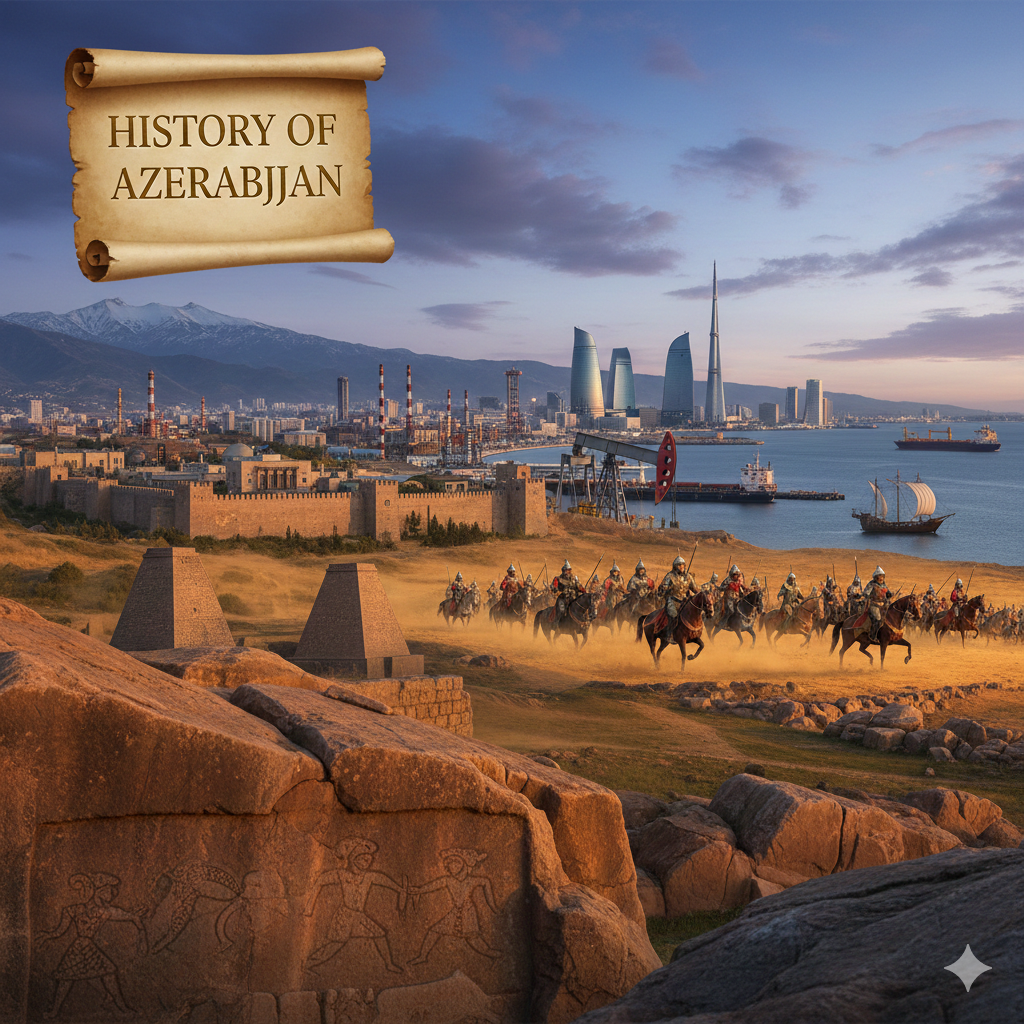
The History of Azerbaijan is long and complex, spanning millennia and encompassing diverse civilizations, empires, and cultural influences. Situated at the crossroads of Eastern Europe and Western Asia, on the Caspian Sea, Azerbaijan has been a vital bridge and battleground for various powers, shaping its unique identity.
I. Prehistory and Early Civilizations (Paleolithic to the 7th Century BCE)
The earliest signs of human settlement in the territory of modern Azerbaijan date back to the Paleolithic era.
A. Paleolithic and Mesolithic Periods
-
- Azykh Cave: The most significant early human site is the Azykh Cave in the Fuzuli region, where the jawbone of a prehistoric hominid (now called “Azyk-anthropus”) was discovered. This find suggests human habitation in the region hundreds of thousands of years ago, making it one of the oldest human sites in Eurasia.
-
- Gobustan: The Gobustan Rock Art Cultural Landscape, now a UNESCO World Heritage Site, provides evidence of Mesolithic and Neolithic life. The thousands of rock carvings (petroglyphs) depict hunting scenes, ritual dances, animal life, and boats, illustrating the sophisticated cultural life of the early inhabitants.
B. Bronze and Iron Ages
The transition to the Bronze Age saw the development of settled agricultural societies and distinct archaeological cultures:
-
- Kura-Araxes Culture (c. 3400–2000 BCE): This influential Bronze Age culture, named after the Kura and Araxes rivers, extended across a vast area including modern Azerbaijan. Characterized by early metallurgy, sophisticated ceramics, and distinct burial mounds (kurgans), it marks a significant stage in the region’s socio-economic development.
-
- Trialeti-Vanadzor Culture (c. 2200–1500 BCE): Following the Kura-Araxes culture, this period saw further advancements in bronze working and the emergence of hierarchical societies, evidenced by rich burial finds.
The Iron Age (from around the 9th century BCE) saw the rise of the first state formations in the region.
II. Ancient States and Empires (7th Century BCE – 7th Century CE)
The territory of Azerbaijan was integrated into or bordered several powerful empires and saw the emergence of its own political entities.
A. Mannae and the Cimmerians/Scythians
-
- Mannae (c. 9th – 7th Century BCE): Located in what is now northwestern Iran, the kingdom of Mannae had significant cultural and political influence over the southern parts of modern Azerbaijan. It was a local power often caught in conflicts between the mighty Assyrian and Urartian empires.
-
- Scythians: Nomadic tribes known as Scythians and Cimmerians entered the region from the north through the Caucasian passes, establishing temporary dominance and leaving a cultural imprint.
B. Caucasian Albania (4th Century BCE – 8th Century CE)
The most important ancient state in the region was Caucasian Albania, which covered a significant portion of what is today the Republic of Azerbaijan.
-
- Establishment: Caucasian Albania emerged as an independent political entity around the 4th century BCE, following the collapse of the Achaemenid Persian Empire. Its capital was initially thought to be Kabala (Qabala).
-
- Roman and Parthian Influence: Located strategically, Albania was constantly caught between the great regional powers: the Roman Empire and the Parthian (later Sasanian) Empire of Persia. For a time, it was a client state of Rome, though it primarily fell into the sphere of Persian influence.
-
- Christianization: A pivotal moment occurred in the 4th century CE when Christianity became the official state religion of Albania, possibly influenced by the earlier conversion of Armenia. The establishment of the Albanian Apostolic Church and the creation of an Albanian alphabet by Mesrop Mashtots were crucial for the development of a distinct cultural and literary tradition.
-
- Decline: The kingdom’s autonomy gradually diminished under Sasanian rule, until it was largely absorbed by the Persians and then by the Arab Caliphate in the 7th and 8th centuries.
C. Persian and Hellenistic Empires
Throughout this period, the territory was repeatedly controlled by or interacted with major empires:
-
- Achaemenid Empire (6th – 4th Century BCE): The Achaemenid Persians, under Cyrus the Great, incorporated the region into their vast empire, establishing it as a Satrapy.
-
- Alexander the Great and the Seleucids: After Alexander’s conquest, the area was briefly part of his Hellenistic empire, followed by the Seleucid Empire, which fostered a degree of Greek cultural penetration.
-
- Sasanian Empire (3rd – 7th Century CE): The Sasanian dynasty, which succeeded the Parthians, ruled the region for centuries. They promoted Zoroastrianism, and Azerbaijan became an important Sasanian administrative and military borderland, defending the empire against northern nomadic incursions (especially the Huns and Khazars).
III. The Islamic Era (7th – 13th Centuries)
The arrival of the Arab Caliphate fundamentally reshaped the political, religious, and cultural landscape of Azerbaijan.
A. Arab Conquest and Islamization (7th – 9th Centuries)
-
- Conquest: Beginning in the mid-7th century, the Rashidun and then the Umayyad Caliphates conquered the region, bringing it under the rule of the vast Islamic empire. Resistance was strong but ultimately overcome.
-
- Administrative Division: The region was incorporated into the Caliphate under the province of Arminiya, which also included parts of Armenia and Georgia.
-
- Islamization: While the initial imposition of Islam was political, the subsequent centuries saw a gradual but widespread conversion of the local population from Christianity and Zoroastrianism to Islam, primarily to the Sunni branch initially. This marked a profound cultural shift.
B. Local Dynasties and the Iranian Renaissance (9th – 11th Centuries)
As the Abbasid Caliphate weakened, various local and regional dynasties emerged, establishing de facto independence. This period is considered a ‘Golden Age’ of local Azerbaijani statehood and a major part of the broader Iranian Renaissance.
-
- Shirvanshahs (861 – 1538): One of the most enduring and important dynasties, the Shirvanshahs, ruled the region of Shirvan (northeastern Azerbaijan) for nearly 700 years. Their capital, Shamakhi, and later Baku, became centers of culture and trade.
-
- Sajid, Sallarid, and Ravvadid Dynasties: Other local dynasties controlled the southern and western parts of the territory, often fighting for dominance.
C. Seljuk Turkic Dominance (11th – 12th Centuries)
The 11th century marked the arrival of the Oghuz Turkic tribes, led by the Seljuks. This migration was arguably the most significant ethno-linguistic turning point in the history of Azerbaijan.
-
- Arrival: The Seljuks, initially nomadic warriors, quickly established a massive empire across Persia and Anatolia. Their victory at the Battle of Manzikert (1071) was key.
-
- Turkification: The influx of Oghuz tribes led to the gradual linguistic Turkification of the local Caucasian and Iranian populations. The local Iranian dialects began to be replaced by an Oghuz Turkic language, which eventually evolved into the modern Azerbaijani language.
-
- Atabegs of Azerbaijan (Eldiguzids): After the collapse of the Great Seljuk Empire, the Eldiguzid Atabegs established a powerful, independent state centered in Tabriz (now in Iran), controlling much of the region. This period fostered a rich literary and architectural boom, with figures like the great poet Nizami Ganjavi (c. 1141–1209) flourishing.
IV. Mongol and Turco-Mongol Rule (13th – 15th Centuries)
The 13th and 14th centuries were characterized by invasion, destruction, and the establishment of powerful Turco-Mongol successor states.
A. Mongol Invasions and the Ilkhanate (13th Century)
-
- Invasions: The Mongol armies of Genghis Khan and his successors, beginning in the 1220s, devastated the region, destroying cities like Ganja and laying waste to the agricultural lands.
-
- The Ilkhanate: Hulagu Khan, Genghis Khan’s grandson, established the Ilkhanate, a division of the Mongol Empire. Azerbaijan, with its new capital at Tabriz, became the heartland and most prosperous region of the Ilkhanate. This period saw the conversion of the ruling Mongols to Islam.
B. Successor States and Tamerlane (14th – 15th Centuries)
-
- Chupanids and Jalayirids: Following the decline of the Ilkhanate, several shorter-lived dynasties fought for control.
-
- Timur’s Invasion: In the late 14th century, the Turco-Mongol conqueror Timur (Tamerlane) invaded and annexed Azerbaijan into his vast empire.
-
- Kara Koyunlu and Ak Koyunlu (Black Sheep and White Sheep Turkomans): These two rival Oghuz Turkoman tribal confederations dominated the 15th century, with their control shifting between eastern Anatolia, Azerbaijan, and Persia. They solidified the Turkic cultural and political character of the region.
V. The Safavid Empire and the Rise of Shi’ism (16th – 18th Centuries)
The 16th century brought a dramatic shift with the rise of the Safavid dynasty, which fundamentally changed the religious orientation of the entire region.
A. Ismail I and the Establishment of the Safavid State
-
- Safavid Origins: The Safavids originated from a Sufi order in Ardabil (southern Azerbaijan). Their leader, Ismail I (Shah Ismail), led his Qizilbash (Turkoman Shia) followers to victory over the Ak Koyunlu.
-
- Foundation of the Empire (1501): Ismail I proclaimed himself Shah of Iran and established Twelver Shi’ism as the official state religion, separating Persia and Azerbaijan religiously from the predominantly Sunni Ottoman and Uzbek states.
-
- Azerbaijan as the Heart: Azerbaijani Turks formed the backbone of the Qizilbash military and the administrative elite of the early Safavid Empire. The capital was first established at Tabriz (in historic Azerbaijan), and the Azerbaijani language was the court language until the shift to Isfahan and the increasing use of Persian.
B. Ottoman-Persian Rivalry
For nearly two centuries, the territory of modern Azerbaijan was a constant battleground between the powerful Shi’a Safavid Empire and the Sunni Ottoman Empire.
-
- Wars and Treaty Lines: The two powers fought numerous wars, with the territory of Azerbaijan repeatedly changing hands, leading to massive destruction and population movements. Treaties like the Treaty of Amasya (1555) and the Treaty of Zuhab (1639) attempted to demarcate borders, but instability persisted.
C. The Age of Khanates (Mid-18th Century)
Following the collapse of the Safavid Empire and the short-lived rule of Nadir Shah Afshar, a power vacuum emerged in the South Caucasus.
-
- Fragmentation: The region broke up into a number of independent or semi-independent Muslim principalities known as Khanates (e.g., Baku, Ganja, Shamakhi, Karabakh, Kuba, Nakhchivan, Talysh).
-
- Local Rule: These Khanates were ruled by local Turkic and sometimes Iranian nobles, who maintained their own armies and administered justice. They were highly decentralized and frequently at war with each other, making them vulnerable to external powers.
VI. Russian Domination and the Partition of Azerbaijan (19th Century)
The 19th century was defined by the relentless expansion of the Russian Empire, which sought to control the Caucasus and gain access to the Caspian Sea.
A. Russo-Persian Wars and the Treaties
Russia’s southward push inevitably clashed with Qajar Persia (the successor to the Safavids).
-
- First Russo-Persian War (1804–1813): The war ended with the Treaty of Gulistan (1813), which ceded the northern Khanates (including Karabakh, Ganja, Kuba, Baku, and Derbent) to Russia.
-
- Second Russo-Persian War (1826–1828): The conflict concluded with the decisive Treaty of Turkmenchay (1828). This treaty permanently ceded the Nakhchivan and Erivan Khanates to Russia and established the Araxes River as the boundary between the Russian Empire and Qajar Persia.
-
- Partition: The Treaties of Gulistan and Turkmenchay formally and permanently partitioned the Azerbaijani people and their historic territory into two parts: Northern Azerbaijan (Russian rule) and Southern Azerbaijan (Persian/Iranian rule).
B. Imperial Russian Rule (Northern Azerbaijan)
Under Russian rule, Northern Azerbaijan experienced profound social and economic transformations.
-
- Economic Boom: The discovery and rapid development of the oil fields in Baku in the latter half of the 19th century transformed the city into a global industrial center (the “Black City”). Foreign investment (Nobel Brothers, Rothschilds) poured in, creating a massive working class and a new Azerbaijani bourgeoisie.
-
- Social Changes: The emergence of a wealthy, educated class led to a cultural and national awakening known as the Azerbaijani Enlightenment.
-
- Intellectuals: Figures like Mirza Fatali Akhundov, Hasan bey Zardabi, and others promoted secular education, theater, and a modern press, focusing on a distinct Azerbaijani identity and language.
-
- Political Thought: Ideas of pan-Turkism, Islamic Modernism, and secular nationalism gained currency.
-
- Social Changes: The emergence of a wealthy, educated class led to a cultural and national awakening known as the Azerbaijani Enlightenment.
VII. The First Republic and Soviet Era (1918 – 1991)
The collapse of the Russian Empire in 1917 provided the opportunity for national self-determination.
A. The Azerbaijan Democratic Republic (ADR) (1918 – 1920)
-
- Establishment: Following the chaos of the Russian Revolution, the Muslim faction of the Transcaucasian Seym declared the independence of the Azerbaijan Democratic Republic (ADR) on May 28, 1918.
-
- Firsts: The ADR was the first secular, democratic republic in the Muslim world.
-
- It granted universal suffrage, making it one of the first countries in the world to give women the right to vote.
-
- It adopted a national flag (blue, red, and green tricolor) and national symbols.
-
- Firsts: The ADR was the first secular, democratic republic in the Muslim world.
-
- Challenges: The young republic was immediately faced with immense challenges: ethnic conflict (especially with Armenians over Karabakh and Nakhchivan), a weak economy, and pressure from internal Bolsheviks and external White and Red Russian armies.
-
- Fall: In April 1920, the Red Army invaded and overthrew the ADR, ending its 23-month existence.
B. Soviet Azerbaijan (1920 – 1991)
Northern Azerbaijan was integrated into the Soviet system, first as a Soviet Socialist Republic (SSR) and later as a key member of the Transcaucasian Soviet Federative Socialist Republic (until 1936).
-
- Political Structure: The Azerbaijan Soviet Socialist Republic (AzSSR) was established. The Soviet government formalized the disputed territories by creating the Nagorno-Karabakh Autonomous Oblast (NKAO) and the Nakhchivan Autonomous Soviet Socialist Republic (ASSR) within the AzSSR.
-
- Industrialization: Oil production remained central, but Soviet policy diversified the economy. Baku continued to be a major industrial and intellectual hub.
-
- Repression: The 1930s saw the purges under Joseph Stalin, during which many Azerbaijani intellectuals, poets, and politicians were executed or imprisoned, a massive blow to the national elite.
-
- World War II: Azerbaijan was a vital strategic location. Its oil fields supplied over 70% of the Soviet Union’s oil during the war, making the defense of Baku a critical objective.
-
- Heydar Aliyev Era: In the latter half of the 20th century, Heydar Aliyev rose to power, first as the head of the AzSSR (1969–1982) and later as a Deputy Prime Minister of the USSR. He initiated major development projects and consolidated the republic’s infrastructure, though his rule was also characterized by a rigid Soviet political system.
VIII. The Second Republic and Modern Era (1991 – Present)
The final decade of the 20th century saw the collapse of the Soviet Union and the re-establishment of an independent Azerbaijan.
A. The Independence and the Karabakh War
-
- Dissolution of the USSR: The independence movement, spearheaded by the Azerbaijani Popular Front, gained momentum during Gorbachev’s perestroika.
-
- The “Black January” events of 1990 (a violent crackdown by the Soviet Army in Baku) galvanized the independence movement.
-
- Dissolution of the USSR: The independence movement, spearheaded by the Azerbaijani Popular Front, gained momentum during Gorbachev’s perestroika.
-
- Declaration of Independence (1991): The AzSSR officially declared its independence from the Soviet Union on October 18, 1991, adopting the flag and anthem of the ADR.
-
- The First Karabakh War (1988–1994): The long-simmering conflict with neighboring Armenia over the mountainous Nagorno-Karabakh region erupted into full-scale war.
-
- The war resulted in a devastating loss for Azerbaijan, with Armenian forces (supported by Armenia) seizing control of the NKAO and seven adjacent Azerbaijani districts, comprising nearly 20% of Azerbaijan’s internationally recognized territory.
-
- This conflict created nearly one million Azerbaijani internally displaced persons (IDPs) and refugees.
-
- A fragile ceasefire was signed in Bishkek in 1994, leaving the situation in a state of ‘frozen conflict.’
-
- The First Karabakh War (1988–1994): The long-simmering conflict with neighboring Armenia over the mountainous Nagorno-Karabakh region erupted into full-scale war.
B. The Heydar Aliyev and Ilham Aliyev Era
-
- Return of Heydar Aliyev: In the tumultuous early years of independence, Heydar Aliyev returned to power in 1993. He stabilized the country, quelled internal unrest, and established an authoritarian political structure.
-
- Oil and the “Contract of the Century” (1994): Aliyev signed a massive deal with Western oil companies, marking the beginning of the post-Soviet oil boom. This led to the construction of major pipelines, such as the Baku-Tbilisi-Ceyhan (BTC) pipeline, and rapidly growing state revenues.
-
- Ilham Aliyev (2003 – Present): Upon Heydar Aliyev’s death, his son, Ilham Aliyev, assumed the presidency. The country continued its economic development, leveraging its hydrocarbon wealth to build modern infrastructure and exert geopolitical influence. However, the government has been widely criticized by international bodies for human rights abuses, stifling political dissent, and corruption.
C. The Second Karabakh War (2020) and Restoration of Control
-
- The 44-Day War: In September 2020, full-scale hostilities erupted. The Azerbaijani military, equipped with modern technology (especially drones), achieved a swift and decisive victory, regaining control over the seven adjacent districts and a substantial part of Nagorno-Karabakh itself.
-
- Ceasefire and Aftermath: The war ended with a Russian-brokered ceasefire on November 10, 2020. This radically altered the geopolitical landscape of the South Caucasus, resulting in a significant number of Russian peacekeepers being deployed.
-
- Anti-Terrorist Operation (2023): In September 2023, Azerbaijan launched a final one-day military operation in Nagorno-Karabakh. The remaining Armenian forces surrendered, and the de facto Nagorno-Karabakh Republic dissolved itself. This led to the exodus of the entire ethnic Armenian population of the region (over 100,000 people) to Armenia, effectively ending the three-decade-long conflict and placing the region entirely under the sovereignty of the Republic of Azerbaijan.
IX. Conclusion
The History of Azerbaijan is a story of resilience, cultural synthesis, and strategic significance. It is a narrative woven from the threads of ancient Caucasian Albania, Zoroastrian Persia, Turkic migrations, Islamic empires, and Russian imperial ambition. The nation’s unique identity as a secular, democratic, and predominantly Shi’a Muslim nation with strong Turkic roots stands as a testament to its complex geopolitical location.
From the first oil booms of the 19th century to its current role as a major energy exporter, Azerbaijan has maintained its importance on the world stage. Today, the nation faces the challenges of post-conflict reconstruction, establishing a fully functional democratic society, and navigating the global energy transition while solidifying its long-term sovereignty and national unity.
Visit : www.dkbtech.com and www.allcircular.com