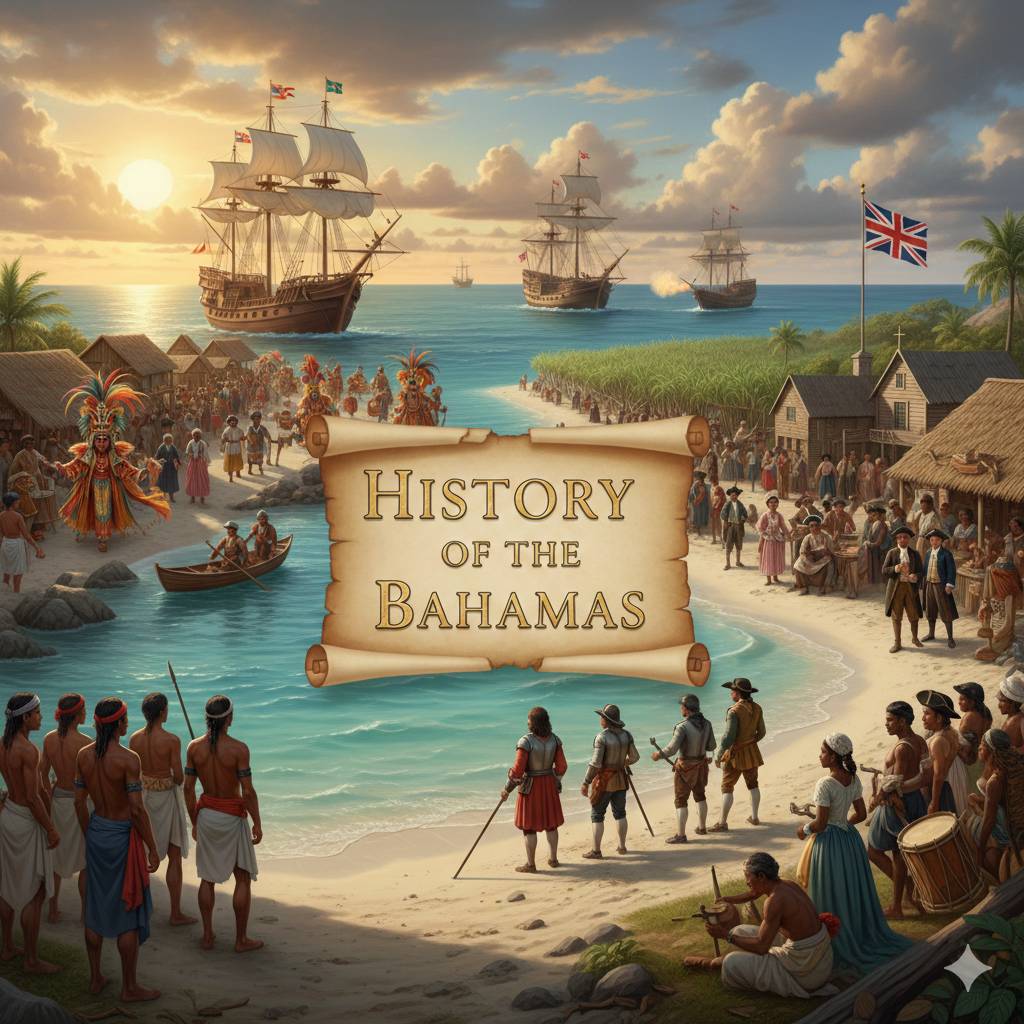
 The History of The Bahamas: From Lucayan Homeland to Sovereign Nation
The Commonwealth of The Bahamas is an archipelago of captivating beauty, its history as rich and layered as the coral reefs that surround its over 700 islands and cays. Extending over 5,382 square miles (13,939 square kilometers) of land scattered across an enormous ocean area, this chain of islands has been a silent witness to indigenous civilization, European conquest, the golden age of piracy, the rise and fall of the plantation economy, and the eventual triumph of independence.3 The history is a vibrant tapestry woven from indigenous Arawakan culture, African resilience, European political ambition, and the constant, transformative influence of the sea.
 I. The Pre-Columbian Era: The Lucayan Homeland (c. 500 AD – 1500 AD)
Long before the arrival of Europeans, the islands of The Bahamas were settled and thrived under the careful stewardship of the Lucayan people.
 The Arrival and Expansion of the Lucayans
The Lucayans were an Arawakan-speaking branch of the Taíno people, who originated in South America and migrated northward through the Caribbean islands. Their arrival in the Bahamian archipelago is generally dated between 500 and 800 AD.
-
- Migration Routes: Scholars suggest the migration route likely started from Hispaniola or Cuba, extending northward into the Turks and Caicos Islands and the larger islands of the southern Bahamas, such as Great Inagua.
-
- Settlement and Adaptation: The Lucayans adapted skillfully to the unique island environment, which, unlike the volcanic islands to the south, featured shallow soils and limited fresh water. Their settlements were typically located near the coast, allowing easy access to the ocean, which served as their primary source of sustenance.
-
- Population Peak: By the time of the European arrival in 1492, the Lucayan population across the islands is estimated to have reached approximately 40,000 people, inhabiting much of the archipelago.
 Lucayan Society and Culture
Lucayan society was characterized by a peaceful, well-developed system with distinct political, social, and religious structures.
-
- Governance: The largest communities were led by hereditary chiefs known as Caciques. The Caciques held both secular and religious authority, managing food resources and overseeing ceremonial life.
-
- Economy and Sustenance: Their diet was a blend of marine and land-based resources. They were adept fishermen, hunting sea turtles, fish (like grouper and snapper), and marine mammals. On land, they cultivated crops like cassava (manioc), sweet potatoes, beans, and peanuts, employing a slash-and-burn farming technique known as conuco. They also utilized the islands’ flora for cotton and tobacco.
-
- Technology and Craftsmanship: The Lucayans were skilled artisans. They crafted smooth, painted pottery, used shell and stone to make tools, and built excellent dugout canoes large enough to carry dozens of people, which facilitated trade and travel between islands.
-
- Cosmology: Their religion centered on the worship of nature spirits and deities, with the Caciques and priests (or Bohuti) acting as intermediaries, communicating through rituals involving cohoba (a hallucinogenic snuff) and honoring carved wooden figures known as zemis.
The Lucayans’ peaceful existence and rich culture, which had thrived for nearly a millennium, were violently curtailed by the next major turning point in the islands’ history.
 II. The Spanish Encounter and Depopulation (1492 – 1648)
The arrival of Christopher Columbus marked the beginning of recorded history in the region, but also the rapid and tragic end of the Lucayan era.
 The First Landfall (1492)
On October 12, 1492, Christopher Columbus, on his first voyage to the New World, made his initial landfall on an island in the Bahamian chain.
-
- Guanahani/San Salvador: The island, known to the Lucayans as Guanahani, was renamed San Salvador (Holy Savior) by Columbus. The exact identity of the island remains a subject of debate among historians, with modern San Salvador (formerly Watling’s Island) and Samana Cay being the most frequently cited candidates.
-
- The Baja Mar: It is from Columbus’s description of the shallow waters surrounding the islands—referring to the region as “islands of the baja mar” (shallow sea)—that the name “Bahamas” is believed to have originated.
-
- Initial Impressions: Columbus noted the Lucayans’ peaceful and gentle nature, observing that they were “all well-made… with very fine features.” He also immediately recognized their potential for labor.
 The Lucayan Extinction
While Columbus formally claimed the islands for Spain, the Spanish had little interest in settling the archipelago, which lacked the gold and other precious metals found in the Greater Antilles. Their primary interest in The Bahamas quickly shifted to one resource: slave labor.
-
- The Slave Raids (1492 – 1520): Spanish slave traders began capturing Lucayans to work in the gold mines and plantations of Hispaniola (present-day Haiti and the Dominican Republic). The Lucayans were described as strong laborers, and their peaceful nature made them easy targets.
-
- Total Depopulation: Within two decades of Columbus’s arrival, the entire indigenous Lucayan population—estimated at 40,000—was decimated. They succumbed to enslavement, European diseases to which they had no immunity, and the sheer brutality of forced labor. By 1520, when a Spanish expedition sought to remove any remaining natives, only eleven were found.
-
- The Isles of Silence: The Bahamas became essentially depopulated and were known for the next century and a half as the Islas Inútuiles (Useless Islands) or the Isles of Silence, largely ignored by the Spanish, who maintained only a titular claim. The lush forests reported by the first Europeans were also diminished as the Lucayan agricultural system collapsed.
 III. English Settlement and the Privateers’ Republic (1648 – 1718)
The islands’ next era began with English settlement, quickly followed by a period dominated by lawlessness and buccaneering, which defined the Bahamas in the late 17th and early 18th centuries.
 The Eleutheran Adventurers (1648)
The first permanent European settlement in The Bahamas was not founded by state command, but by a group of religious dissidents.
-
- The Adventurers: In 1648, a group of English and Bermudian Puritan settlers, led by Captain William Sayle, sailed to the islands seeking religious freedom away from the turmoil of the English Civil War. They called themselves “The Company of Adventurers for the Plantation of the Islands of Eleutheria.”
-
- Eleuthera: They landed on an island they named Eleuthera, from the Greek word eleutheros, meaning “free.”
-
- Early Hardship: The early years were marked by severe hardship, with food shortages forcing Sayle to seek aid from the Massachusetts Bay Colony.38 The assistance received was a reciprocal gesture for the Puritans’ shared religious ideals, demonstrating early North American connections.
-
- New Providence: Seeking a better harbor, some settlers moved to New Providence island, naming their main settlement Nassau (after William III of England, Prince of Orange-Nassau) in the 1690s. This central island, with its excellent natural harbor, soon became the center of the fledgling colony’s commerce and population.
 The Privateers’ Republic (Late 17th – Early 18th Century)
The proprietary governors, to whom King Charles II granted The Bahamas in 1670, proved unable to control the islands’ growing allure to maritime opportunists.
-
- The Rise of Piracy: The Bahamas’ strategic location—lying across major transatlantic shipping lanes—and its geography—hundreds of shallow, maze-like channels perfect for hiding—made it an irresistible sanctuary for privateers and, increasingly, outright pirates (buccaneers).
-
- Lawless Haven: As England, Spain, and France constantly warred, privateers operating with official state sanction used Nassau as their base to attack enemy ships. When the wars ended, many of these men simply transitioned into piracy. For a period of nearly two decades, the islands functioned as an independent Pirates’ Republic, where law and order were non-existent.
-
- Famous Buccaneers: The most notorious pirates of the era made their headquarters in Nassau, including the infamous Blackbeard (Edward Teach), Calico Jack Rackham, and female pirates Anne Bonny and Mary Read. At its peak, the pirate population in the Bahamas may have exceeded 1,000, significantly outnumbering the permanent settler families.
-
- External Attacks: The lack of effective government made the settlements vulnerable, and Nassau was sacked and burned several times by combined Spanish and French forces (e.g.,1684 and 1703).
 IV. The British Crown Colony and Loyalist Migration (1718 – 1834)
The state of lawlessness finally compelled the British Crown to take direct control, ushering in the era of the Crown Colony and profoundly reshaping Bahamian demographics.
 Restoration of Order (1718)
To suppress piracy and restore orderly governance, the British Crown rescinded the proprietary charter and declared The Bahamas a Crown Colony in 1718.
-
- Governor Woodes Rogers: The first Royal Governor appointed was Woodes Rogers, a former privateer himself, who arrived with a mandate to clean up Nassau. Rogers famously offered a “King’s Pardon” (amnesty) to pirates who surrendered by a certain date.
-
- The End of the Republic: While over 300 pirates surrendered, those who resisted, including Blackbeard, were hunted down. Rogers’s firm rule, symbolized by the hanging of several prominent defiant pirates, effectively ended the Pirates’ Republic. His motto became the colonial motto of The Bahamas: Expulsis Piratis, Restituta Commercia (“Pirates Expelled, Commerce Restored”).
 The Loyalist Influx (1783)
A second, more profound demographic shift occurred after the American War of Independence.57
-
- American Revolution Aftermath: Following the 1783 Treaty of Paris, which formally recognized American independence, thousands of American colonists who had remained loyal to the British Crown (Loyalists) were forced to evacuate the newly formed United States.
-
- The Move to The Bahamas: The Crown compensated these Loyalists by granting them land in The Bahamas and other Caribbean colonies. They began arriving in The Bahamas in large numbers, settling primarily on Abaco, Eleuthera, and Cat Island. The population soared from 4,058 in 1783 to over 11,000 by 1789.
-
- The Plantation Economy and Slavery: The Loyalists brought with them their agricultural expertise, shipbuilding skills, and, crucially, thousands of enslaved Africans whom they had owned in the American colonies. This influx established a short-lived but impactful plantation economy, primarily growing cotton, which relied entirely on slave labor.
-
- African Heritage: The majority of the enslaved people brought by the Loyalists were of West African descent. Their arrival established the foundation for the islands’ present-day demographic profile, with people of African descent forming the vast majority of the population.
 The Abolition of Slavery (1807 & 1834)
The economic system introduced by the Loyalists began to crumble due to poor soil, insect infestations, and, most importantly, Britain’s shifting policy on slavery.
-
- Abolition of the Slave Trade (1807): The British Parliament abolished the transatlantic slave trade, though existing slavery in the colonies remained legal.
-
- The Royal Navy’s Role: Following 1807, the Royal Navy’s anti-slavery patrols often intercepted illegal slave ships and brought the liberated Africans (recaptives) to The Bahamas for resettlement. These freed people were established in settlements that still bear their names.
-
- Abolition of Slavery (1834):Full emancipation of all enslaved people in the British Empire came into effect on August 1, 1834. The freed population, now the majority, abandoned the failing plantations, often settling in ancestral villages or creating new, independent communities. This pivotal moment marked the end of the plantation era and the beginning of a long process of social and economic adjustment for the majority of the population.
 V. Economic Cycles and War-Time Booms (1834 – 1950)
The period following emancipation was characterized by economic uncertainty, punctuated by short but intense periods of prosperity tied to external conflicts and international law.
.
 Post-Emancipation Industries (Mid-19th Century)
The collapse of the plantation system forced the majority of Bahamians to turn to the sea and local industries.
-
- Sponging: The sponge industry became the leading economic activity. Bahamian sponges, primarily harvested off Andros and Abaco, were highly valued globally. The industry reached its peak around 1901 but suffered a catastrophic collapse in 1939 due to a fungal blight.
-
- Wrecking and Salvaging: Building on the traditions of the buccaneer era, the salvage of goods from shipwrecks (wrecking) was a legitimate and often profitable industry until the US passed laws requiring salvage to be taken to American ports.
-
- Other Exports: Smaller industries, such as exporting pineapples, sisal, and conch shells, also provided modest income.
 The American Civil War Boom (1861 – 1865)
The United States Civil War brought an unexpected but massive economic boom to The Bahamas.74
-
- Blockade-Running: During the Union blockade of Confederate ports, Nassau served as a crucial blockade-running center. British merchants shipped manufactured goods to Nassau, where smaller, faster vessels known as “blockade runners” transported them to Confederate ports like Charleston, exchanging them for highly sought-after cotton.
-
- Sudden Wealth: Nassau’s harbor was choked with vessels, and immense wealth flowed into the colony, primarily benefiting a handful of white merchants and politicians who came to be known as the “Bay Street Boys” (named after the main commercial street in Nassau).
-
- Post-War Slump: The boom ended abruptly with the war’s conclusion in 1865, plunging the islands back into depression, compounded by a devastating hurricane in 1866.
 The Prohibition Era Boom (1920 – 1933)
Another period of sudden, explosive prosperity occurred during the US Prohibition era.
-
- Rum-Running: When the United States outlawed the sale and consumption of alcohol in 1920, The Bahamas’ proximity to Florida made it an ideal rum-running hub. Ships brought liquor from Europe and the Caribbean to The Bahamas, where it was then ferried illegally to the US mainland.
-
- Infrastructure Investment: The colonial government, eager for the revenue, expanded Prince George Wharf in Nassau to accommodate the massive influx of trade.
-
- End of the Boom: Just as quickly as it began, the boom ended with the repeal of the Eighteenth Amendment in 1933. This collapse, combined with the earlier failure of the sponge industry, created a severe economic depression that lasted into the 1940s.
 VI. The Rise of Modernity and the Path to Independence (1950 – 1973)
The mid-20th century witnessed the transformation of The Bahamas from a backwater colony ruled by a white mercantile oligarchy to a modern, self-governing nation driven by a tourism-based economy and a new political consciousness.
 The Tourism and Financial Services Boom
The economic foundation of the modern Bahamas was laid with the deliberate development of two industries.
-
- Tourism Development: Beginning with the Hotel and Steam Ship Service Act of 1898, the government provided support for the construction of major resort hotels and subsidized steamship service.86 The rise of air travel and the closure of Cuba to American tourists in the 1960s further solidified The Bahamas’ position as a premier tourist destination.
-
- Offshore Finance: Favorable tax laws and political stability led to the development of a major offshore financial services sector, providing a robust second pillar to the national economy.89
 The Quiet Revolution and Majority Rule
The decades after World War II saw the growth of political parties advocating for the interests of the black majority population.90
-
- The Progressive Liberal Party (PLP): Founded in 1953, the PLP was the first national party organized to represent the interests of the majority African-descended population, challenging the entrenched power of the Bay Street Boys (whose political arm was the United Bahamian Party – UBP). Key early figures included Lynden Pindling and Milo Butler.
-
- The General Strike of 1958: A general strike by workers, especially in the tourism industry, was a major turning point, demonstrating the power of organized labor and contributing to the gradual shift of power.
-
- The Constitution of 1964: The UK granted a new constitution, establishing a ministerial system of government and giving the colony a greater degree of internal self-governance.
-
- Majority Rule (1967): The 1967 general election was a landmark event. After a stunningly close result, the PLP, led by Lynden Pindling, managed to form a government with the support of the Labour Party, ending the centuries-long rule of the white minority. This event is celebrated as the achievement of Majority Rule. Pindling became the country’s first Black Premier.
 Independence (1973)
Following the victory of Majority Rule, the move toward full independence was swift and decisive.
-
- Final Steps: The PLP, winning subsequent elections, began the negotiations for sovereignty.
-
- Sovereign Nation: On July 10, 1973, The Bahamas became a free and sovereign country, ending 325 years of continuous peaceful British rule. Sir Lynden Pindling became the first Prime Minister.
-
- Commonwealth Membership: The Bahamas chose to remain a member of the Commonwealth of Nations and a constitutional monarchy, retaining the British Monarch as the head of state, represented locally by the Governor-General.
VII. The Independent Bahamas (1973 – Present)
Since independence, The Bahamas has successfully navigated the complexities of nationhood, focusing on developing its key economic sectors and asserting its place on the international stage.
 Political Stability and Governance The country has maintained a high degree of political stability as a parliamentary democracy.103
-
- Lynden Pindling Era (1967 – 1992): Pindling, often referred to as the “Father of the Nation,” led the country for 25 years. His administration oversaw the initial establishment of national infrastructure, social programs, and the expansion of the Bahamian civil service. However, the later years of his tenure were marred by drug-trafficking allegations and commission-of-inquiry investigations.
-
- The Free National Movement (FNM): In 1992, the PLP was defeated by the opposition Free National Movement (FNM), led by Hubert Ingraham, marking the first peaceful transfer of power in the independent nation’s history. The two parties—the PLP and the FNM—have since alternated in government, solidifying the democratic process.
-
- Modern Challenges: Contemporary politics continues to focus on issues of economic diversification, addressing the impacts of climate change (hurricanes), controlling immigration (especially from Haiti), and combating crime and drug transshipment.
 Economic Diversification and Challenges
The economy remains robust but heavily dependent on two sectors.
-
- The Twin Pillars: Tourism accounts for roughly half of the Gross Domestic Product (GDP) and employs nearly half of the workforce, while the financial services sector provides the crucial second stream of revenue.
-
- Economic Strategy: The government has consistently sought to promote new investments, particularly in the outer islands (the Family Islands), to decentralize economic activity away from the primary hubs of New Providence (Nassau) and Grand Bahama (Freeport).
-
- Hurricane Resilience: A major ongoing challenge is rebuilding and maintaining infrastructure in the face of increasingly severe hurricanes, such as Hurricane Dorian in 2019, which devastated Abaco and Grand Bahama.
 Culture and Identity
Independence galvanized the development of a distinct and proud Bahamian culture.
-
- Junkanoo: The national festival of Junkanoo, a vibrant, rhythmic street parade occurring on Boxing Day (December 26) and New Year’s Day, is the ultimate expression of Bahamian identity. Tracing its roots back to African traditions of celebration during the Christmas break, it is now a national spectacle of elaborate costumes made from crepe paper, music dominated by cowbells, whistles, and goat-skin drums, and choreographed dancing.
-
- Language and Religion: English is the official language, though a distinct Bahamian Creole is widely spoken. The country has a very strong religious tradition, predominantly Baptist, Anglican, and Roman Catholic.
Conclusion: A Legacy of Resilience
The history of The Bahamas is one of dramatic contrast and profound resilience. It is a story that began with the peaceful sophistication of the Lucayan people, witnessed their sudden, total destruction, endured a century of lawlessness, and became defined by the forced migration of enslaved Africans. The history of the Bahamas is not just a tale of European colonialism, but a testament to the enduring strength of the descendants of those who were brought to its shores.
From the shackles of slavery and the restrictive rule of the Bay Street Boys, the Bahamian people forged a “Quiet Revolution,” culminating in the peaceful achievement of Majority Rule and full Sovereignty on July 10, 1973. Today, the Commonwealth of The Bahamas stands as a politically stable, economically successful, and culturally vibrant nation, a jewel of the Caribbean that has earned its place on the global stage. Its ongoing story is one of maintaining this hard-won freedom, protecting its pristine environment, and building an increasingly diversified and prosperous future for all its citizens.
Visit : www.dkbtech.com and www.allcircular.com