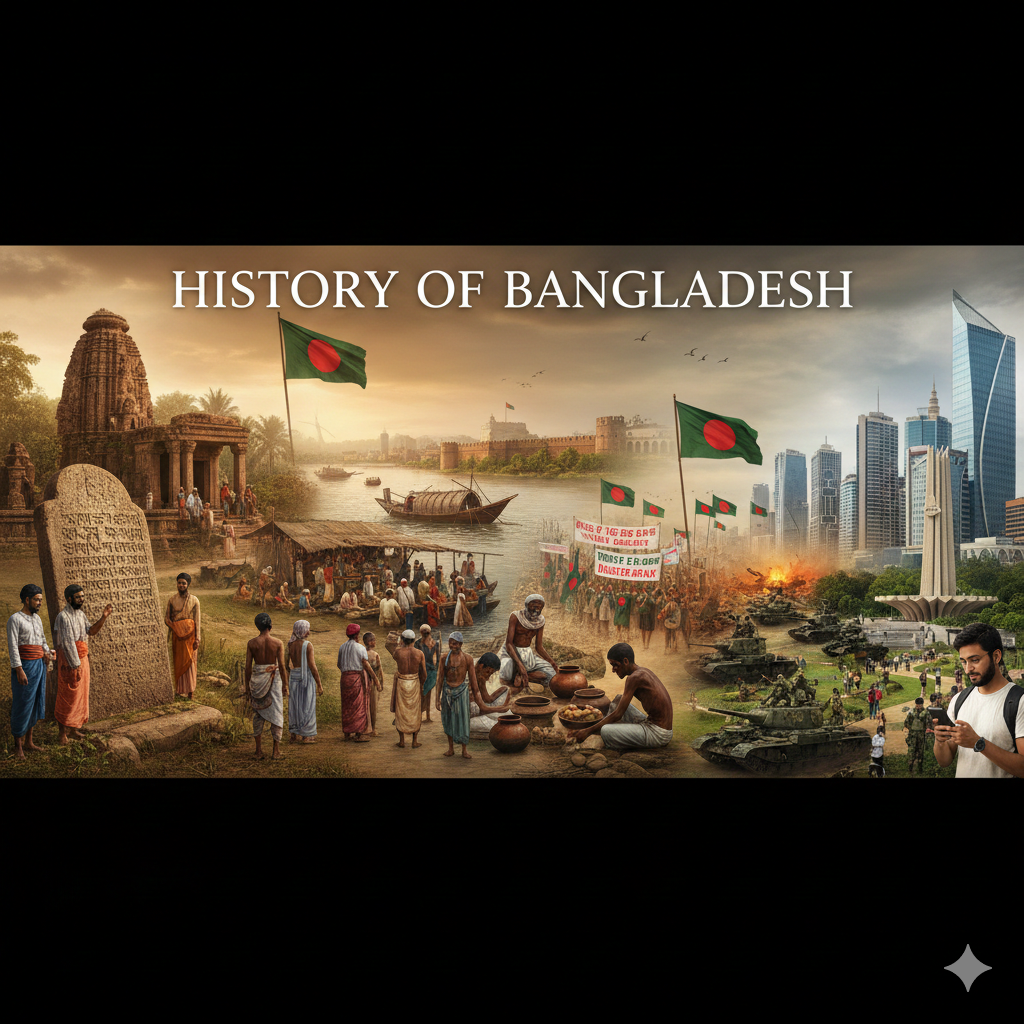
 An Extensive History of Bangladesh: From Ancient Bengal to an Independent Nation
The history of Bangladesh is a vibrant and complex tapestry woven from ancient kingdoms, powerful empires, the rise of major world religions, centuries of colonial rule, nationalist movements, and a bloody, defining war for independence. Located in the fertile delta of the Ganges, Brahmaputra, and Meghna rivers, this region, historically known as Bengal, has always been a crossroads of culture, trade, and political ambition.
I. Ancient and Classical Bengal (c. 1000 BCE – 1204 CE)
The history of Bengal begins long before the modern state. The region was first settled by various ethnic and linguistic groups, with the Vanga (or Bangla) region giving the land its name.
A. Pre-Mauryan and Mauryan Period
-
- Early Kingdoms: Archaeological evidence suggests settled agriculture and sophisticated societies existed well before 1000 BCE. By the 7th century BCE, the powerful kingdom of Pundra (with its capital at Pundranagara, modern Mahasthangarh) was established in northern Bengal.
-
- The Gangaridai: Greek accounts mention the formidable Gangaridai kingdom, located in the Ganges Delta. Their military might, particularly their large elephant corps, famously deterred Alexander the Great from marching further eastward in 326 BCE.
-
- Ashoka’s Influence: Bengal was brought under the vast Mauryan Empire in the 3rd century BCE, which introduced Buddhism to the region under Emperor Ashoka. The administrative capital was located at Samatata (in the southeast).
B. The Classical Empires (Gupta and Pala)
-
- Gupta Empire (c. 3rd–6th Century CE): Northern Bengal (Pundravardhana) became a vital province of the Gupta Empire, often considered the “Golden Age of India.” This period saw a flowering of Sanskrit literature, art, and Hindu philosophical thought.
-
- The Pala Empire (c. 8th–12th Century CE): Following a period of anarchy (matsyanyaya or ‘fish justice’), the Pala dynasty was established by Gopala in the mid-8th century. The Palas were ardent patrons of Mahayana Buddhism, establishing the renowned monastic universities of Vikramashila and Somapura Mahavihara (Paharpur), a UNESCO World Heritage site in modern Bangladesh. The Pala Empire was arguably the most powerful native empire to rule a unified Bengal, extending its influence across northern India for over four centuries and developing a distinct Vanga-Kamarupa school of art.
-
- The Sena Dynasty (c. 11th–13th Century CE): The Sena rulers, originally from South India, supplanted the Palas. They were Hindu revivalists and oversaw the final phase of classical Bengali culture. The capital was established at Vickrampur (near Dhaka). Lakshman Sena was the last major Hindu ruler of Bengal.
II. The Sultanate and Mughal Period (1204 – 1757 CE)
The arrival of Islamic rule marked a transformative epoch, fundamentally altering Bengal’s political, social, and cultural landscape.
A. The Delhi Sultanate and Independent Bengal
-
- Ghurid Conquest (1204 CE): The Turkic general Bakhtiyar Khilji overran the capital of the Sena Kingdom, effectively ending Hindu rule in the western and central parts of the region.
-
- Sultanate Rule: Bengal initially remained a province of the Delhi Sultanate but, given its distance and immense wealth, it frequently asserted independence.
-
- The Bengal Sultanate (1352–1576 CE): This was a period of great prosperity, with capitals at Gaur and Sonargaon. The independent Bengali sultans fostered syncretic Indo-Islamic culture. They financed massive public works, encouraged local literature (including the translation of Hindu epics like the Mahabharata into Bengali), and presided over a massive demographic shift as Sufi mystics and Islamic scholars spearheaded the conversion of the local population, leading to Bengal becoming a Muslim-majority region. It was a major global trading hub, attracting merchants from China, the Middle East, and Europe.
B. The Mughal Subah (Province)
-
- Mughal Conquest (1576 CE): The Bengal Sultanate was conquered by the forces of Mughal Emperor Akbar, though full subjugation took decades.
-
- The Subah of Bengal: Under the Mughals, Bengal became the richest province (Subah) of the empire, known as the “Paradise of Nations” and the “Storehouse of the World.” Its fertile lands produced vast quantities of rice, jute, cotton, and silk.
-
- Dhaka as Capital: The capital was shifted to Dhaka, and the city was renamed Jahangirnagar. Shaista Khan, a prominent governor, oversaw significant construction and economic expansion in the 17th century. Bengal became a center for the global textile trade, exporting fine muslin to Europe.
-
- Nawabs of Bengal: As the Mughal Empire declined in the 18th century, the governors of Bengal (the Nawabs) became effectively independent rulers, though they nominally acknowledged the Mughal Emperor. Murshid Quli Khan established his own dynasty, which was immensely wealthy but militarily weak.
III. Colonial Rule and the British Raj (1757 – 1947 CE)
The economic wealth of Bengal attracted European trading companies, leading to a clash that irrevocably altered the region’s trajectory.
A. The Battle of Plassey and Early British Rule
-
- Battle of Plassey (1757): The Nawab Siraj-ud-Daulah was betrayed by his own general, Mir Jafar, and defeated by the forces of the British East India Company, led by Robert Clive. This victory was the single most pivotal event in the history of British India, establishing the Company as the de facto ruler of Bengal.
-
- Dual Government and Famine: The Company imposed a “Dual Government,” which led to massive economic exploitation. This mismanagement, combined with severe drought, culminated in the devastating Great Bengal Famine of 1770 (Chhiattorer Monnontor), which killed an estimated one-third of the population.
-
- The Permanent Settlement (1793): Lord Cornwallis introduced this land revenue system, which created a new class of powerful landlords (Zamindars). This system largely benefited Hindu upper castes, who often lived in Calcutta (Kolkata), while the majority Muslim peasantry in East Bengal faced increasing economic hardship.
B. The Renaissance and Nationalist Movements
-
- Bengal Renaissance: Centered in Calcutta, this was a period of intense socio-cultural and intellectual awakening, primarily among the Hindu elite. It produced giants like Ram Mohan Roy and Rabindranath Tagore, but its impact was initially limited among the predominantly rural Muslim population of East Bengal.
-
- 1857 Rebellion: After the Sepoy Mutiny, the British Crown took direct control, establishing the British Raj.
-
- The Partition of Bengal (1905): Lord Curzon partitioned Bengal into a predominantly Muslim-majority East Bengal and Assam, and a Hindu-majority West Bengal. While the stated goal was administrative efficiency, it was seen as a move to divide the surging Bengali nationalist movement. The Swadeshi movement, a massive Hindu-led protest, forced the British to annul the partition in 1911, an act that deeply alienated the Muslims of East Bengal who had welcomed the creation of a new province where they were the majority.
C. The Road to Partition
-
- The All India Muslim League (1906): Founded in Dhaka, the League sought to protect Muslim political rights in India.
-
- Communal Tensions: The failure of the 1905 partition to stand, combined with economic disparities, deepened communal divisions in Bengal. Muslim leaders increasingly felt that their cultural and economic interests were not safe in an independent, Hindu-dominated, united India.
-
- The Lahore Resolution (1940): A.K. Fazlul Huq, a major Bengali Muslim leader, moved the historic resolution demanding “geographically contiguous units… be grouped to constitute ‘independent states’ in which the constituent units shall be autonomous and sovereign.” This resolution laid the foundation for the demand for Pakistan.
IV. The Pakistan Period (1947 – 1971)
In 1947, the British Raj was dissolved, and India was partitioned. Bengal was divided again, with the Muslim-majority eastern part becoming East Pakistan, a geographically non-contiguous part of the new state of Pakistan.
A. The Seeds of Discontent
-
- The Two-Wing State: East Pakistan, despite having a larger population, was geographically and culturally separated from West Pakistan (which housed the central government). Urdu was declared the sole national language of Pakistan, immediately triggering a nationalist backlash in East Bengal.
-
- The Language Movement (1952): Bengali students and activists protested the imposition of Urdu. On February 21, 1952, police fired on demonstrators in Dhaka, killing several students. This event, now observed as International Mother Language Day, was the first assertion of Bengali cultural nationalism and proved that Bengali identity would take precedence over a shared religious one.
-
- Economic Exploitation: East Pakistan consistently contributed the majority of Pakistan’s exports (jute, tea) but received disproportionately little in return in terms of budget allocation, industrial development, and military expenditure. Political power remained concentrated in West Pakistan.
B. The Rise of Sheikh Mujibur Rahman
-
- The Six-Point Movement (1966): Sheikh Mujibur Rahman, leader of the Awami League, presented a six-point charter demanding comprehensive provincial autonomy for East Pakistan, including control over currency, foreign trade, and defense. This was seen by the West Pakistani establishment as a demand for secession.
-
- The Agartala Conspiracy Case (1968–69): Sheikh Mujib was arrested and charged with treason for allegedly conspiring with India. Massive protests forced the government to drop the case and release him, earning him the title Bangabandhu (Friend of Bengal).
C. The War of Liberation (1971)
-
- 1970 Election: The Awami League, led by Sheikh Mujib, won a landslide victory in the first democratic general elections in Pakistan’s history, securing a clear absolute majority in the national assembly. The West Pakistani military establishment refused to hand over power.
-
- Operation Searchlight (March 25, 1971): Following stalled negotiations, the Pakistan Army launched a brutal military crackdown on the night of March 25, targeting Bengali intellectuals, students, and Hindus. Sheikh Mujibur Rahman was arrested.
-
- Declaration of Independence: Just before his arrest, Mujib broadcast a call for independence. On March 26, 1971, Ziaur Rahman, a Major in the Pakistan Army, read a declaration of independence on behalf of Mujib over the radio. The Provisional Government of Bangladesh (Mujibnagar Government) was formed on April 10, 1971.
-
- The Genocide: The resulting conflict was a vicious, nine-month-long war. The Pakistan Army, aided by local collaborators, carried out what is widely considered a genocide, killing an estimated 300,000 to 3,000,000 people and forcing over 10 million refugees to seek shelter in India. The Bengali freedom fighters, known as the Mukti Bahini, engaged in widespread guerrilla warfare.
-
- Victory: India intervened in December 1971. The joint forces of the Indian Army and the Mukti Bahini overwhelmed the Pakistani forces. On December 16, 1971, the Pakistan Army formally surrendered at the Ramna Race Course in Dhaka, and Bangladesh was born as an independent, sovereign nation.
V. Independent Bangladesh (1971 – Present)
The early years of independent Bangladesh were marked by euphoria, but also immense challenges: recovering from the war, economic devastation, and political instability.
A. The Mujib Era (1972–1975)
-
- Constitution: Sheikh Mujibur Rahman returned from Pakistani imprisonment and was sworn in as Prime Minister. The new constitution was adopted in 1972, establishing a parliamentary democracy based on four founding principles: Nationalism, Socialism, Democracy, and Secularism.
-
- Economic Crisis and Instability: The new nation faced famine, corruption, and a severe economic crisis. Mujib’s attempts to nationalize industries failed to spur growth.
-
- The Coup (1975): Frustrated by instability, Mujib moved towards a one-party state (BAKSAL) in 1975. On August 15, 1975, he and most of his family were assassinated in a military coup, plunging the nation into decades of political uncertainty and military rule.
B. Military and Restored Democracy (1975–1990)
-
- Ziaur Rahman: Major General Ziaur Rahman (the Major who declared independence), initially seized power through a series of counter-coups. He founded the Bangladesh Nationalist Party (BNP), transitioned the country back to a limited democracy, and steered the country towards a market economy. He was assassinated in 1981.
-
- Hussain Muhammad Ershad: Another military chief, General Ershad, seized power in a bloodless coup in 1982. He also founded his own party (Jatiya Party) and served until a mass pro-democracy movement forced him to resign in 1990. During his rule, he made Islam the state religion, a significant shift from the secular principles of the original constitution.
C. The Two-Party Era and Economic Growth (1991 – Present)
-
- Restoration of Democracy: Following the 1990 movement, Bangladesh returned to parliamentary democracy, dominated by two parties: the Awami League (led by Sheikh Hasina, Mujib’s daughter) and the BNP (led by Khaleda Zia, Ziaur Rahman’s widow). The period was marked by fierce political rivalry, with frequent strikes and political deadlock.
-
- Economic Transformation: Despite political instability, Bangladesh has achieved remarkable economic growth, particularly since the 1990s. The Ready-Made Garment (RMG) industry became the country’s primary export earner, and significant progress was made in poverty reduction, female education, and healthcare (aided by institutions like the Grameen Bank and BRAC). Bangladesh has transitioned from a “basket case” (a term used by Henry Kissinger) to a Lower Middle-Income Country.
-
- Current Political Landscape: The Awami League has been in power since 2009. This period has seen sustained economic growth and massive infrastructure projects (like the Padma Bridge). However, it has also faced scrutiny regarding the state of democracy, human rights, and political opposition space. Bangladesh is currently on track to graduate from the UN’s Least Developed Country (LDC) status by 2026, marking a pivotal moment in its post-independence journey.
The history of Bangladesh is a story of resilience—a nation born out of a cultural identity that refused to be subjugated, first by colonial powers and then by a central government that denied its people self-determination. It is a history that celebrates cultural heritage and an ongoing struggle to balance democracy, development, and national identity in one of the world’s most densely populated and strategically important river deltas.
Visit : www.dkbtech.com and www.allcircular.com