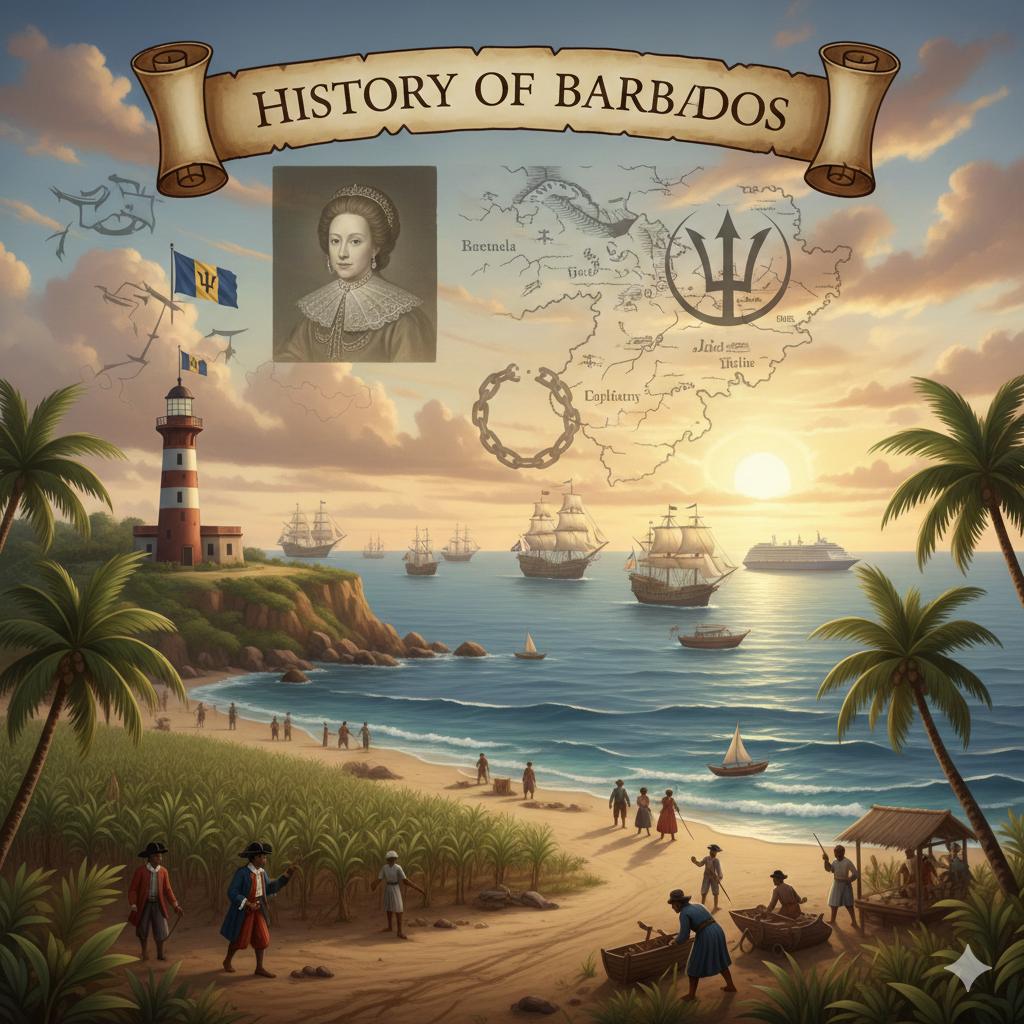
 A Comprehensive History of Barbados: From ‘Ichirouganaim’ to Republic
The History of Barbados is a singular narrative among Caribbean islands. Unlike its volcanic neighbours, which often changed hands between rival European powers, Barbados remained under continuous English (and later British) control from its initial settlement until independence. This long, unbroken colonial period shaped the island into a unique entity—a laboratory for the race-based plantation economy, a strategic linchpin of the British Empire, and ultimately, a nation forged through resistance, labour, and a deliberate, peaceful quest for sovereignty.
The Pre-Columbian and Early European Eras
Amerindian Settlement (c. 1600 BCE – 16th Century CE)
Archaeological evidence suggests Barbados, which indigenous peoples may have called Ichirouganaim, was first visited or settled as early as 1600 BCE. The island’s documented prehistory is divided into waves of migration from the South American mainland:
-
- Saladoid-Barrancoid Peoples (c. 350–650 CE): The earliest permanent settlers, likely migrating via the Lesser Antilles.
-
- Arawak-speaking Tainos (c. 800 CE): These groups settled and cultivated the island.
-
- Kalinago (Caribs): The last Amerindian group, who visited and may have driven out earlier settlers, but appear to have only established temporary settlements before the arrival of Europeans.
By the early 16th century, the island was largely uninhabited. Spanish slave raids may have captured or dispersed the remaining indigenous population to more defensible islands.
European “Discovery” and Claim (16th–17th Century)
The island’s European name, “Los Barbados” (The Bearded Ones), is attributed to either the Portuguese explorer Pedro Campos in 1536 or earlier Spanish visitors, referencing the long, aerial roots of the island’s native Bearded Fig Trees. Neither Spain nor Portugal established a lasting settlement, leaving the island a strategic blank slate.
The English claimed Barbados in 1625 when Captain John Powell’s ship, en route from Brazil, touched the island. The first permanent English settlement was established in 1627 near what is now Holetown (originally Jamestown) by Powell’s younger brother, Henry, with 80 settlers and a small number of African and English indentured labourers.
The Sugar Revolution and the Roots of the Plantocracy (1640–1700)
From Tobacco to Sugar
The first decades of the colony were characterized by small farms growing cash crops like tobacco, cotton, and indigo, largely worked by white indentured servants (including transported prisoners and political dissidents from England and Ireland). However, these crops proved difficult to market profitably against competition from other colonies.
This changed dramatically in the 1640s—a period known as the Sugar Revolution. With the assistance of experienced Dutch merchants and technicians, Barbadian planters acquired sugarcane and the technology for its processing, transitioning the island’s economy entirely to sugar production.
The Establishment of the Slave System
The consequences of the Sugar Revolution were profound and swiftly brutal:
-
- Land Consolidation: Sugar production was capital-intensive and required large tracts of land. Small family farms were rapidly bought out and amalgamated into vast, single-crop plantations, forcing many poor whites to emigrate to other colonies like Jamaica and the Carolinas.
-
- Shift to African Slavery: The demand for relentless, year-round labour far outstripped the supply of indentured servants. Planters turned overwhelmingly to the forced importation of enslaved Africans from West Africa via the horrific transatlantic slave trade.
-
- Demographic Shift: The island’s ethnic mix was completely inverted. By the 1680s, the enslaved African population outnumbered the white population by more than two-to-one, a ratio that would only widen over the next century. Barbados quickly became the most densely populated and profitable colony in the English Empire.
The 1661 Slave Code
To maintain control over a rapidly growing, forcibly oppressed population, the Barbadian elite enacted the Barbados Slave Code of 1661. This legislation was the foundational blueprint for race-based slavery across the British Americas. It explicitly defined enslaved Africans as chattel (property), stripped them of all legal rights, legalized brutal punishments, and entrenched the system of racial oppression that governed the island for nearly two centuries.
3. The Colonial Zenith and the Seeds of Resistance (1700–1834)
“Little England” and the Plantocracy
Barbados became known as “Little England” due to its early and robust establishment of English customs, law, and a parliamentary tradition. The House of Assembly, established in 1639, made it the third oldest parliament in the Commonwealth (after Westminster and Bermuda’s House of Assembly).
However, this democratic tradition was highly exclusive. The true power resided with the plantocracy, a small, wealthy, and politically dominant elite of sugar barons who controlled the Assembly and used it to protect their economic interests, primarily by maintaining the institution of slavery.
The Age of Resistance
Despite the stringent controls of the Slave Code, resistance was constant, ranging from quiet sabotage and truancy to outright rebellion.
Bussa’s Rebellion (1816)
The most significant and devastating slave revolt in Barbadian history was Bussa’s Rebellion in April 1816.
-
- The Context: Following the 1807 abolition of the slave trade (though not slavery itself), and buoyed by rumours that emancipation had been granted but withheld by the local planters, the enslaved population sought to force the issue.
-
- The Leader: The rebellion was led by Bussa, an African-born slave who held the relatively privileged position of a ‘ranger’ (overseer) at Bayley’s Plantation in St. Philip.
-
- The Uprising: Coordinated actions began on Easter Sunday, April 14, 1816, with fires set across numerous plantations in the parishes of St. Philip, Christ Church, and St. George. The rebels’ aim was to overthrow the plantocracy and establish a free society.
-
- The Aftermath: The revolt lasted only three days before it was violently suppressed by the colonial militia and British troops. Bussa was killed in battle. The reprisal was brutal: hundreds of enslaved people were killed during and after the fighting, and many more were tried and executed.
While crushed, Bussa’s Rebellion proved that the enslaved population was determined to fight for their freedom. Alongside the later revolts in Demerara (1823) and Jamaica (1831–32), it played a crucial role in shifting public opinion in Britain, giving momentum to the growing abolitionist movement.
4. Emancipation and the Transition to Free Labour (1834–1890)
The Abolition of Slavery (1834)
In 1834, the Slavery Abolition Act was passed by the British Parliament, formally ending the institution of slavery in all British colonies, including Barbados.
-
- Apprenticeship: The emancipation did not lead to immediate, full freedom. Instead, a period of “Apprenticeship” was instituted, forcing former slaves to continue working for their former masters for a transition period (initially set for six years). This system was intended to ease the planters’ transition to free labour but quickly proved to be just another form of enforced servitude.
-
- Full Freedom (1838): Due to the widespread abuse and ineffectiveness of the apprenticeship system, and strong agitation from the formerly enslaved, the colonial government was pressured to declare full freedom for all by August 1, 1838.
The Reign of the Plantocracy Continues
Unlike some of its Caribbean neighbours where former slaves could squat on unused land, Barbados was almost entirely under sugar cultivation. This limited geographic mobility meant the newly freed population had little choice but to remain on the plantations as wage labourers, forcing them to accept low wages and harsh conditions.
Planters used the “locate system”, where workers’ tenancy was tied to their employment, effectively ensuring a continued supply of cheap labour. Political power remained firmly in the hands of the white land-owning elite due to high property qualifications for voting.
5. The Rise of Mass Politics and Labour Movements (1890–1966)
Early Calls for Reform
The late 19th and early 20th centuries were marked by mounting social and economic pressure. The sugar industry faced international competition, and poverty among the vast majority of the black working class was widespread. Calls for constitutional reform—specifically lowering the voting qualifications to allow the black professional and working classes to gain a political voice—grew louder.
The Moyne Commission and the Birth of Modern Politics
The simmering tensions erupted in the 1937 Riots across the island, sparked by economic hardship and the deportation of Clement Payne, a Trinidadian political activist who was organizing Barbadian workers. The riots led the British Government to establish the West India Royal Commission (the Moyne Commission) to investigate conditions across the Caribbean.
The Commission’s findings were damning, advocating for social and political reforms, which provided the impetus for the rise of organized political parties:
-
- Sir Grantley Herbert Adams (1898–1971): A lawyer and labour advocate, Adams founded the Barbados Labour Party (BLP) in 1938. The BLP focused on constitutional change, universal adult suffrage, and better working conditions. He spearheaded the push for internal self-governance.
-
- Errol Walton Barrow (1920–1987): Originally a member of the BLP, Barrow split to form the Democratic Labour Party (DLP) in 1955, advocating for a faster, more assertive path to independence and social reforms.
The Decolonization Era
In 1951, universal adult suffrage was finally introduced, radically shifting the political landscape and transferring power from the plantocracy to the elected representatives of the majority.
-
- Internal Self-Government: Grantley Adams served as the first Premier of Barbados (1954–1958).
-
- West Indies Federation: Barbados was a founding member of the short-lived West Indies Federation (1958–1962), with Grantley Adams serving as its only Prime Minister.
-
- The Path to Independence: After the collapse of the Federation, Errol Barrow, then Premier, decided to steer Barbados towards independent nationhood, famously declaring the island would proceed with “friends of all, satellites of none.” The DLP won the 1961 elections, and Barrow accelerated the decolonization process.
History of Barbados Independence (1966)
On November 30, 1966, Barbados achieved full political independence from Britain. Errol Walton Barrow became the country’s first Prime Minister. The new nation adopted the Westminster parliamentary system and joined the Commonwealth as a Commonwealth Realm, retaining Queen Elizabeth II as Head of State, represented by a Governor-General.
6. Modern Barbados: Sovereignty and the Republic (1966–Present)
Economic and Social Transformation
Following independence, the DLP government under Barrow implemented massive social reforms focused on economic diversification and human development:
-
- “The Father of Independence” championed programs that laid the foundation for the modern Barbadian welfare state, including free secondary and tertiary education for all, the establishment of the National Insurance Scheme, and the active promotion of tourism and manufacturing to reduce reliance on sugar.
-
- Barbados successfully transformed itself from a mono-crop economy to a mixed economy reliant on tourism, international business, and financial services, achieving one of the highest Human Development Indices in the region.
The Road to a Republic
The notion of full republican status—removing the British monarch as head of state—had been an ongoing discussion since the 1970s. For many, becoming a republic was the final, necessary step to complete the journey of sovereignty begun in 1966.
-
- Constitutional Review: Multiple commissions recommended the move over the decades, but the momentum was often stalled.
-
- The 2020 Announcement: In September 2020, the government of Prime Minister Mia Mottley announced its intention to transition to a parliamentary republic by the 55th anniversary of independence.
-
- Republican Status (2021): On November 30, 2021, Barbados formally transitioned to a republic. The Queen was replaced as head of state by a Barbadian President elected by Parliament. Dame Sandra Mason, the former Governor-General, was sworn in as the nation’s first President.
The transition, witnessed by dignitaries including the Prince of Wales (now King Charles III), marked the end of nearly 400 years of monarchical rule, solidifying the island’s full and final declaration of sovereignty and self-determination.
The history of Barbados is a testament to the resilience of a people who turned an exploited island—a place that was, in the 17th century, a crucible of European colonial brutality—into a stable, prosperous, and proudly independent nation, driven by the enduring spirit of its labour leaders and its citizens’ commitment to democratic ideals.
Visit : www.dkbtech.com and www.allcircular.com