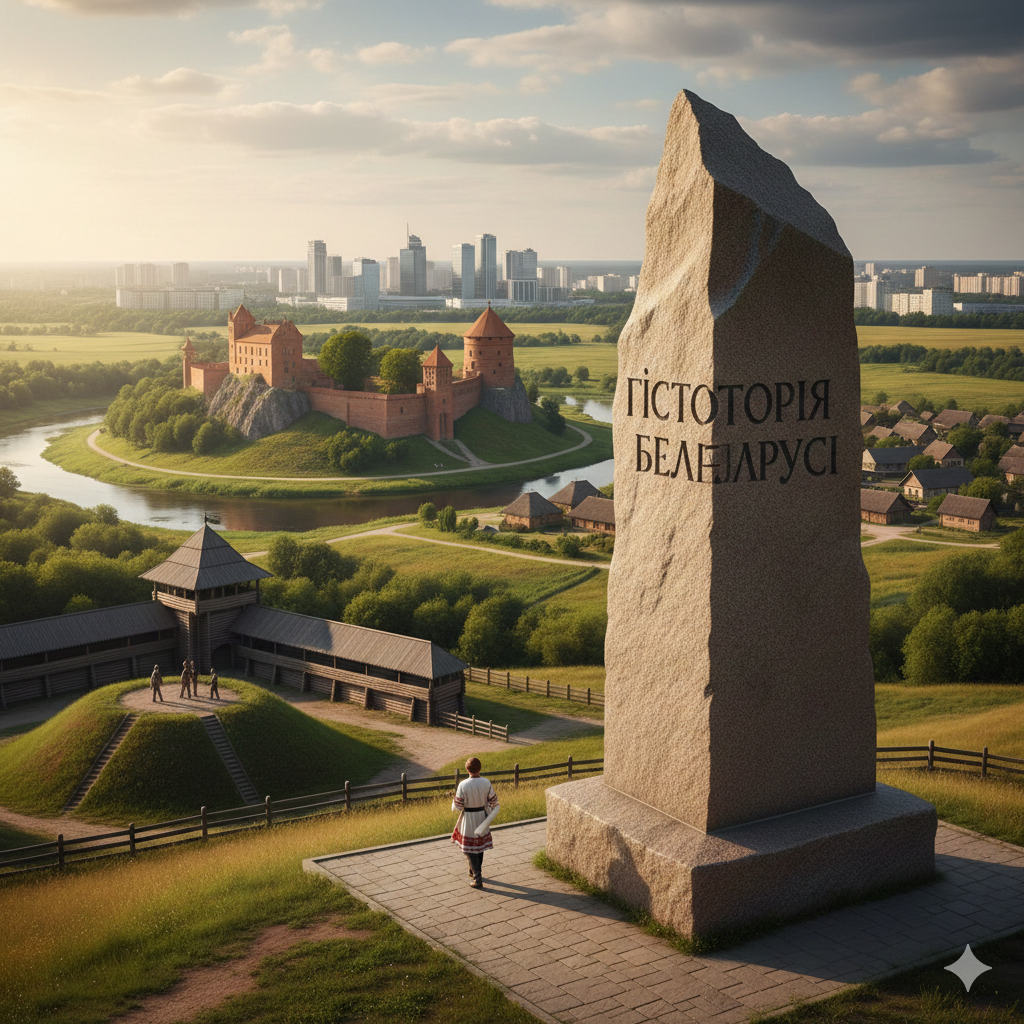
The history of Belarus is a narrative of resilience, cultural synthesis, and persistent struggle for self-determination at the geopolitical crossroads of Eastern Europe, influenced heavily by its neighbors: the Nordic, Baltic, Slavic, and Eurasian worlds.
I. Early History and the Rise of East Slavic Principalities (Pre-9th Century – 13th Century)
The territory of modern Belarus has been inhabited since the Paleolithic era. Early settlements dating back 23,000–26,000 years have been discovered in the Gomel oblast.
The Slavic Settlement and Early Cultures
Around the 5th century, the region began to be permanently settled by East Slavic tribes, notably the Kryvians (in the north), Dregovians (in the center), and Radzimians (in the east). These tribes gradually replaced the earlier Baltic (like the Dnieper Balts and Yotvingians) and other cultures, integrating local traditions into the emerging East Slavic identity.
The Principality of Polotsk(9th – 13th Century)
The first proto-state entity on Belarusian lands was the Principality of Polotsk, first mentioned in chronicles in 862 AD. Polotsk emerged as a dominant center, strategically located on the “Route from the Varangians to the Greeks” (the ancient trade route connecting Scandinavia to the Byzantine Empire).
-
- Political Significance: The principality repeatedly asserted its sovereignty in relation to the larger centers of Kievan Rus’, of which it was nominally a part. Its rulers, like the legendary Prince Rogvolod and his family, often engaged in power struggles with Kiev and Novgorod.
-
- Cultural Zenith: This period saw a flourishing of architecture, literature, and enlightenment, marked by the activities of Euphrosyne of Polotsk (1120–1173). She established monasteries, promoted literacy, and sponsored art, becoming one of Belarus’s most revered figures. The construction of the Cathedral of Holy Wisdom in Polotsk (1044–1066) symbolized its independent-mindedness, rivaling the cathedrals of Kiev and Novgorod.
-
- Other Centers: Other principalities, such as the Principality of Turov, were also established in the south (first mentioned in 980).
II. The Grand Duchy of Lithuania (13th Century – 1569)
The loose-knit East Slavic principalities were unable to withstand the Mongol invasions, which severely weakened them. This created a power vacuum that was filled by a new political entity: the Grand Duchy of Lithuania (GDL).
Formation and Expansion
Starting in the 13th century, under rulers like Mindaugas (Mindovg), the GDL began to consolidate power, incorporating the weakened Belarusian principalities (Polotsk, Turov, Minsk, etc.) without major conquest. By its zenith, the GDL stretched from the Baltic Sea to the Black Sea, becoming one of the largest states in Europe.
-
- Ruthenian Influence: The majority of the GDL’s territory, population, and cultivated land was historically East Slavic (Ruthenian). Consequently, the Old Belarusian language (known as Ruthenian or Chancery Slavonic) was the official language of the state administration, law, and diplomacy until the late 17th century.
-
- The Statutes of Lithuania: The legal codification of the GDL, the Statutes of Lithuania (published 1529, 1566, and 1588), were landmark documents written in Old Belarusian. They laid the foundation for a legal system and are seen as a cornerstone of Belarusian national statehood and law.
Cultural Renaissance (16th Century)
The 16th century, coinciding with the Renaissance, was a period of high cultural achievement:
-
- Francysk Skaryna: A doctor and humanist, Francysk Skaryna (c. 1470 – c. 1551) became one of the first printers in Eastern Europe. In 1517, he published the Psalter in the Old Belarusian language in Prague, an event seen as the start of printing among East Slavs and a key moment in the development of the modern Belarusian language.
-
- Architecture and Arts: Fortified architecture (castles in Mir and Nesvizh) and the synthesis of local traditions with Gothic and Romanesque styles flourished.
III. The Polish-Lithuanian Commonwealth (1569 – 1795)
Faced with the growing military power of Muscovy (Russia), the Grand Duchy of Lithuania and the Kingdom of Poland signed the Union of Lublin in 1569, creating a federative state: the Polish-Lithuanian Commonwealth (Rzeczpospolita).
The Commonwealth Period
Belarusian lands formed a large and crucial part of the Commonwealth.
-
- Religion: The Union of Brest in 1596 created the Uniate Church (Greek Catholic), which recognized the Pope’s authority while retaining Orthodox rites. This was a significant development, contributing to a unique cultural and religious identity distinct from both Catholic Poland and Orthodox Russia.
-
- Polonization and Decline: Over time, the Polish cultural and political influence increased. The Polish language replaced Old Belarusian as the official language of administration at the end of the 17th century, and a significant portion of the Belarusian nobility became polonized (or Catholic). The state was weakened by constant wars (with Russia, Sweden, the Cossack-Peasant Uprisings) and internal feuds.
The Partitions of the Commonwealth (1772, 1793, 1795)
The weakened Commonwealth was partitioned among its neighbors—Russia, Prussia, and Austria—in three stages. The vast majority of the ethnic Belarusian lands were incorporated into the Russian Empire for the first time.
-
- End of an Era: The 1795 Third Partition officially ended the Polish-Lithuanian Commonwealth, and Belarus became a part of the “North-Western Krai” of the Russian Empire.
IV. Under the Russian Empire (1795 – 1917)
The period under Russian rule was marked by imperial administrative control, occasional revolts, and the emergence of a modern national consciousness.
Imperial Rule and Suppression of Uprisings
The Russian government implemented policies of integration and, at times, Russification.
-
- Revolts: Belarusian lands were a center of anti-Russian uprisings, often linked to Polish efforts to restore the Commonwealth. Key events include:
-
- The Polish Revolt of 1830–1831
-
- The Great Rebellion of 1863–1864, led by Kastus Kalinowski (Konstanty Kalinowski), who became a national hero for the modern Belarusian movement. Kalinowski’s vision of national liberation connected the fate of the peasantry with the idea of independence.
-
- Revolts: Belarusian lands were a center of anti-Russian uprisings, often linked to Polish efforts to restore the Commonwealth. Key events include:
-
- Cultural Repression: After the failed 1863-1864 revolt, the Russian government severely restricted the use of the Belarusian language, reintroduced the Cyrillic alphabet (following a brief period of Latin script, or Łacinka, being permitted), and allowed no documents in Belarusian until 1905. The official state narrative denied the existence of a distinct Belarusian nationality, viewing them merely as a dialect of Russians.
The Belarusian National Revival (Late 19th – Early 20th Century)
Despite the repressive environment, a modern Belarusian national and cultural movement began to form, driven by the intelligentsia.
-
- Literary Foundations: The early 20th century saw the formation of classical Belarusian literature, with figures like Yanka Kupala and Yakub Kolas establishing the basic standards and regulations of the modern Belarusian literary language.
-
- Political Awakening: The Revolution of 1905, which granted some freedoms, allowed for the development of a national press, printing, and theater, intensifying the process of political and state self-identification.
V. Revolution, Wars, and the Soviet Period (1917 – 1991)
The collapse of the Russian Empire and the subsequent turmoil of World War I and the Russian Civil War led to the first attempts at Belarusian statehood.
The Short-Lived Belarusian People’s Republic (BNR)
Following the Bolshevik Revolution in 1917, the Belarusian People’s Republic (BNR) declared its independence on March 25, 1918, while German forces occupied much of the territory. However, the BNR had little popular support or administrative power and ceased to exist after the German withdrawal later that year.
The Division of Belarus
The political chaos that followed resulted in the division of the Belarusian nation:
-
- Western Belarus fell under Polish control after the Polish-Soviet War (1918–1921) and the Treaty of Riga (1921).
-
- Eastern Belarus became the Byelorussian Soviet Socialist Republic (BSSR), proclaimed on January 1, 1919, and officially established on July 31, 1920. The BSSR became one of the four founding constituent republics of the Soviet Union (USSR) in 1922.
Interwar Years (1920s-1930s)
-
- “Belarusianization” in the BSSR: In the 1920s, a policy of “Belarusianization” was briefly adopted, promoting the Belarusian language and national culture. However, from the late 1920s and throughout the 1930s, this was brutally reversed by the Stalinist regime. The Belarusian intelligentsia and emerging national movement were decimated during the purges, with many victims being deported to the Gulag or executed (e.g., at Kuropaty).
-
- Reunification (1939): On September 17, 1939, two weeks after the start of World War II, the Red Army moved into eastern Poland (Western Belarus), and these lands were reintegrated into the BSSR.
World War II and the Great Patriotic War (1941 – 1945)
This period is the most catastrophic and heroic in Belarusian history, known as the Great Patriotic War.
-
- German Occupation (1941–1944): Nazi Germany invaded the USSR in June 1941. Belarus was fully occupied by September 1941. The invaders established a brutal “new order” based on terror, mass executions, and the systematic extermination of the Jewish population, including the establishment of the Minsk Ghetto.
-
- The Partisan Movement: Belarus was the site of the largest anti-Nazi partisan movement in Europe. Partisan groups tied up significant German forces and played a crucial role in undermining the occupation.
-
- Devastation and Loss: Military operations and occupation devastated Belarus, which lost an estimated one-quarter of its population (over 2 million people, including approximately 380,000 Jews) and nearly half of its economic resources. Entire villages were burned to the ground (e.g., Khatyn).
-
- Liberation: Operation Bagration by the Red Army in the summer of 1944 liberated the BSSR, with the capital, Minsk, freed on July 3, 1944, which is now celebrated as Independence Day (a continuation of the Soviet-era Victory Day celebration).
Post-War BSSR (1945 – 1991)
-
- International Recognition: In 1945, the Byelorussian SSR, despite being part of the Soviet Union, became a founding member of the United Nations, along with the USSR and the Ukrainian SSR, as recognition of its people’s immense contribution to the Allied victory.
-
- Industrialization and Russification: The post-war period saw a rapid transformation of the BSSR from an agrarian society into an industrial hub of the Soviet Union. However, this was accompanied by an intensive policy of Russification, especially after the 1960s, leading to a decline in the use of the Belarusian language and the suppression of national cultural expression.
-
- Chernobyl Disaster (1986): The explosion of the Chernobyl nuclear reactor in neighboring Ukraine severely affected Belarus, with approximately 60% of the radioactive fallout landing on Belarusian territory, contaminating vast areas of agricultural land and causing long-term health and environmental issues.
VI. The Republic of Belarus (1991 – Present)
Declaration of Independence
The liberalizing reforms of Perestroika and Glasnost in the late 1980s led to a revival of the Belarusian national movement.
-
- The BSSR proclaimed its sovereignty on July 27, 1990.
-
- During the dissolution of the Soviet Union, Belarus declared its full independence on August 25, 1991.
-
- In December 1991, in the Belovezhskaya Pushcha National Park in Belarus, the leaders of Russia, Ukraine, and Belarus signed the agreement that formally dissolved the USSR and established the Commonwealth of Independent States (CIS), with Minsk becoming its headquarters.
The Lukashenko Era (1994 – Present)
Following the adoption of a new constitution in 1994, which introduced the presidency, the first and only relatively free presidential election was held.
-
- 1994 Election: Alexander Lukashenko was elected as the first President of the Republic of Belarus.
-
- Integration with Russia and Authoritarian Rule: Lukashenko quickly consolidated power, implementing policies that favored closer integration with Russia (including making Russian an official state language again) and reversing many post-Soviet democratic and market reforms.
-
- Constitutional Changes: Through controversial referenda (1995, 1996, 2004), presidential powers were significantly expanded, term limits were removed, and state symbols similar to those of the BSSR were restored.
-
- “Last Dictatorship in Europe”: Under Lukashenko, Belarus has become increasingly authoritarian, characterized by highly centralized governance, state control over the economy, suppression of political opposition, and media control. This has led to the regime being frequently referred to as the “last dictatorship in Europe.”
-
- Protests: Significant opposition movements and street protests have occurred, notably after presidential elections in 2006, 2010, and, most prominently, in 2020, following a disputed election result. These protests have been met with a violent state response.
-
- Integration with Russia and Authoritarian Rule: Lukashenko quickly consolidated power, implementing policies that favored closer integration with Russia (including making Russian an official state language again) and reversing many post-Soviet democratic and market reforms.
The history of Belarus remains highly contested, caught between competing Soviet/neo-Soviet and nationalist historical narratives, reflecting the country’s ongoing struggle to define its national identity and political future at the boundary between East and West.
Visit : www.dkbtech.com and www.allcircular.com