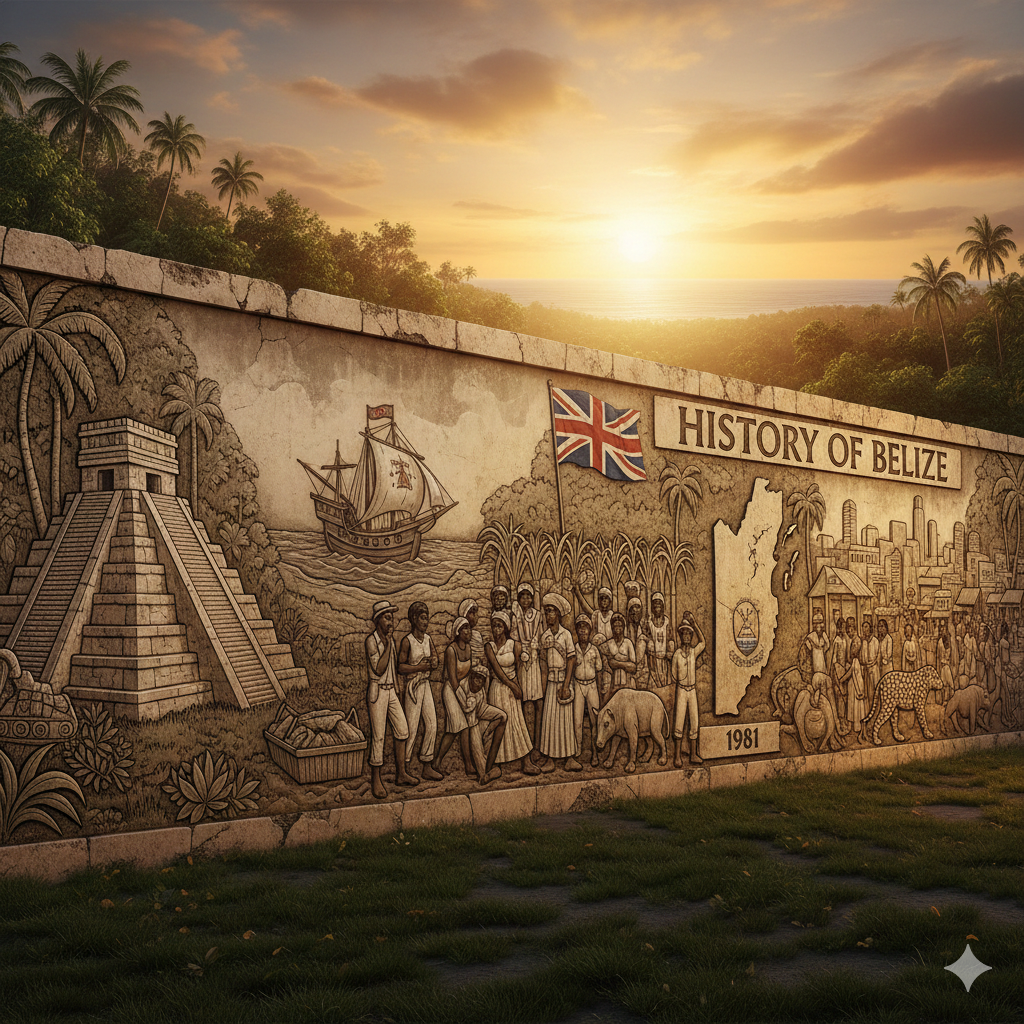
The History of Belize is a vibrant and complex tapestry woven from the threads of ancient civilizations, European piracy and colonization, the struggles of enslaved and indentured peoples, and a determined national independence movement. It is the story of the only English-speaking nation in Central America, a country whose identity is a unique blend of Maya, Creole, Garifuna, Mestizo, and other global influences.
The Maya Golden Age: The Pre-Columbian Era (c. 1500 BC – AD 1600)
The history of the land now known as Belize begins not with European settlers, but with the magnificent Maya civilization. For nearly 3,000 years, this region was a critical part of the expansive Maya world, and it remains one of the most concentrated areas of Maya archaeological sites.
1.1 Early Settlement and the Classic Period
Initial settlement in Belize can be traced back to approximately 1500 BC, marking the beginning of the Preclassic period. Farming communities began to establish themselves, utilizing the fertile lands and abundant natural resources.
The Classic Period (c. AD 250 – 900) was the zenith of Maya civilization in the region. Belize was home to vast, sophisticated city-states, each a center of political, religious, and economic life.
-
- Caracol: Located in the Cayo District, Caracol was perhaps the largest and most powerful city-state in modern Belize. At its peak, it is estimated to have housed a population of over 100,000 people, controlling a large territory and defeating its massive rival, Tikal (in modern Guatemala), in a major war in AD 562. Its central pyramid, Canaa (Sky Palace), remains the tallest human-made structure in Belize.
-
- Lamanai: Meaning “Submerged Crocodile,” Lamanai was one of the longest continuously occupied Maya sites, from the Preclassic into the Post-Classic period, and was still in use when the Spanish arrived. Its trade connections extended far into the Maya lowlands.
-
- Xunantunich: Meaning “Stone Woman,” this ceremonial center near the Guatemalan border is known for its impressive structures, particularly the El Castillo pyramid, adorned with stucco friezes.
-
- Altun Ha: Located closer to the coast, Altun Ha was an important trade and transport hub, particularly for coastal and sea trade routes. Its most famous discovery is the colossal Jade Head of the Sun God Kinich Ahau.
Maya society in Belize was highly complex, characterized by advanced knowledge of mathematics, astronomy, and architecture. City-states were governed by powerful dynastic rulers and engaged in both trade and warfare with their neighbors.
1.2 Decline and Post-Classic Survival
Around the 9th and 10th centuries AD, the great southern lowland Maya cities experienced a widespread decline, often referred to as the Maya Collapse. While the exact causes are debated—ranging from prolonged drought and environmental degradation to endemic warfare and peasant revolts—the large ceremonial centers were largely abandoned.
However, Maya civilization did not vanish in Belize. Smaller, more resilient communities, such as those at Lamanai and Tipu, continued to thrive during the Post-Classic period (c. AD 900 – 1500). They resisted the initial Spanish incursions for centuries, maintaining their political and cultural integrity well into the colonial era.
2. European Arrival and the Baymen Settlement (c. 1502 – 1798)
The arrival of Europeans marked a tumultuous and violent shift in the region’s history, setting the stage for the creation of modern Belize.
2.1 Spanish Claim and Neglect
Christopher Columbus sailed near the coast of Belize during his fourth voyage in 1502, but did not land. The first confirmed European presence was in 1511, when a small crew of shipwrecked Spanish sailors landed near Chetumal Bay.
The Spanish Crown claimed dominion over the entire territory as part of the Captaincy General of Guatemala. However, the Spanish never successfully or extensively colonized the area for several reasons:
-
- Fierce Maya Resistance: The Maya populations in Belize, particularly the people of Tipu and the groups in the north, mounted relentless resistance to Spanish “pacification” and missionary efforts. A major Maya uprising in 1546 successfully expelled the Spanish for a time.
-
- Lack of Mineral Wealth: Unlike Mexico and Peru, the Belizean territory lacked the gold and silver that primarily motivated the Spanish Conquistadors.
-
- Swampy Geography: The coastal environment was less appealing for large-scale agricultural exploitation compared to other parts of the Spanish Empire.
Due to this lack of interest and successful resistance, the Spanish essentially left the coastal areas of Belize largely unoccupied, creating a vacuum soon to be filled by the British.
2.2 The Rise of the Baymen
From the mid-17th century, English and Scottish settlers, primarily logwood cutters and former privateers (pirates), began to establish a permanent presence along the coast and rivers. These were the original Baymen, named after the Bay of Honduras. The first permanent settlement is traditionally dated to 1638.
The primary motivation for their presence was the lucrative trade in logwood (Haematoxylum campechianum), a tree whose wood produced a valuable, high-quality dye essential for Europe’s textile industry.
-
- Shift from Piracy to Logging: Following the Anglo-Spanish Treaty of Madrid in 1667, which aimed to suppress piracy, many buccaneers transitioned into the more legitimate, though still perilous, trade of logwood cutting.
-
- The Introduction of Slavery: The arduous labor of felling and transporting logwood and later, the much harder mahogany, led the Baymen to import enslaved Africans from the Caribbean, particularly Jamaica. By the 18th century, enslaved people, who were predominantly of West and Central African descent, formed the majority of the population. The society they created was rigidly hierarchical, with a small white elite controlling the wealth and political structure.
2.3 Spanish Incursions and The Battle of St. George’s Caye
The Spanish never relinquished their claim to the territory, regarding the Baymen as illegal squatters. This led to a long series of sporadic attacks and expulsions by Spanish forces throughout the 18th century.
The Baymen, however, were tenacious and consistently re-established themselves. Their de facto control was gradually acknowledged through various Anglo-Spanish treaties, though British sovereignty was still denied:
-
- Treaty of Paris (1763): Spain permitted the Baymen to cut logwood but stipulated that Spain would maintain sovereignty and that the Baymen could not establish fortifications or a formal government.
-
- Convention of London (1786): This expanded the area for logging but reiterated the prohibition on fortifications and self-governance. It also led to the appointment of the first British Superintendent, John Despard, giving the settlement a degree of official, if limited, recognition.
The final, decisive military confrontation came in September 1798 with the Battle of St. George’s Caye. A large Spanish fleet from Yucatan attempted to decisively remove the British settlers. After a series of minor naval skirmishes, the Spanish forces withdrew without landing a major attack. This victory is celebrated annually as a national holiday and is considered a pivotal moment that secured the permanent presence of the British and the Baymen in the territory.
3. The Colonial Era: British Honduras (1799 – 1964)
The Baymen’s settlement, now secure from Spanish threat, gradually evolved into a full-fledged British colony, experiencing major economic shifts, the abolition of slavery, and the formalization of colonial rule.
3.1 The Age of Mahogany and Emancipation
Following the Battle of St. George’s Caye, the focus of the woodcutting economy shifted from logwood to mahogany (Swietenia macrophylla). Mahogany was a more difficult, but vastly more valuable, export, driving the settlement’s economy throughout the 19th century.
The system of chattel slavery, brutal and essential to the mahogany trade, persisted until its Emancipation in 1838. Unlike the plantation systems of the Caribbean, slavery in Belize was characterized by the “gang system” in the forest camps, which required mobility and less direct daily supervision, though the work was exceptionally harsh.
The abolition of slavery led to a labor shortage. The former enslaved people, known as Creoles, often resisted re-entering the grueling, low-wage work of the mahogany camps. This prompted the colonial elite to seek new sources of labor, fundamentally altering Belize’s demographic and cultural landscape.
3.2 Formalization of British Rule and Immigration
In the mid-19th century, events both internal and external solidified the colony’s status and diversified its population:
-
- Formal Colonial Status: The British government, seeking to solidify its long-held but disputed claim, formally declared the settlement the Colony of British Honduras in 1862, designating it a Crown Colony in 1871. Belize City became the center of administration and commerce.
-
- The Garifuna Arrival (1832): The Garifuna (or Garinagu), descendants of shipwrecked African slaves and indigenous Caribs from St. Vincent, settled along the southern coast of Belize (particularly in Dangriga and Punta Gorda) after being exiled by the British. They brought with them a distinct language, culture, and subsistence economy (fishing, small farming), adding a unique Caribbean flavor to the national identity.
-
- The Caste War Refugees (1847-1901): The brutal Caste War in the Yucatán Peninsula of Mexico resulted in a massive influx of Mestizo (mixed Maya and Spanish) refugees into northern British Honduras, primarily settling in Corozal and Orange Walk. They introduced a tradition of small-scale sugar cultivation, shifting the economic base toward agriculture.
-
- Mopan and Q’eqchi’ Maya: Indigenous Maya groups, particularly the Mopan and Q’eqchi’, who had fled Spanish authority in Guatemala, settled the southern and western regions of the colony, continuing to practice traditional farming and forest management.
-
- Indentured Labor and Other Groups: Subsequent attempts to secure cheap labor brought indentured laborers from India and China, and later, agricultural communities like the Mennonites (starting in the 1950s) from Canada and Mexico, further adding to the demographic “melting pot.”
3.3 Economic and Political Stagnation (Late 19th – Early 20th Century)
The late 19th and early 20th centuries were marked by economic stagnation. The mahogany trade began to decline due to resource depletion and competition. The reliance on timber exports made the colony extremely vulnerable to global economic shocks.
Politically, British Honduras was governed as a typical Crown Colony, with limited political participation for the local population. The colonial administration largely favored the small merchant elite and maintained social and economic structures based on racial hierarchy.
Major natural disasters also played a significant role in the colony’s history:
-
- 1931 Hurricane: A devastating hurricane struck Belize City, killing thousands and prompting the colonial government to accept a loan from the UK, which came with increased control from the Colonial Office. This financial dependence was a major point of contention and helped fuel the later independence movement.
-
- 1961 Hurricane Hattie: This catastrophic storm virtually destroyed Belize City, resulting in a decision to move the capital inland to a new, hurricane-safe location: Belmopan, which was officially inaugurated in 1970.
4. The Road to Independence (1930s – 1981)
The mid-20th century saw the rise of nationalism and the struggle for self-governance, leading to the birth of the independent nation of Belize.
4.1 Genesis of Modern Politics and Nationalism
The economic hardships of the 1930s Great Depression, coupled with the slow pace of colonial reform and the devaluation of the British Honduran dollar in 1949, galvanized a new generation of political activists. They argued that the colonial system was inherently exploitative and that self-governance was necessary for economic prosperity and social justice.
Key political developments included:
-
- The People’s United Party (PUP): Formed in 1950, the PUP quickly became the leading force in the independence movement. Its charismatic leader, George Price, a former seminarian, became the “Father of the Nation.” The party advocated for economic development, social reform, and full independence.
-
- Constitutional Reform: Pressure from the PUP and the general public led to incremental constitutional changes. Universal adult suffrage (the right to vote for all adults) was introduced in 1954, opening the door for mass politics.
4.2 Self-Government and the Guatemalan Dispute
The pace of decolonization accelerated in the 1960s.
-
- Internal Self-Government (1964): The UK granted British Honduras full internal self-government, with a ministerial system. George Price became the country’s first Premier, responsible for all domestic affairs, while the UK retained control over defense and foreign policy.
-
- Renaming to Belize (1973): In a move to shed the colonial identity and foster national pride, the country officially changed its name from British Honduras to Belize.
The path to full independence was complicated, however, by the persistent territorial claim by Guatemala. Guatemala claimed that Belize was historically part of its territory, inherited from the Spanish Crown. The dispute dated back to an 1859 treaty concerning a road construction commitment that Guatemala alleged was unfulfilled.
Fearing an invasion from Guatemala upon British withdrawal, the move to independence had to be delayed while Belize, led by Price, sought international support to guarantee its territorial integrity. Belize successfully lobbied in the United Nations, gaining overwhelming international recognition and backing for its right to self-determination. The UK, meanwhile, maintained a substantial military presence.
4.3 History of Belize Full Independence (1981)
After years of negotiation and the firm internationalization of the dispute, Belize achieved full independence on September 21, 1981. George Price became the first Prime Minister.
The independence was celebrated with great joy, but it was a restricted independence: Guatemala refused to recognize the new nation, meaning British troops had to remain in Belize to provide a security guarantee. The national motto, Sub Umbra Floreo (Under the Shade I Flourish), was replaced by Shade (Under the Shade of the British Forces).
5. Post-Independence Belize (1981 – Present)
Since 1981, Belize has worked to consolidate its democracy, diversify its economy, and resolve the lingering issue of the Guatemalan territorial claim.
5.1 Political Development
Belize’s political system is a constitutional monarchy and a parliamentary democracy, retaining the British monarch as the head of state, represented by a Governor-General.
-
- Two-Party System: Post-independence politics has been dominated by two major parties: the center-left People’s United Party (PUP), founded by George Price, and the center-right United Democratic Party (UDP). Power has alternated between these two parties over the decades.
-
- Constitutional Stability: Despite political disagreements, the country has maintained a strong democratic tradition and constitutional stability since 1981, holding regular, free, and fair elections.
5.2 Economic Diversification
The post-independence economy has shifted away from the colonial reliance on timber and even the later agricultural focus on sugar and citrus. The major pillars of the modern Belizean economy are:
-
- Tourism: Capitalizing on its spectacular natural assets—including the Belize Barrier Reef (a UNESCO World Heritage Site), Maya ruins, and vast rainforests—tourism has become the primary source of foreign exchange and employment.
-
- Agriculture: Export of sugar, citrus, and bananas remains important.
-
- Offshore Services and Oil: Smaller sectors include financial services and, more recently, small-scale oil extraction.
Despite economic growth, Belize faces significant challenges, including high debt levels, vulnerability to natural disasters (hurricanes), and persistent issues of poverty, particularly in rural and indigenous communities.
5.3 The Guatemalan Claim Resolution
The territorial dispute with Guatemala remained the most serious threat to Belize’s sovereignty for decades. The UK gradually reduced its troop presence as the threat lessened, though the dispute continued to dominate foreign policy.
A significant breakthrough came in the 21st century:
-
- Referendums and the ICJ: In 2008, both countries agreed to a process to submit the dispute to the International Court of Justice (ICJ) for a final, binding resolution. This process required a national referendum in both countries. Belize held its referendum in 2019, with a majority voting Yes to take the case to the ICJ. Guatemala had previously voted Yes in 2018.
-
- ICJ Case: The case is now before the ICJ in The Hague, where Belize is arguing for the definitive recognition of its current borders. A final judgment will bring an end to a centuries-old dispute.
5.4 A Multicultural Nation
Contemporary Belize is defined by its remarkable cultural and ethnic diversity, a legacy of all the historical epochs:
-
- Creole and Mestizo: The two largest groups, the Creoles (descendants of Baymen and enslaved Africans) and the Mestizos (descendants of Maya and Spanish/Yucatec refugees), form the cultural backbone of the country.
-
- Garifuna: Their culture, music (Punta Rock), and language are recognized as an Intangible Cultural Heritage by UNESCO.
-
- Maya: The Mopan and Q’eqchi’ Maya continue to maintain their traditional languages and communal life in the interior and south, contributing to the country’s indigenous heritage.
-
- Kriol Language: Belize’s unique English-based Creole is the most widely spoken language, reflecting its cultural fusion.
The History of Belize, from the Maya monumental architecture to the wooden houses of the Baymen, and from the mahogany camps to the modern tourism resorts, is a testament to the resilience of its people. Emerging from a colonial past shadowed by a territorial dispute, Belize stands today as a small, sovereign nation in Central America with a distinct Caribbean identity, navigating the complexities of globalization while striving to preserve its unique heritage and unparalleled natural environment. The final resolution of its border dispute promises to close the longest chapter of its political history, allowing the nation to focus entirely on its future development.
Visit: www.dkbtech.com. and. www.allcircular.com