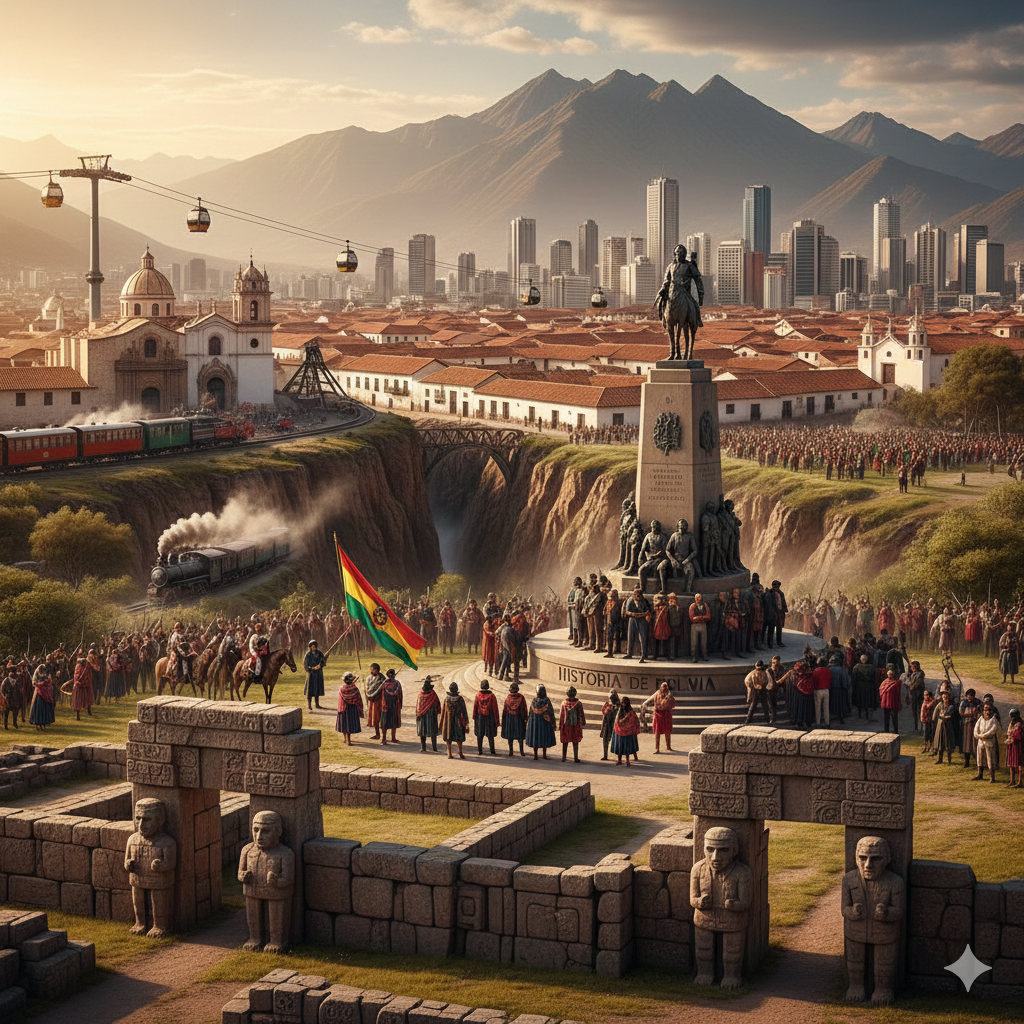
 The History of Bolivia: A Nation Forged in the Andes and Defined by Resilience
Bolivia, officially the Plurinational State of Bolivia, is a land of stunning ecological and ethnic diversity, encompassing the high-altitude Andean altiplano, deep valleys, and vast Amazonian lowlands. Its history is a testament to extraordinary resilience—a story of powerful indigenous empires, brutal colonial exploitation, devastating territorial losses, and a continuous struggle for political and economic sovereignty. Often referred to as a “beggar on a throne of gold” due to its immense mineral wealth juxtaposed with widespread poverty, Bolivia’s past has been fundamentally shaped by its unique geography and its enduring natural resources, primarily silver, tin, and hydrocarbons.
I. Ancient History: The Pre-Columbian Foundations (c. 10,000 BCE – 1532 CE)
The area that would become Bolivia has been inhabited for thousands of years, with its oldest and most complex cultures developing in the demanding, high-altitude setting of the Andean altiplano.
The Rise and Fall of Tiwanaku
The most significant pre-Inca culture in the region centered around Lake Titicaca, the world’s highest navigable lake, which served as a crucial source of sustenance and cultural development.4 Around 400 BCE, the Tiwanaku civilization began to flourish, eventually becoming an influential regional power between 600 CE and 1000 CE.5
-
- Advanced Culture: The Tiwanaku people, ancestors of the modern Aymara, reached a high level of civilization.6 Their capital city, Tiwanaku, near the southern shore of Lake Titicaca, was a massive ceremonial and urban center covering an estimated $6.5 \text{ km}^2$. Its great works of architecture, like the Gate of the Sun (Puerta del Sol), and sophisticated metallurgy in copper, silver, and obsidian, demonstrate a complex, organized society.
-
- Agricultural Innovation: Faced with poor soils and extreme weather, the Tiwanaku developed ingenious agricultural techniques, most notably the suka qullu (flooded-raised fields).7 This system managed water and absorbed solar radiation, allowing them to grow potatoes and quinoa more efficiently in the harsh climate. This productivity sustained a vast population, with some estimates suggesting the Tiwanaku sphere of influence supported between 285,000 and 1.5 million people.
-
- Expansion and Decline: The Tiwanaku culture exerted influence across much of western Bolivia and southern Peru through trade and a common religious cult centered on the creator god Viracocha.8 However, around 1000 CE, likely due to prolonged drought and climate change affecting the suka qullu system, the empire broke up into smaller, competing Aymara kingdoms, such as the Collas and Lupacas.
The Inca Conquest and Qullasuyu
In the 15th century, the swiftly expanding Inca Empire (Tawantinsuyu), based in Cuzco (modern-day Peru), turned its attention south. Under the rule of emperors like Pachacuti Inca Yupanqui (1438–1471) and his son Topa Inca Yupanqui (1471–1493), the Inca conquered much of the Andean region, including the territory that is now western Bolivia.
-
- Integration: The Inca incorporated this vast region into their empire as the province of Qullasuyu, the largest of the four Inca suyus (territories). They established a centralized political structure and a highly organized administrative system, overseen by the Inca (emperor) and governed by a local high official.
-
- Infrastructure and Exploitation: The Inca presence was marked by the construction of impressive fortresses (like Incallajta in the Cochabamba valley), extensive road systems (Qhapaq Ñan), and new agricultural settlements. Critically, the Inca instituted a draft labor system called the Mit’a, which compelled subject peoples to work in mines, on construction, or for the military, though notably, the Incas compensated their workers. This system would be brutally intensified by the subsequent Spanish administration.
-
- Aymara Autonomy: Despite their powerful centralization, the Incas failed to completely dismantle the Aymara kingdoms or fully assimilate them. The Aymara were generally allowed to retain their language (Aymara), cultural practices, and local nobility, providing a deep-seated foundation of indigenous identity that would persist through the colonial era.
-
- The Lowlands: In both the Tiwanaku and Inca periods, the vast, challenging lowlands and tropical jungles of eastern Bolivia remained largely unconquered, populated by independent groups like the nomadic Guaraní and the advanced Moxos (Moxeños) of the Beni region, who built impressive networks of earthen mounds and causeways to manage seasonal flooding.
II. The Colonial Era: Upper Peru and the Silver Mountain (1532–1825)
The arrival of the Spanish conquistadors, led by Francisco Pizarro, in the early 16th century marked a swift and violent end to the Inca Empire. The search for gold and, more consequentially, silver, defined the next three centuries of the region’s history.
Spanish Conquest and Exploitation
In 1532, Pizarro’s forces captured and executed the Inca emperor Atahualpa. The conquest of the altiplano soon followed. The region that would become Bolivia was initially called Upper Peru (Alto Perú) and was placed under the authority of the Viceroyalty of Peru, with its capital in Lima.
-
- Potosí: The Imperial Mint: The discovery of a massive silver lode in 1545 in the towering peak of Cerro Rico (“Rich Hill”) near the city of Potosí fundamentally transformed the region and the global economy. Potosí rapidly became the largest and richest city in the Western Hemisphere, a staggering metropolis whose wealth funded the Spanish Crown’s global power for centuries. The Spanish phrase “valer un Potosí” (to be worth a Potosí) entered the language, signifying something of enormous value.
-
- The Mita System: To extract this wealth, the Spanish revived and cruelly intensified the Inca Mit’a labor draft. Tens of thousands of indigenous men were forced into the perilous, toxic mines of Cerro Rico. The work was brutal, conditions were horrific, and mortality rates were catastrophic. Potosí became the epicenter of colonial extraction, demonstrating the extreme exploitation of the indigenous population and resources.
-
- Administration: New Spanish cities were founded, including Chuquisaca (Sucre, 1538), La Paz (1548), and Cochabamba (1571). Chuquisaca became a crucial legal and cultural center as the seat of the Audiencia de Charcas, a high court whose jurisdiction roughly corresponded to modern Bolivia. In 1776, administrative control of Upper Peru was transferred from the Viceroyalty of Peru to the newly established Viceroyalty of the Río de la Plata, with its capital in Buenos Aires.
ndigenous Rebellions and the Seeds of Independence
Colonial rule was consistently met with resistance, most notably by the indigenous populations whose lives were most impacted by the Mit’a and oppressive tribute systems.
-
- Túpac Amaru II and Túpac Katari: The most significant uprising of the colonial era occurred in the late 18th century, coinciding with other anti-colonial movements across Spanish America. In 1780, Túpac Amaru II (José Gabriel Condorcanqui), a wealthy Quechua cacique, led a revolt in Lower Peru. This quickly spread to Upper Peru, where it was spearheaded by the Aymara leader Túpac Katari (Julián Apaza). Katari’s forces laid siege to La Paz for months in 1781. Though the rebellions were eventually crushed with extreme violence, and Túpac Katari was executed in a brutal public spectacle, these indigenous movements were a stark premonition of the wars of independence to follow, fueling a profound, though largely suppressed, demand for autonomy.
III. The Birth of a Republic: Independence and the Caudillo Era (1825–1880)
The early 19th century was defined by the Spanish American wars of independence, which ultimately led to the creation of the Republic of Bolivia.
The Struggle for Independence
The final independence of Upper Peru was not a simple or unified event. It involved years of guerrilla warfare and military campaigns, often as a secondary theater to the larger conflicts in the region.
-
- The First Cry: In 1809, the cities of Chuquisaca and La Paz issued declarations of independence, sparking early, though swiftly crushed, uprisings led mostly by the Creole (Spanish descent born in the Americas) elite.
-
- The Patriots vs. Royalists: For 16 years, the territory was a battleground between Spanish Royalist forces and independence fighters, including the local, often Mestizo/indigenous guerrilleros known as republiquetas.
-
- Bolívar and Sucre: The ultimate defeat of the Spanish armies came with the arrival of the armies from the north. The decisive battles were led by the “Liberator,” Simón Bolívar, and his trusted lieutenant, General Antonio José de Sucre. Following the final Royalist defeat at the Battle of Ayacucho in Peru in 1824, Sucre’s forces entered Upper Peru.
-
- The Republic of Bolívar: On August 6, 1825, the Constituent Assembly declared the independence of the new republic. The new nation was named Bolivia in honor of Simón Bolívar. Sucre became the country’s first president. Bolívar himself drafted the country’s second constitution in 1826, which featured a strong, lifetime presidency, reflecting his fears of political instability.
The Era of Instability and Territory Loss
The post-independence era was characterized by political instability, economic depression following the collapse of the colonial silver industry, and the rise of caudillos (strongmen/military leaders) who constantly seized and lost power through coups and uprisings.
-
- Andrés de Santa Cruz: One of the most capable early leaders was Marshal Andrés de Santa Cruz (President, 1829–1839). He attempted to revive the regional power of Upper Peru by uniting it with Peru in the Peru-Bolivian Confederation (1836–1839). This alarmed neighboring countries, and the Confederation was ultimately dissolved after being defeated by a combined Chilean and Argentine force in the War of the Confederation. This defeat established a precedent for external interference and territorial vulnerability.
-
- The Loss of the Coast (The War of the Pacific, 1879–1884): This was the most devastating conflict in Bolivian history. The war was fought against Chile over control of the resource-rich Atacama Desert coastline, a region containing vast deposits of sodium nitrate (saltpeter).
-
- The Cause: Long-standing border disputes were exacerbated by a breach of a 1874 treaty when the Bolivian government of President Hilarión Daza imposed a new tax on a Chilean-owned mining company in the coastal port of Antofagasta.
-
- The Conflict and Outcome: Chile, better-equipped and militarily stronger, occupied Antofagasta in February 1879. Bolivia, allied with Peru (who had a secret defensive pact), declared war. The Chilean Navy quickly secured naval supremacy, and after the Battle of Tacna in 1880, Bolivia withdrew from the war, leaving its ally to fight on. The 1884 truce and the subsequent 1904 Treaty of Peace and Friendship formally ceded Bolivia’s entire coastal province of Litoral (Antofagasta) to Chile.
-
- The Legacy: The loss was a crippling blow, leaving Bolivia permanently landlocked and cementing a national feeling of vulnerability and grievance that persists to this day, epitomized by the national demand for sovereign sea access (reivindicación marítima).
-
- The Loss of the Coast (The War of the Pacific, 1879–1884): This was the most devastating conflict in Bolivian history. The war was fought against Chile over control of the resource-rich Atacama Desert coastline, a region containing vast deposits of sodium nitrate (saltpeter).
IV. The Oligarchic and Mining Republic (1880–1952)
Following the War of the Pacific, a period of relative, though still often violent, political stability emerged, dominated by a small, Europeanized elite whose power was tied to the changing fortunes of the nation’s mineral wealth.
The Silver and Tin Cycles
-
- The Silver Oligarchy (Conservative Rule, 1884–1899): In the late 19th century, the silver industry briefly revived due to British and Chilean capital investment and new technology. A stable political system emerged under the Conservative Party, representing the interests of the powerful silver barons.
-
- The Federal Revolution and the Tin Barons (Liberal Rule, 1899–1920): In 1899, the Liberal Party, representing the emerging interests of the tin industry and based in La Paz, defeated the Conservative silver elite in the Federal Revolution. La Paz became the de facto seat of government, while Sucre remained the constitutional capital. Tin replaced silver as the dominant export, and the country’s economic fate became inextricably linked to a small number of immensely wealthy “Tin Barons,” such as Simón Iturri Patiño, who became one of the world’s richest men.
-
- New Territory Losses: The turn of the century brought another round of territorial losses. In the Acre War (1899–1903), rubber tappers in the rich Amazonian region of Acre rebelled, supported by Brazil. Bolivia ultimately sold the vast, rubber-rich territory to Brazil in the Treaty of Petrópolis (1903). Smaller border disputes also resulted in the loss of territory to Peru.
The Chaco War and the Rise of Reformism
The political and economic exploitation, coupled with national humiliation from territorial losses, fueled widespread discontent and radical new political thinking.
-
- The Chaco War (1932–1935): The last major military conflict involved a disastrous war with Paraguay over a sparsely populated, dry scrubland region known as the Gran Chaco, where oil was rumored to be discovered. Driven by nationalism and the search for a navigable outlet to the Atlantic Ocean via the Paraná-Paraguay river system, the poorly prepared and badly led Bolivian army suffered a crushing defeat.
-
- The Aftermath: The war was a national catastrophe, costing over 50,000 Bolivian lives and resulting in the loss of three-quarters of the disputed territory. The defeat was a profound turning point, discrediting the traditional elite (the “Rosca” of politicians and Tin Barons) who had mismanaged the conflict. Thousands of indigenous soldiers, often forced into service, returned from the front lines with a newfound political consciousness, paving the way for radical political change.
-
- The Chaco War (1932–1935): The last major military conflict involved a disastrous war with Paraguay over a sparsely populated, dry scrubland region known as the Gran Chaco, where oil was rumored to be discovered. Driven by nationalism and the search for a navigable outlet to the Atlantic Ocean via the Paraná-Paraguay river system, the poorly prepared and badly led Bolivian army suffered a crushing defeat.
-
- “Military Socialism” and the MNR: The post-Chaco years saw a rise in radical, nationalist, and socialist-leaning political movements. Progressive military officers, embracing an ideology of “Military Socialism,” seized power, briefly nationalizing the holdings of the American Standard Oil Company in 1937. A new political party, the Nationalist Revolutionary Movement (Movimiento Nacionalista Revolucionario, MNR), was formed, combining middle-class, intellectual, and eventually, mass indigenous and worker support. The MNR was committed to nationalization, land reform, and universal suffrage.
V. The National Revolution and Military Rule (1952–1982)
The mid-20th century saw Bolivia undergo its most profound social transformation since the colonial conquest, followed by decades of military dictatorship.
The Bolivian National Revolution of 1952
After years of political maneuvering and instability, the MNR, led by Víctor Paz Estenssoro, seized power in a popular uprising in April 1952, marking the beginning of the Bolivian National Revolution. This event is considered one of the most significant revolutions in 20th-century Latin America.
-
- Key Reforms: The MNR government immediately implemented a sweeping program of reforms:
-
- Universal Suffrage: Illiteracy and poverty restrictions were abolished, granting universal suffrage to all adults, including indigenous people and women, dramatically shifting the political base of the country.
-
- Nationalization of Mines: The mines of the three great Tin Barons (Patiño, Hochschild, and Aramayo) were nationalized, and the state mining corporation, COMIBOL, was established, placing the country’s main source of wealth under national control.
-
- Agrarian Reform: A major land reform program was initiated, abolishing the latifundio (large, semi-feudal estates) system and redistributing land to indigenous peasant communities, fundamentally altering the rural social structure.
-
- Key Reforms: The MNR government immediately implemented a sweeping program of reforms:
-
- The Co-Government: The government initially relied on the support of powerful organized labor, particularly the Federation of Mine Workers of Bolivia (Federación Sindical de Trabajadores Mineros de Bolivia, FSTMB), and its umbrella organization, the Bolivian Workers’ Central (Central Obrera Boliviana, COB). For a time, the workers exerted massive influence, even having co-representatives in the government bureaucracy.
The Return to Military Rule
The revolutionary moment, however, was short-lived. Economic stagnation, political infighting within the MNR, and the rise of a new middle class soon undermined the radical reforms.
-
- The Coup of 1964: In 1964, the military, restructured and re-equipped with U.S. aid (provided as part of the Cold War’s Alliance for Progress), staged a coup, overthrowing the MNR government.
-
- Decades of Instability: The next 18 years were characterized by a seemingly endless cycle of coups, counter-coups, and repressive military dictatorships. Different military factions, often with shifting nationalistic, populist, or right-wing anti-communist ideologies, seized power. Notable figures included:
-
- René Barrientos Ortuño (1964–1969), a popular general who attempted to balance populism with repression, and whose regime was responsible for the infamous 1967 military campaign that led to the capture and execution of Cuban revolutionary Ernesto “Che” Guevara in the Bolivian jungle.
-
- Hugo Banzer Suárez (1971–1978), a brutal, right-wing dictator whose regime was marked by the suppression of political opposition, labor unions, and any signs of popular mobilization. Banzer was a key player in the anti-communist Operation Condor conspiracy across South America.
-
- Decades of Instability: The next 18 years were characterized by a seemingly endless cycle of coups, counter-coups, and repressive military dictatorships. Different military factions, often with shifting nationalistic, populist, or right-wing anti-communist ideologies, seized power. Notable figures included:
-
- Economic Collapse: Despite periods of temporary stability, the debt crisis and government corruption in the late 1970s led to economic disaster, culminating in crippling hyperinflation in the early 1980s.
VI. The Democratic Transition and the Rise of Indigenous Power (1982–Present)
The 1980s ushered in a new era of democratic governance, but the country continued to grapple with economic instability and deep social divisions. The late 20th and early 21st centuries saw the emergence of indigenous political power as a decisive factor.
Neoliberal Reforms and Popular Resistance
-
- The Restoration of Democracy (1982): Following a final, chaotic military regime—briefly infamous for its connections to drug trafficking—civilian rule was restored in 1982. The newly elected democratic government faced the challenge of a collapsing economy.
-
- Stabilization and Structural Adjustment: In 1985, President Paz Estenssoro (returning for his fourth, non-consecutive term) enacted the controversial Decree 21060, which drastically implemented neoliberal economic policies. It halted hyperinflation but required severe structural adjustment, including the closing of unprofitable state-owned mines (leading to mass lay-offs of the powerful miners) and the privatization of state enterprises.
-
- The Water and Gas Wars: The implementation of aggressive privatization and resource-control policies generated massive popular resistance, often led by indigenous and working-class organizations.
-
- Cochabamba Water War (2000): Widespread protests, led by social activists and coca growers, successfully reversed the privatization of the city’s water utility.
-
- The Gas War (2003): Protests, primarily centered in El Alto (the sprawling Aymara city above La Paz) and the altiplano, erupted over plans to export Bolivia’s massive natural gas reserves through Chilean ports. The mass movement, often led by Aymara organizations and cocalero unions, brought down the government of President Gonzalo Sánchez de Lozada, forcing him to resign and flee the country. These conflicts marked the political maturation of a new generation of indigenous and mestizo leaders.
-
- The Water and Gas Wars: The implementation of aggressive privatization and resource-control policies generated massive popular resistance, often led by indigenous and working-class organizations.
The Evo Morales Era and the Plurinational State
The social movements of the “Water” and “Gas” wars culminated in the 2005 presidential election victory of Evo Morales Ayma, a former coca grower and trade union leader of indigenous Aymara descent. He became Bolivia’s first openly indigenous president, leading the Movement for Socialism (Movimiento al Socialismo, MAS).
-
- Resource Nationalization: Morales’s government, fueled by a surge in international commodity prices, implemented the nationalization of hydrocarbon resources (natural gas and oil) in 2006. This vastly increased state revenues and allowed for the implementation of cash transfer programs (bonos) that significantly reduced poverty and inequality.
-
- Constitutional Reform: In 2009, a new constitution was promulgated, transforming the Republic of Bolivia into the Plurinational State of Bolivia. The constitution granted greater rights and autonomy to indigenous groups, recognized the country’s ethnic diversity, and formally recognized indigenous communal land ownership.
-
- Economic Stability and Growth: The period from 2006 to 2014 saw unprecedented economic growth and stability, largely due to high gas prices and state investment in social programs. A new indigenous and mestizo middle class began to emerge, transforming the traditional social hierarchy inherited from the colonial era.
Recent Political Turmoil and the Future
Morales’s successful political dominance began to wane as he attempted to seek re-election beyond the constitutional limit.
-
- The 2019 Crisis: Following a disputed constitutional referendum and a highly controversial presidential election in 2019, massive nationwide protests erupted. Amid mass demonstrations, a police mutiny, and the military “suggesting” he resign, Morales stepped down and fled the country. A political crisis ensued, culminating in a short-lived, conservative interim government led by Jeanine Áñez. The events of 2019 remain deeply contested, with his supporters calling it a coup and his opponents calling it a necessary defense of democracy.
-
- MAS Restoration: In 2020, in a peaceful general election held under the interim government, the MAS party returned to power, with Luis Arce Catacora, Morales’s former Minister of Economy, winning the presidency.
- Challenges: The modern Bolivian state continues to face persistent challenges: managing the volatility of its resource-dependent economy, navigating deep regional and ideological divisions between the Andean highlands and the eastern lowlands (Santa Cruz), and grappling with the ongoing national legacy of inequality and resource control—a history that has defined the nation since the silver was first found in Cerro Rico nearly five centuries ago. Bolivia’s story is one of a continuous, determined effort to build a sovereign nation that can finally manage its enormous wealth for the benefit of all its citizens.