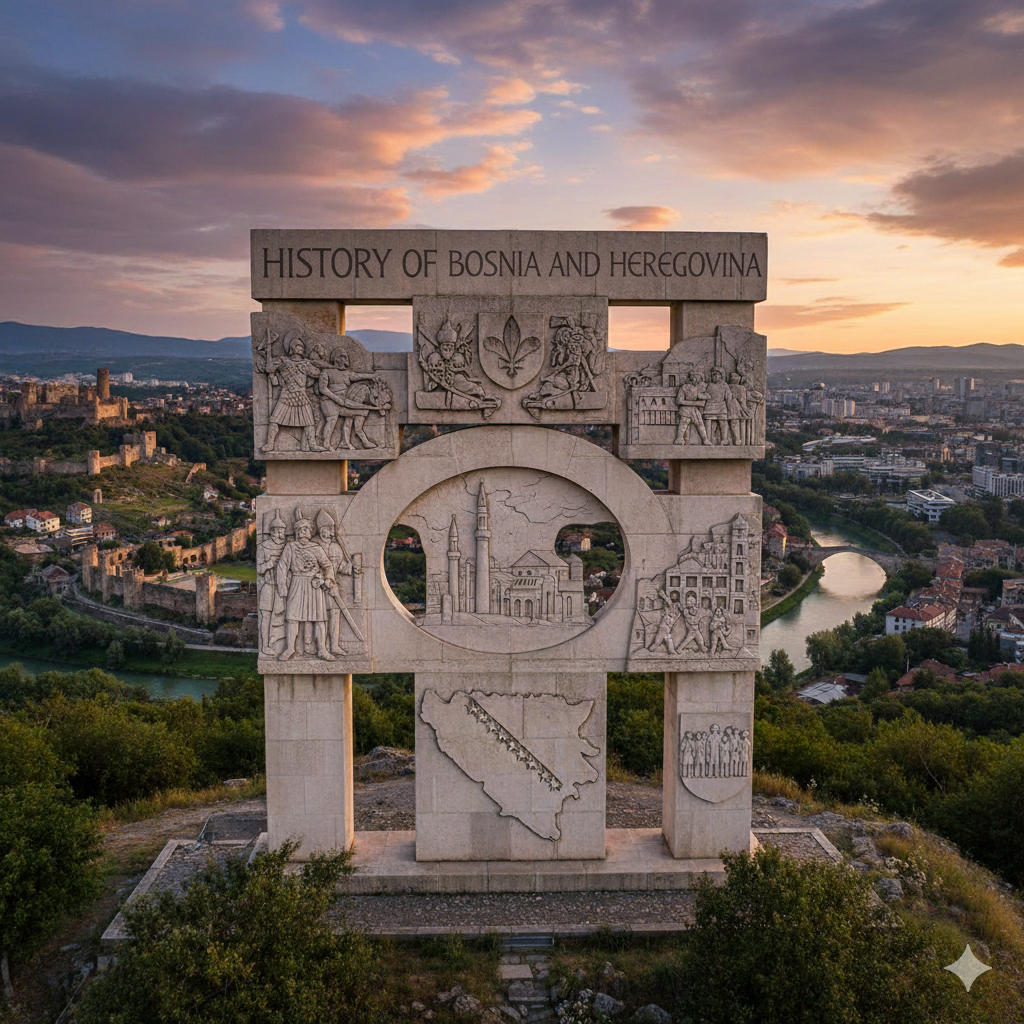
The History of Bosnia and Herzegovina is a tapestry woven from the threads of ancient civilizations, medieval kingdoms, Ottoman conquest, Austro-Hungarian modernization, and the complexities of 20th-century geopolitical shifts, culminating in the tragic war of the 1990s and the establishment of a fragile, independent state. This land, situated in the volatile heart of the Balkans, has long been a crossroads of cultures, religions, and empires, a reality that has profoundly shaped its unique, multi-ethnic character.
 Ancient and Roman Eras
The earliest evidence of human habitation in Bosnia and Herzegovina dates back to the Paleolithic era, with notable finds like the cave engravings in the Badanj Cave near Stolac. During the Neolithic period, sophisticated cultures like the Butmir and Kakanj flourished along the Bosna River, leaving behind distinctive ceramics and anthropomorphic figurines.
Around the 8th century BCE, the Illyrians, Indo-European tribes known for their warlike nature, became the dominant population. They organized into various kingdoms, with the Daors tribe in the south developing a significant Hellenistic influence, establishing their capital at Daorson near Stolac, complete with massive stone walls.
The conflict between the Illyrians and the expanding Roman Empire began in 229 BCE. The Romans eventually annexed the region, though not without fighting one of their most difficult campaigns, the Bellum Batonianum (6–9 AD), a major Illyrian revolt. Most of modern Bosnia was incorporated into the Roman province of Dalmatia. Under Roman rule, Latin-speaking settlers and retired soldiers integrated with the local Illyrian population. Christianity arrived in the region by the end of the 2nd century.
Following the division of the Roman Empire in the 4th century, the region fell under the Western Roman Empire and was subsequently conquered by the Ostrogoths in 455 AD. The land briefly changed hands between various groups like the Alans and Huns before the Byzantine Emperor Justinian I reconquered the area in the 6th century, making it nominally part of the Byzantine Empire.
 The Medieval Bosnian State (c. 6th – 1463)
The most significant demographic change occurred in the 6th and 7th centuries with the mass migration and settlement of Slavic tribes into the Balkans. These South Slavs would become the progenitors of the modern Bosnian, Serb, and Croat peoples. The territory of Bosnia became a contested buffer zone between the Byzantine Empire, the expanding Hungarian Kingdom, and the nascent Serbian and Croatian principalities.
The concept of a distinct Bosnian state began to emerge in the Middle Ages. The earliest Bosnian political entity was the Banate of Bosnia, established around the 12th century. The title Ban was a local ruler, often acknowledging the nominal sovereignty of either the Byzantine Empire or the Kingdom of Hungary, but frequently maintaining de facto independence.
The Rise of the Kingdom
Three rulers stand out in the medieval history of Bosnia:
-
- Ban Kulin (ruled c. 1180–1204): His reign is often remembered as a period of peace and prosperity, formalized in the Charter of Ban Kulin (1189), one of the oldest state documents in the region, which regulated trade with the Republic of Ragusa (Dubrovnik). During his rule, Bosnia’s distinct local Christian church, the Bosnian Church (often incorrectly associated with Bogomilism), became a source of religious and political controversy with both the Roman Catholic and Orthodox Churches, leading to periodic crusades instigated by Hungary.
-
- Ban Stjepan Kotromanić (ruled 1322–1353): He significantly expanded the Banate, incorporating the region of Hum (modern Herzegovina) in the south, which contributed to the later dual name of the country. Under his leadership, Bosnia became the most powerful state in the western Balkans for a time.
-
- King Tvrtko I (ruled 1353–1391): The zenith of medieval Bosnian power was reached under Tvrtko I. He was crowned as the first King of Bosnia in 1377, claiming kingship over Serbs, Bosnia, and the seaside. His kingdom stretched into parts of modern-day Serbia, Croatia, and Montenegro, and he even acquired a portion of the Dalmatian coast. The medieval Bosnian state’s cultural uniqueness is best symbolized by the stećak tombstones , large, monolithic stone memorials, many of which are now UNESCO World Heritage sites.
Following Tvrtko I’s death, the kingdom entered a period of civil strife, weakened by feuding local nobles and Hungarian interference, leaving it vulnerable to the burgeoning Ottoman power.
 Ottoman Rule (1463–1878)
The Ottoman Empire, after its decisive victory over the Serbs at the Battle of Kosovo in 1389, began to exert increasing pressure on the western Balkans. The final collapse of the Bosnian Kingdom came in 1463 with the capture of the last King, Stjepan Tomašević. The territory of Bosnia was gradually incorporated into the Ottoman administrative system as the Eyalet of Bosnia. The southern region, formerly Hum, was renamed Herzegovina after one of the last powerful local rulers, Stjepan Vukčić Kosača, who adopted the title Herceg (Duke).
The Bosnian Vilayet and Islamization
The Ottoman period fundamentally transformed Bosnia and Herzegovina, introducing a new political, social, and religious order.
-
- Islamization: The most profound change was the widespread adoption of Islam by a significant portion of the South Slav population. This process was voluntary, driven by various factors, including the Ottoman millet system, which granted certain advantages to Muslims (e.g., in military service and land ownership), as well as the ambiguous status of the pre-existing Bosnian Church. The new Slavic-speaking Muslim community, who would later be known as Bosniaks, eventually became the largest religious group in the region.
-
- Infrastructure and Architecture: Ottoman rule brought new architectural styles, establishing major cities like Sarajevo and Mostar as thriving administrative and trade centers. Iconic structures such as the Gazi Husrev-bey Mosque in Sarajevo and the Stari Most (Old Bridge) in Mostar (built in 1566) became enduring symbols of the region’s cultural blend.
-
- Social Structure: A distinct land tenure system, with spahis (feudal cavalry) and kmetovi (serfs), was introduced. The local Christian populations (Orthodox Serbs and Catholic Croats) were grouped into their respective millets, allowing them to practice their faiths under the protection of the Sultan, though they paid a poll tax (jizya).
Decline and Crisis
By the 18th and 19th centuries, the Ottoman Empire was in decline, and its grip on the distant province of Bosnia weakened. The local Muslim landed nobility often held greater power than the central imperial administration, leading to revolts and internal instability. The most notable revolt was the one led by Husein Gradaščević in the 1830s, who championed Bosnian autonomy, albeit ultimately in vain.
Growing nationalist movements in the neighboring Balkan states (Serbia, Montenegro, and Croatia) further destabilized the region, with many Orthodox Serbs and Catholic Croats in Bosnia looking to their respective national centers. The harsh economic conditions for the Christian peasantry culminated in the Herzegovina Uprising of 1875, which quickly spread to other parts of Bosnia and provoked a series of crises across the Balkans, ultimately leading to the Russo-Turkish War.
Habsburg Monarchy and the Road to World War I (1878–1918)
The Russo-Turkish War ended in an Ottoman defeat, leading to the Congress of Berlin in 1878. Although Bosnia and Herzegovina nominally remained under the sovereignty of the Ottoman Sultan, the Congress awarded Austria-Hungary the right to occupy and administer the provinces to restore order.
Modernization and Annexation
The period of Austro-Hungarian administration brought significant modernization:
-
- Infrastructure: The Habsburg Monarchy invested heavily in infrastructure, building railways, schools, and hospitals, and introducing a modern legal and administrative system. Cities like Sarajevo were rebuilt with a blend of Central European and Ottoman architectural styles (e.g., the Sarajevo City Hall, Vijećnica).
-
- Political Tensions: The new rulers attempted to foster a “Bosnian nation” (Bošnjaštvo) to transcend the emerging Serb and Croat nationalisms. However, this policy was unsuccessful. Simultaneously, the Catholic and Orthodox populations gained new rights, but this often exacerbated tensions with the established Bosniak-Muslim elite.
In 1908, Austria-Hungary formally annexed Bosnia and Herzegovina. This move, known as the Bosnian Crisis, caused a major international uproar, particularly in Serbia, which viewed the annexation as a block to its goal of uniting all South Slavs. The crisis heightened nationalist feelings and brought the region to the brink of war.
The Spark of World War I
The culmination of these ethnic and geopolitical tensions was the event that thrust Bosnia and Herzegovina onto the global stage: the Assassination of Archduke Franz Ferdinand in Sarajevo on June 28, 1914. The heir to the Austro-Hungarian throne and his wife were shot by Gavrilo Princip, a Bosnian Serb and a member of the nationalist secret society Mlada Bosna (Young Bosnia), which sought to liberate the South Slav provinces from Habsburg rule and unite them with Greater Serbia or a future Yugoslavia. The assassination served as the pretext for Austria-Hungary’s declaration of war on Serbia, igniting World War I.
 The Yugoslav Periods (1918–1992)
The Kingdom of Yugoslavia (1918–1941)
Following the collapse of the Austro-Hungarian Empire at the end of World War I, Bosnia and Herzegovina, along with other South Slav territories, became part of the Kingdom of Serbs, Croats, and Slovenes on December 1, 1918, which was renamed the Kingdom of Yugoslavia in 1929. In this new state, Bosnia and Herzegovina had no formal status or distinct administrative entity of its own; its territory was divided among various administrative units, reflecting a struggle between a centralized, Serb-dominated government and Croat and other national aspirations.
World War II and Socialist Yugoslavia (1941–1992)
In 1941, the Axis powers invaded and partitioned Yugoslavia. Most of Bosnia and Herzegovina was incorporated into the Independent State of Croatia (NDH), a Nazi puppet state run by the ultranationalist Ustaše movement, which launched a brutal campaign of persecution and genocide against Serbs, Jews, and Roma.
The war years in Bosnia were marked by a bloody civil war among three main factions:
-
- The Ustaše forces of the NDH.
-
- The Chetniks, a Serb nationalist and royalist movement.
-
- The Partisans, a multi-ethnic, communist-led resistance movement under Josip Broz Tito.
Bosnia’s rugged terrain and multi-ethnic makeup made it the principal theater of operations for the Partisans, who successfully fought both the Axis forces and their local collaborators.
Following the Allied victory, Tito’s Partisans established the Socialist Federal Republic of Yugoslavia (SFRY). In this new, communist-led federation, Bosnia and Herzegovina was granted the status of one of the six constituent republics (Socialist Republic of Bosnia and Herzegovina), ensuring its territorial integrity and recognizing the distinct presence of its three main ethnic groups: the Bosnian Muslims (later recognized as a separate nation—the Bosniaks), Serbs, and Croats.
Under Tito, Bosnia and Herzegovina experienced a period of industrial growth, modernization, and relative peace, often promoted under the ideology of “Brotherhood and Unity.” The government deliberately fostered a multi-ethnic identity and suppressed nationalist sentiments to maintain a unified Yugoslav state. The 1984 Winter Olympic Games, hosted in Sarajevo, became a symbol of this inter-ethnic harmony.
 Independence and War (1992–1995)
The death of Tito in 1980, coupled with the rapid decline of the Yugoslav economy in the 1980s and the collapse of communism across Eastern Europe, led to the resurgence of ethno-nationalist politics. The rise of Serbian nationalist leader Slobodan Milošević and similar movements in Croatia and Slovenia destabilized the federation.
The Breakup of Yugoslavia and the Path to Independence
Slovenia and Croatia declared independence in June 1991, leading to a brief war in Slovenia and a full-scale conflict in Croatia. Bosnia and Herzegovina’s population was deeply divided on the question of its future:
-
- Bosniaks (Muslims), led by the Party of Democratic Action (SDA), generally favored a centralized, independent Bosnia.
-
- Bosnian Serbs, led by the Serb Democratic Party (SDS) under Radovan Karadžić, overwhelmingly favored remaining in a Serb-dominated Yugoslavia.
-
- Bosnian Croats, influenced by the nationalist revival in neighboring Croatia, largely favored a sovereign Bosnia, often with ties to Croatia.
In October 1991, the Bosnian Serb deputies walked out of the central Parliament and set up their own Serb National Assembly. In February–March 1992, the government of Bosnia and Herzegovina held a referendum on independence, which was boycotted by most Bosnian Serbs. With a turnout of 63.4%, 99.7% of voters supported independence. Bosnia’s parliament formally declared independence on April 5, 1992.
The Bosnian War (1992–1995)
The war began almost immediately after the international recognition of Bosnia’s independence on April 6, 1992. Bosnian Serb forces, with the backing of the Serb-dominated Yugoslav People’s Army (JNA), launched an offensive to secure territories they claimed for their self-proclaimed Republika Srpska.
The war was a brutal, three-sided conflict, initially between Bosnian Serbs on one side and a fragile alliance of the Bosnian government army (mainly Bosniak) and Bosnian Croat forces on the other. Later, a war within a war erupted between Bosniaks and Croats (1993–1994). The conflict was characterized by the policy of “ethnic cleansing,” a systematic campaign of forced displacement, mass detention, torture, and murder aimed at creating ethnically homogenous territories.
Key events and atrocities included:
-
- Siege of Sarajevo: A 44-month siege of the capital by Bosnian Serb forces, which became the longest siege of a capital city in modern history.
-
- Srebrenica Genocide: In July 1995, Bosnian Serb forces under General Ratko Mladić captured the UN “safe haven” of Srebrenica and systematically murdered over 8,000 Bosniak men and boys. This act was later ruled a genocide by international courts.
-
- International Response: The war prompted a slow and often ineffective international response. The UN Protection Force (UNPROFOR) was deployed as a peacekeeping force but was unable to prevent the worst atrocities. NATO finally launched air strikes against Bosnian Serb military positions in 1995, which, combined with a Croatian military offensive, brought the war to an end.
The Dayton Accords and Postwar Bosnia
The conflict ended with the General Framework Agreement for Peace in Bosnia and Herzegovina, negotiated in Dayton, Ohio, in November 1995, and formally signed in Paris in December 1995 (the Dayton Accords).
The Dayton Accords ended the fighting but established a highly complex and decentralized state structure, dividing Bosnia and Herzegovina into two semi-autonomous entities:
-
- The Federation of Bosnia and Herzegovina (mostly Bosniak and Croat).
-
- The Republika Srpska (mostly Serb).
A third entity, the Brčko District, was established as an internationally supervised administrative unit. The central government has limited powers, and the state is overseen by the Office of the High Representative (OHR), an international civilian body authorized to impose laws and dismiss officials. The country’s Presidency is composed of three members: one Bosniak, one Croat, and one Serb.
 Bosnia and Herzegovina Today
Since 1995, Bosnia and Herzegovina has embarked on a difficult path toward recovery, reconciliation, and integration into the European structure. The country faces ongoing challenges in economic reform, political stability, and overcoming the deep ethnic divisions institutionalized by the Dayton framework. Despite its complex governance, Bosnia and Herzegovina is a sovereign state with a rich cultural heritage, continuing its journey as a multi-ethnic society at the crossroads of Europe.
Visit : www.dkbtech.com and www.allcircular.com