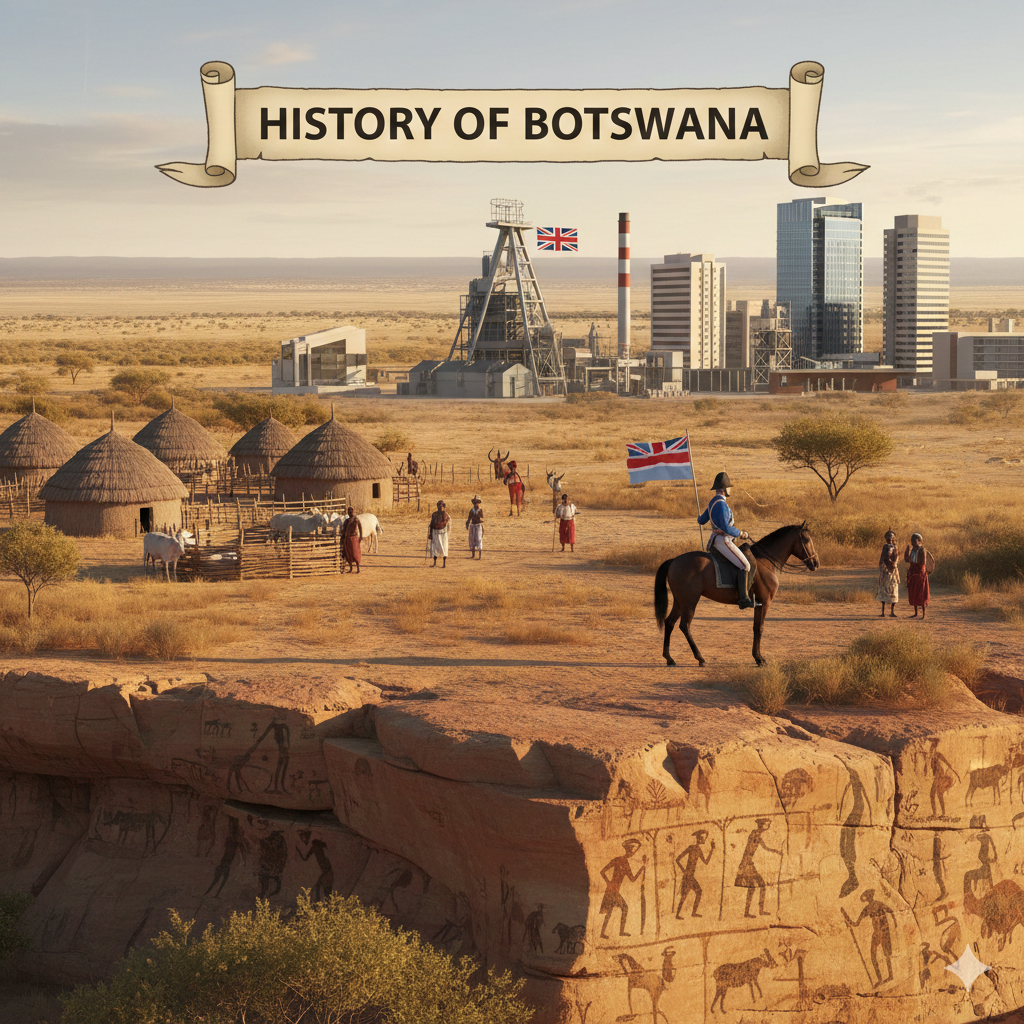
The History of Botswana is a compelling narrative that spans ancient human origins, successive waves of migration, the formation of powerful Tswana chiefdoms, a period as a British protectorate, and its remarkable transformation into one of Africa’s most stable and prosperous democratic nations.
Pre-Colonial Era: From Hunter-Gatherers to Tswana Chiefdoms
The earliest inhabitants of the land that is now Botswana were the San (Bushmen) and Khoi peoples, collectively known as Khoisan speakers. Archaeological evidence suggests human occupation in the region dating back hundreds of thousands of years, with some proposals suggesting the region as the birthplace of modern humans approximately 200,000 years ago. The San and Khoi were hunter-gatherer and pastoral societies, respectively, who occupied the vast Kalahari region for millennia, evidenced by ancient rock paintings found in places like the Tsodilo Hills.
Early Bantu Migrations and the Rise of States
Around 200 AD, the first Bantu-speaking peoples arrived, bringing with them iron-working technology, settled agriculture, and larger-scale chiefdoms. The most significant group to migrate into the area were the Batswana (singular: Motswana), whose recorded history can be traced back to the 14th century, believed to be descendants of King Mogale in the present-day Magaliesberg Mountains of South Africa.
This period saw the rise of significant local powers:
-
- Toutswe: A large chiefdom based near the Sowa Pan and Tswapong Hills that flourished between the 7th and 13th centuries. Its wealth was based on cattle herding, which was a vital part of the economy and culture.
-
- Tswana Chiefdoms: By the 18th century, the Tswana society had sub-divided into at least eight principal chiefdoms, which form the basis of the modern Republic of Botswana. These included the Kwena, Ngwato, Kgatla, and Ngwaketse, among others. Their political system was highly structured, centering on the Kgotla, a traditional assembly or court that served as a public forum for decision-making and justice, a key institution that would later be incorporated into the modern democratic state.
The Difaqane and European Contact (Late 18th and 19th Centuries)
The late 18th and early 19th centuries were marked by the Difaqane (“the crushing” or “forced migration”), a period of widespread turmoil, migration, and conflict among indigenous ethnic groups in Southern Africa, often driven by the expansion of the Zulu Kingdom under Shaka. This instability led to further consolidation and militarisation of the Tswana chiefdoms as they sought to protect their territories.
European missionaries, explorers, and traders began to penetrate the region in the mid-19th century. Figures like David Livingstone were active, and their presence facilitated the opening of trade routes, particularly the “Missionary Road” which passed through Tswana territory and became a vital route to the interior. The discovery of gold at Tati (near modern-day Francistown) in 1867 also briefly brought an influx of prospectors.
The Bechuanaland Protectorate (1885–1966)
The greatest threat to the Tswana chiefdoms towards the end of the 19th century came from the aggressive expansion of the Afrikaner (Boer) settlers moving north from the Transvaal Republic, and the Germans moving east from South West Africa (Namibia).
Request for British Protection
Fearing the annexation and loss of their lands, three powerful Tswana chiefs—Khama III (of the Bangwato), Sebele I (of the Bakwena), and Bathoen I (of the Bangwaketse)—made direct appeals to the British government in 1885. Their lobbying, supported by British missionaries and anti-slavery groups, was successful.
In March 1885, the British proclaimed the Bechuanaland Protectorate over the northern territories (the future Botswana) and the southern portion (which was later incorporated into the Cape Colony). Crucially, the British only agreed to protection against external threats, allowing the Tswana chiefs to retain a significant degree of internal autonomy under their own traditional laws and the kgotla system. The administrative capital was inconveniently set up outside the territory in Mafikeng, South Africa, a sign of Britain’s initial lack of interest in developing the area.
Years of Neglect and Opposition to Incorporation
For the next 80 years, the Bechuanaland Protectorate was largely neglected by the British, who viewed it primarily as a strategic buffer between the German territories and the Boer republics. Little to no economic or social development took place. At the time of independence, there were only about 10 kilometers of paved roads, literacy was around 25%, and the economy was almost entirely based on cattle ranching and migrant labour to South Africa’s mines.
Throughout the Protectorate era, there were repeated attempts by Britain to incorporate the territory into either the Union of South Africa or Southern Rhodesia (Zimbabwe). These attempts were consistently and fiercely resisted by the Tswana chiefs, British missionaries, and later, the burgeoning Batswana nationalist leaders, which ultimately secured Botswana’s separate path to independence.
The Path to Independence (1950s–1966)
The push for independence accelerated in the 1950s and 1960s, heavily influenced by political developments in neighboring South Africa, including the rise of Apartheid, and the wider decolonization movement across Africa.
The Rise of Nationalism and Political Parties
A key figure in this era was Seretse Khama, the heir to the Ngwato chieftainship. His marriage to a white British woman, Ruth Williams, in 1948 caused a political scandal in both the UK and apartheid South Africa, leading to his exile for several years. His return and eventual renunciation of the chieftainship for democratic politics galvanized Tswana nationalism.
Key political parties emerged in the early 1960s:
-
- Bechuanaland People’s Party (BPP): Founded in 1960, it was more radical and focused on immediate independence.
-
- Bechuanaland Democratic Party (BDP): Formed by Seretse Khama in 1962, it adopted a moderate approach, appealing to rural populations and those who valued the traditional Tswana governance models.
Self-Government and the First Elections
Constitutional discussions for self-government took place in 1963 and 1964. The seat of government was moved from Mafikeng in South Africa to the newly established capital, Gaborone, in 1965.
The first general elections were held in March 1965, resulting in a landslide victory for Seretse Khama’s BDP, which won 28 of the 31 contested seats.
Independent Botswana: A Success Story (1966–Present)
The Republic of Botswana achieved full independence on September 30, 1966, with Sir Seretse Khama as its first President. The new nation was one of the poorest in the world, lacking infrastructure, a skilled workforce (only 40 citizens had university degrees), and known natural resources. Its immediate survival was precarious, dependent on international aid and its hostile, apartheid neighbor, South Africa, for access to the global community.
The Diamond Discovery and Economic Transformation
In a stroke of fortune that would fundamentally alter the nation’s trajectory, vast diamond deposits were discovered in 1967 (and further expanded in the early 1970s), notably at Orapa.
The government, under Khama’s visionary leadership, implemented a highly effective policy for managing this new wealth:
-
- Negotiation: The government negotiated highly favourable terms with the mining company, De Beers, leading to the creation of Debswana, a 50/50 partnership between the government and De Beers. This ensured the majority of the profits remained in Botswana.
-
- Prudent Management: Khama’s government committed to sound fiscal policies, reinvesting the diamond revenues into education, infrastructure, healthcare, and building a civil service based on merit. This strategy avoided the “resource curse” that plagued many other resource-rich African nations.
This economic boom saw Botswana transform from one of the world’s poorest nations to a middle-income country with sustained high growth rates.
Political Stability and Democracy
Botswana has maintained an unbroken record of multi-party constitutional democracy since independence, an exception in a continent where many newly independent states succumbed to authoritarianism or military coups.
-
- Incorporation of Tradition: The government successfully married the Westminster parliamentary model with Tswana traditional practices, retaining the Kgotla as a local decision-making forum and creating the House of Chiefs (now the Ntlo ya Dikgosi) to advise the National Assembly on tribal matters.
-
- Peaceful Transitions: Botswana has a tradition of smooth, peaceful presidential transitions:
-
- Sir Seretse Khama (1966–1980)
-
- Sir Ketumile Masire (1980–1998): Continued Khama’s policies of prudent economic management.
-
- Festus Mogae (1998–2008)
-
- Ian Khama (2008–2018): Seretse Khama’s son, who voluntarily stepped down after his second term.
-
- Mokgweetsi Masisi (2018–Present)
-
- Peaceful Transitions: Botswana has a tradition of smooth, peaceful presidential transitions:
The Botswana Democratic Party (BDP) has been the dominant ruling party since 1966, though the country maintains a robust and active opposition.
Foreign Policy and Modern Challenges
During the Cold War and the regional conflicts in Southern Africa, Botswana maintained a non-aligned foreign policy while standing firm against the white minority regimes in Rhodesia (Zimbabwe) and apartheid South Africa, providing refuge to many exiles despite the economic and military risks.
Today, Botswana faces modern challenges, including:
-
- Economic Diversification: Reducing reliance on diamond mining by promoting tourism (especially eco-tourism in the Okavango Delta), manufacturing, and financial services.
-
- Social Inequality: Addressing high unemployment and persistent income inequality, despite the nation’s overall wealth.
-
- The HIV/AIDS Epidemic: Though rates have significantly declined, it remains a serious public health issue, which the government has fought with comprehensive treatment programs.
Botswana’s history is a testament to the power of strong institutions, prudent economic management, and democratic governance, making it a celebrated model of stability and prosperity in Africa.
Visit: www.dkbtech.com and www.allcircular.com