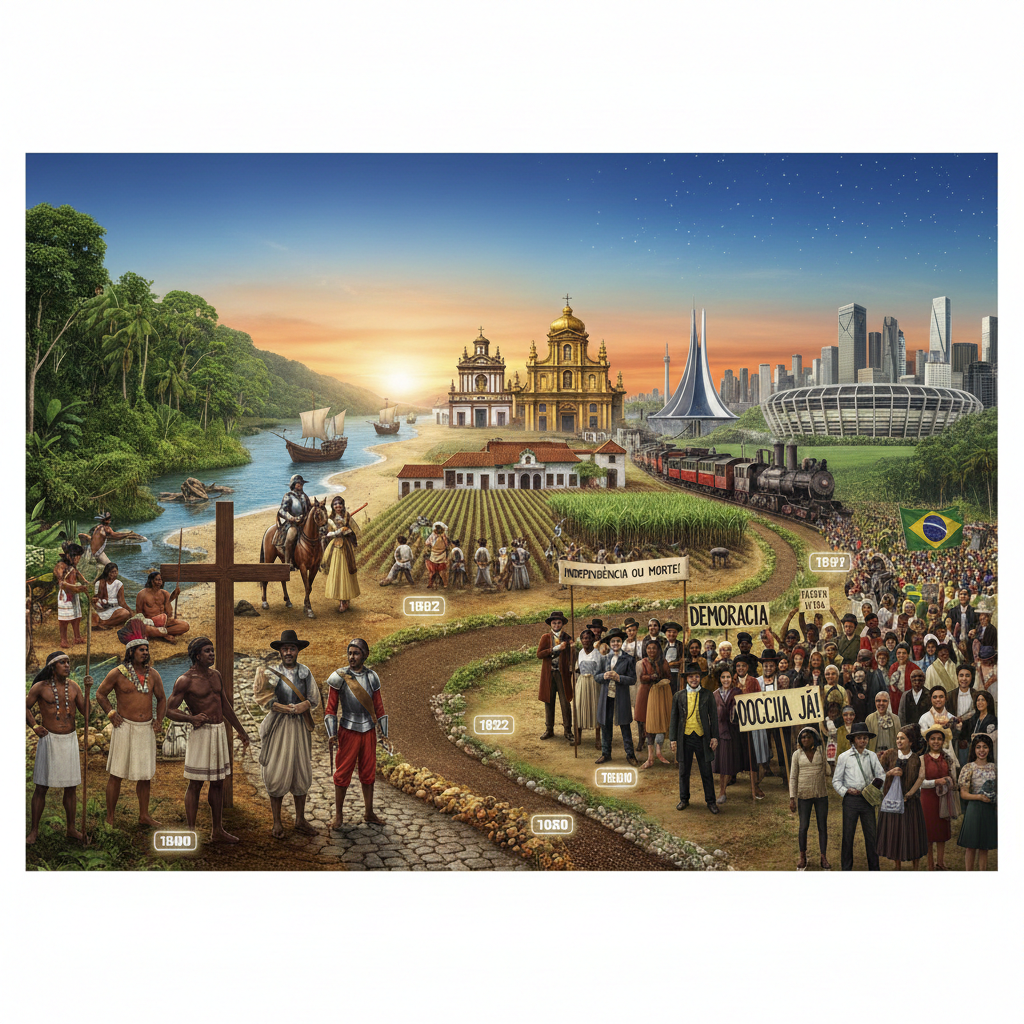
The History of Brazil is a sweeping saga that spans thousands of years, transitioning from the diverse indigenous societies of the pre-colonial era to the global powerhouse of the 21st century. It is a story marked by deep cultural synthesis, economic cycles that reshaped the landscape, and a unique political evolution that saw the only stable monarchy in the Americas.
1. Pre-Colonial Brazil: The First Inhabitants
Long before the Portuguese caravels appeared on the horizon in 1500, the land now known as Brazil was home to a massive and diverse population of indigenous peoples. Archaeological evidence, such as the sites at Serra da Capivara, suggests human presence dating back at least 11,000 to 30,000 years.
The indigenous population, estimated at between 2 and 7 million at the time of European contact, was divided into hundreds of tribes belonging to various linguistic groups, most notably the Tupi-Guarani, the Ge, and the Arawak. Unlike the complex urban empires of the Aztecs or Incas, Brazilian indigenous societies were largely semi-nomadic. They practiced “slash-and-burn” agriculture, hunting, and fishing.
-
- Social Structure: Most groups were egalitarian, with leadership based on prestige rather than hereditary right.
-
- The Marajoara Culture: On Marajó Island at the mouth of the Amazon, a more complex “cacicado” (chiefdom) developed, known for its intricate pottery and earthwork mounds, proving that the Amazon could indeed support sophisticated, sedentary societies.
2. The Portuguese Arrival and the Brazilwood Era (1500–1530)
In April 1500, a Portuguese fleet commanded by Pedro Álvares Cabral, officially en route to India, landed on the coast of Bahia. Claiming the land for King Manuel I under the Treaty of Tordesillas (1494), the Portuguese initially showed little interest in the territory, as it lacked the gold or silver found in Spanish America.
The first major economic activity was the extraction of brazilwood (pau-brasil), a tree containing a valuable red dye. This period was characterized by “feitorias” (trading posts) and a barter system with the indigenous people, known as escambo.
3. The Colonial Period (1530–1808) The threat of French and Spanish incursions forced Portugal to formalize its colonization. In 1534, King John III divided the territory into Hereditary Captaincies—vast strips of land granted to noblemen. Most failed due to lack of resources or indigenous resistance, but the captaincies of Pernambuco and São Vicente flourished, primarily through a new crop: sugar.
The Sugar Cycle and Slavery
By the mid-16th century, Brazil became the world’s leading sugar producer. This “Sugar Cycle” transformed the Northeast into a plantation-based economy. Because the indigenous people were either decimated by European diseases or resisted forced labor, the Portuguese began the mass importation of enslaved Africans. This brutal transatlantic trade would continue for over three centuries, deeply influencing Brazil’s demographic and cultural DNA.
The Gold Rush
At the end of the 17th century, bandeirantes (explorers from São Paulo) discovered gold in the interior region of Minas Gerais. This sparked the world’s first great gold rush. The center of economic gravity shifted from the Northeast to the Southeast, leading to the relocation of the capital from Salvador to Rio de Janeiro in 1763.
4. The Empire of Brazil (1822–1889)
Brazil’s path to independence was unique. In 1808, fleeing Napoleon’s invading armies, the entire Portuguese Royal Court moved to Rio de Janeiro, making it the capital of the Portuguese Empire. When King João VI finally returned to Lisbon in 1821, he left his son, Pedro, as regent.
Independence
Pressured by the Portuguese parliament to return to colony status, Dom Pedro I famously declared independence on September 7, 1822, with the “Cry of Ipiranga.” He became the first Emperor of Brazil.
The Reign of Dom Pedro II
Following the abdication of Pedro I in 1831, his five-year-old son eventually took the throne. The reign of Dom Pedro II (1840–1889) is often viewed as a “Golden Age” of stability and modernization.
-
- Coffee: Brazil became the world’s leading coffee producer, financing railroads and early industry.
-
- Abolition: Slavery was gradually dismantled, culminating in the Golden Law (Lei Áurea) signed by Princess Isabel in 1888.
The abolition of slavery, however, alienated the powerful landed elites. Combined with a disgruntled military, this led to a bloodless coup in 1889 that ended the monarchy and established the Republic.
5. The Republic and the Vargas Era (1889–1964)
The early republic, known as the Old Republic, was dominated by the “Coffee with Milk” politics—an alliance between the coffee oligarchs of São Paulo and the cattle ranchers of Minas Gerais.
This system collapsed during the Revolution of 1930, which brought Getúlio Vargas to power. Vargas was a populist and a nationalist who ruled as a dictator (the Estado Novo) and later as an elected president. He is credited with industrializing Brazil and creating modern labor laws, though his regime was marked by censorship and political suppression.
6. Military Dictatorship and Redemocratization (1964–Present)
In 1964, a military coup—supported by the U.S. amid Cold War tensions—overthrew President João Goulart. The Military Dictatorship lasted 21 years. While it oversaw the “Brazilian Economic Miracle” in the early 70s, it also engaged in systematic torture, censorship, and political exile.
The New Republic
Democracy returned in 1985, and a new Constitution was promulgated in 1888. Since then, Brazil has navigated economic crises (hyperinflation in the early 90s), followed by periods of growth and social reform.
-
- Fernando Henrique Cardoso: Stabilized the economy with the Plano Real.
-
- Lula da Silva: Oversaw a commodity boom and lifted millions out of poverty through social programs.
-
- Recent Years: The nation has faced political polarization, the “Operation Car Wash” corruption scandals, and the presidency of Jair Bolsonaro, followed by the return of Lula in 2023.
Summary of Key Periods
| Period | Key Characteristics |
| Pre-Colonial | Indigenous diversity, semi-nomadic tribes. |
| Colonial | Sugar, Gold, and the Transatlantic Slave Trade. |
| Imperial | Independence (1822), Dom Pedro II, coffee economy. |
| Old Republic | Oligarchical rule, “Coffee with Milk” politics. |
| Vargas Era | Industrialization, populist nationalism. |
| Military Rule | Economic growth vs. Political repression (1964–1985). |
| Modern Era | Redemocratization, economic stabilization, global influence. |
Brazil remains a country of massive potential and complex contradictions—a “country of the future” that is still grappling with its colonial and authoritarian past while shaping its identity as a diverse, democratic leader in the global south.
Visit: www.dkbtech.com and www.allcircular.com