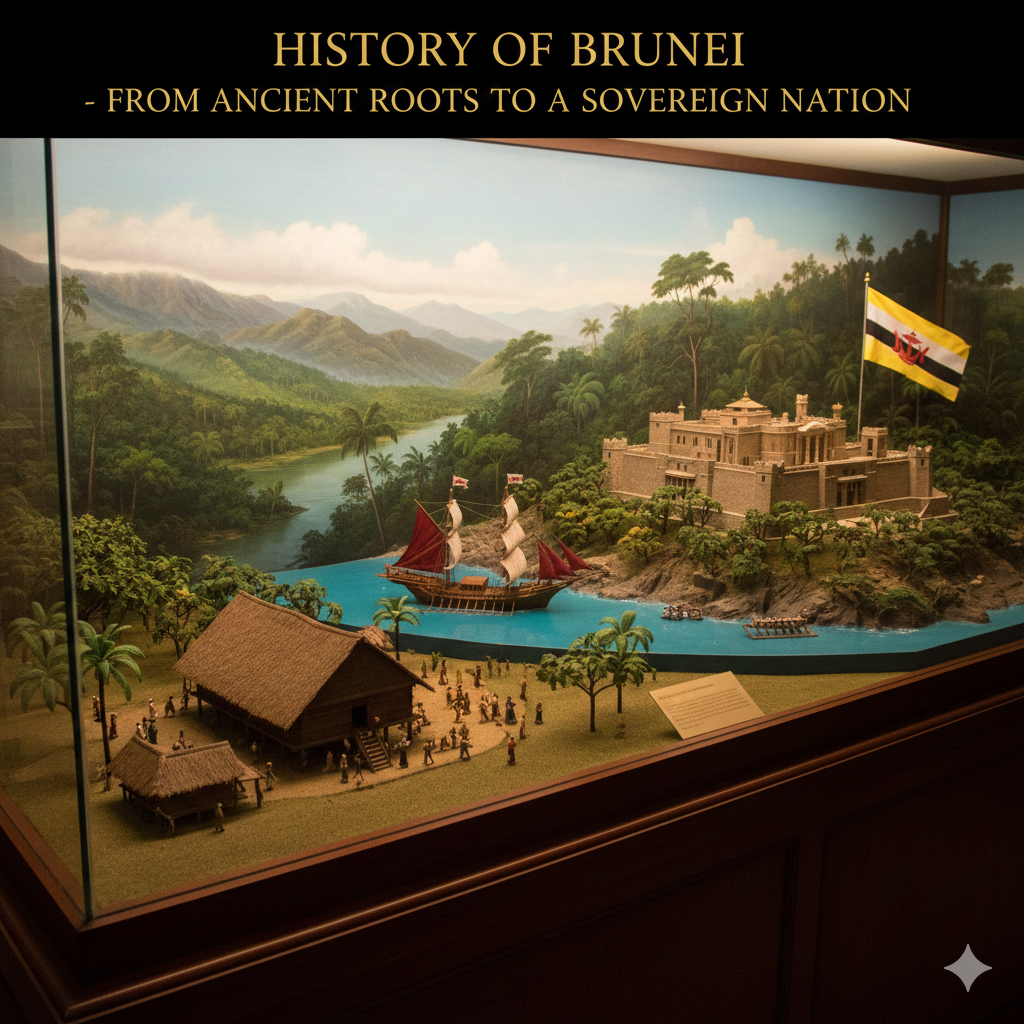
The History of Brunei Darussalam is a remarkable saga of a maritime empire that once dominated the shores of Borneo and the Philippines, weathered the storms of European colonialism, and ultimately transformed into one of the world’s wealthiest sovereign nations. It is the story of a resilient monarchy that has ruled for over 600 years, anchored by a unique national philosophy known as Melayu Islam Beraja (MIB)—Malay Islamic Monarchy.
I. Ancient Roots and the Rise of Po-ni
The earliest chapters of Brunei’s history are shrouded in the mists of the first millennium. Chinese and Arabic records suggest that a trading kingdom existed at the mouth of the Brunei River as early as the 7th or 8th century. Known to the Chinese as Po-ni, this early polity was a vital link in the “Maritime Silk Road.”
-
- Trade and Tribute: Po-ni traded valuable local commodities like camphor, sandalwood, and bird’s nests for Chinese ceramics and silk.
-
- Foreign Influence: For centuries, Po-ni navigated the regional power plays of the Srivijaya and Majapahit empires. At one point, Po-ni was a vassal of the Java-based Majapahit, paying an annual tribute of camphor.
-
- The Foundation Legend: According to the national epic Syair Awang Semaun, Brunei was founded by fourteen brothers who settled along the Brunei River. Their leader, Awang Alak Betatar, became the first sultan, taking the name Sultan Muhammad Shah (r. 1363–1402) upon his conversion to Islam.
II. The Golden Age of the Bruneian Empire (15th – 16th Century)
The 15th and 16th centuries marked the zenith of Brunei’s power. Following the fall of Malacca to the Portuguese in 1511, many Muslim merchants shifted their operations to Brunei, fueling an economic and territorial boom.
The Reign of Sultan Bolkiah
The fifth ruler, Sultan Bolkiah (r. 1485–1524), is often celebrated as the greatest Bruneian monarch. Under his leadership, the sultanate became a true thalassocracy (maritime empire):
-
- Territorial Reach: His influence extended over the entire island of Borneo and north into the Philippines, where he even established a settlement known as Seludong (modern-day Manila).
-
- Cultural Zenith: When the survivors of Ferdinand Magellan’s expedition visited Brunei in 1521, chronicler Antonio Pigafetta described a city of incredible wealth, with a court of elephants caparisoned in silk and a harbor bustling with hundreds of vessels.
III. Colonial Encroachment and the Era of Decline
The 17th century brought internal strife and the arrival of aggressive European powers. Succession disputes between royal factions weakened the state, allowing the Spanish and Dutch to chip away at Bruneian territories.
The Spanish-Bruneian War (1578)
Seeking to curb the spread of Islam and secure trade routes, the Spanish launched a fleet from Manila to attack Brunei. Though they briefly captured the capital, they were eventually forced to retreat due to disease and local resistance. However, the war signaled the end of Brunei’s dominance in the Philippines.
The “White Rajahs” and Territorial Loss
By the 19th century, Brunei was a shadow of its former self. Pirates plagued its coasts, and internal rebellions threatened the Sultan’s rule.
-
- James Brooke: In 1839, an English adventurer named James Brooke arrived in Borneo. In exchange for helping the Sultan suppress a rebellion, Brooke was granted the territory of Sarawak and the title of “Rajah.”
-
- Erosion of Land: Over the next few decades, the Brooke dynasty and the British North Borneo Company gradually annexed more land, eventually splitting Brunei into the two disconnected enclaves it occupies today.
V. The British Protectorate and the Discovery of Oil
To prevent the total disappearance of the state, Sultan Hashim Jalilul Alam Aqamaddin signed a treaty in 1888 making Brunei a British protectorate.
-
- The Residency System (1906): A British Resident was appointed to “advise” the Sultan on all matters except Malay customs and religion. While this stripped the Sultan of executive power, it stabilized the administration and borders.
-
- Black Gold (1929): The discovery of oil in Seria changed everything. Suddenly, the tiny, impoverished protectorate became an asset of immense strategic value. Oil revenue allowed Brunei to fund modern infrastructure and resist being absorbed into neighboring territories.
V. The Path to Sovereignty
The mid-20th century was a period of intense political maneuvering. Under Sultan Omar Ali Saifuddien III (known as the Architect of Modern Brunei), the nation navigated the end of the colonial era.
-
- World War II: Brunei was occupied by Japanese forces from 1941 to 1945. The period was one of hardship, but the eventual British return led to a push for greater autonomy.
-
- The 1959 Constitution: This landmark document gave Brunei internal self-government and established the framework for the modern state.
-
- The 1962 Rebellion: A brief armed uprising by the Parti Rakyat Brunei (who opposed the monarchy and favored joining a North Borneo Federation) was suppressed with British help. This event led to a permanent state of emergency and influenced the Sultan’s decision not to join the Federation of Malaysia in 1963.
VI. Modern Brunei: Independence and Beyond
On January 1, 1984, Brunei Darussalam resumed full sovereignty. Sultan Hassanal Bolkiah, the 29th Sultan, led the nation into a new era of prosperity.
The Wealth of the Abode of Peace
Today, Brunei is defined by its massive oil and gas reserves, which have created a comprehensive welfare state. Citizens enjoy:
-
- Free healthcare and education.
-
- No personal income tax.
-
- Subsidized housing and fuel.
Looking to the Future: Wawasan 2035
Recognizing that fossil fuels are finite, the government has launched Wawasan Brunei 2035 (Brunei Vision 2035). This ambitious plan aims to diversify the economy into sectors like food security, tourism, and “halal” pharmaceuticals, ensuring that the “Abode of Peace” remains stable and prosperous for centuries to come.
Visit: www.dkbtech.com and www.allcircular.com