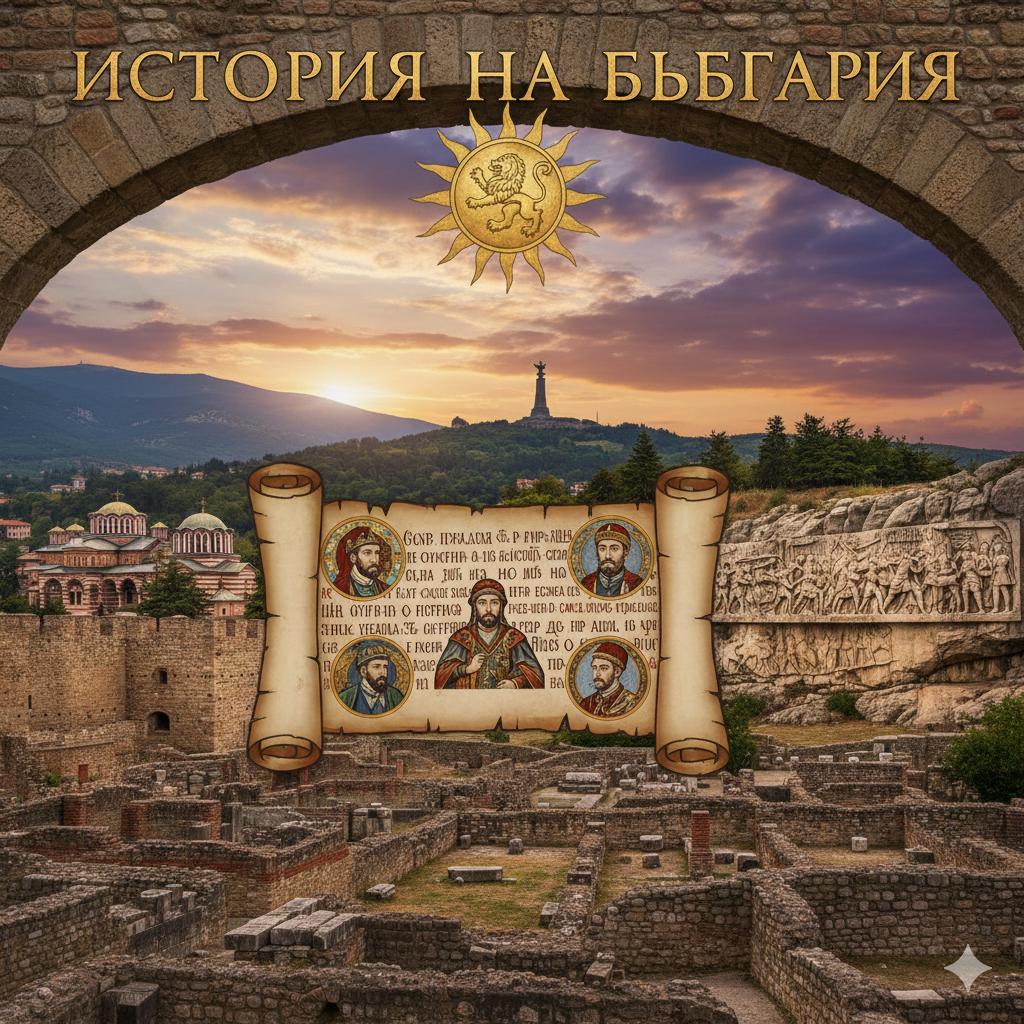
The History of Bulgaria is a monumental narrative of resilience, spanning over seven millennia. From the dawn of European civilization and the legendary Thracian tribes to the birth of a powerful medieval empire that shaped the Slavic world, and through five centuries of Ottoman rule to a modern European republic, Bulgaria’s journey is one of the oldest and most complex in Europe.
I. Prehistory: The Cradle of European Civilization
Bulgaria’s territory has been inhabited since the Paleolithic era, with evidence of human presence in the Kozarnika cave dating back 1.6 million years. However, it was during the Neolithic and Chalcolithic periods (approx. 5000–4000 BC) that the region became a global center of innovation.
-
- The Varna Necropolis: Discovered in 1972, this site yielded the oldest processed gold in the world, dating back to 4600 BC. The sophisticated craftsmanship of the gold artifacts suggests a highly organized society with a clear social hierarchy, predating the civilizations of Mesopotamia and Egypt.
-
- Solnitsata: Considered the oldest town in Europe (c. 4700 BC), this fortified settlement near Provadia was a center for salt production—a “mint” of the ancient world, as salt was as valuable as gold.
II. Antiquity: Thracians, Greeks, and Romans
By the Bronze Age, the Thracians—a group of Indo-European tribes—emerged as the dominant force. Described by Herodotus as the most numerous nation after the Indians, the Thracians were renowned warriors, goldsmiths, and horsemen.
-
- The Odrysian Kingdom: In the 5th century BC, King Teres I unified the Thracian tribes into the Odrysian Kingdom. This state became a regional power, interacting with the Persian Empire and the Greek city-states.
-
- Roman Conquest: By 46 AD, the Roman Empire had fully annexed Thrace. The Romans left an indelible mark on the landscape, building major cities like Serdica (modern-day Sofia), Trimontium (Plovdiv), and Nicopolis ad Istrum.
III. The First Bulgarian Empire (681–1018)
The Migration Period brought two key groups: the Slavs and the Bulgars (a Turkic semi-nomadic people). In 632 AD, Khan Kubrat formed Old Great Bulgaria north of the Black Sea, but after his death, his sons migrated in different directions.
The Foundation
Khan Asparuh led his people to the Danube Delta. After defeating the Byzantine Emperor Constantine IV at the Battle of Ongal (680), he forced the Empire to sign a peace treaty in 681 AD, recognizing the birth of the First Bulgarian Empire with its capital at Pliska.
Key Eras of the First Empire
-
- Expansion under Khan Krum: Krum (r. 803–814) famously defeated the Byzantine Emperor Nikephoros I, expanded the territory to include modern-day Romania and parts of Hungary, and established the first written laws.
-
- Christianization: Boris I (r. 852–889) realized that for Bulgaria to be recognized by Europe, it needed a unified religion. In 864, he adopted Christianity. Crucially, he welcomed the disciples of Saints Cyril and Methodius, who developed the Cyrillic script. This made Bulgaria the cultural and literary center of the Slavic world.
-
- The Golden Age: Under Tsar Simeon the Great (r. 893–927), Bulgaria reached its territorial zenith, stretching between the Black, Aegean, and Adriatic seas. Simeon was the first Bulgarian ruler to take the title “Tsar” (Emperor).
The First Empire eventually fell to the Byzantine Empire in 1018 after a long struggle led by Tsar Samuil, whose tragic defeat at the Battle of Kleidion remains a symbol of national sacrifice.
IV. The Second Bulgarian Empire (1185–1396)
Bulgaria remained under Byzantine rule for 167 years until the brothers Asen and Peter led a successful uprising in 1185, establishing the Second Bulgarian Empire with its capital at Veliko Tarnovo.
-
- Tsar Kaloyan (r. 1197–1207): He defeated the Crusaders of the Latin Empire at the Battle of Adrianople (1205), capturing Emperor Baldwin I.
-
- Tsar Ivan Asen II (r. 1218–1241): His reign was a second “Golden Age” of stability, trade, and cultural flourishment, ending with Bulgaria again touching three seas.
By the late 14th century, internal divisions between local lords (Despots) weakened the state. In 1396, the Ottoman Turks conquered the last Bulgarian stronghold, Vidin, marking the beginning of nearly five centuries of Ottoman rule.
V. The “Turkish Yoke” and National Revival (1396–1878)
For 482 years, Bulgaria ceased to exist as an independent state. The population lived as dhimmi (non-Muslim subjects) within the Ottoman Empire. However, the Bulgarian spirit was preserved through the Orthodox Church and isolated monasteries.
The National Awakening
In 1762, the monk Paisius of Hilendar wrote “Slavic-Bulgarian History”, reminding Bulgarians of their glorious past. This sparked the National Revival, a period of building schools, churches, and eventually, a revolutionary movement.
-
- The April Uprising (1876): A bloody revolt against Ottoman rule that was brutally suppressed. The “Bulgarian Horrors” shocked the world, leading the Russian Empire to declare war on the Ottomans.
-
- Liberation (1878): Following the Russo-Turkish War, the Treaty of San Stefano (March 3, 1878) re-established the Bulgarian state. However, the Great Powers, fearing a large Russian ally, carved the territory into three parts via the Treaty of Berlin.
VI. The Third Bulgarian State (1878–Present)
The late 19th and early 20th centuries were defined by the struggle for national unification—reclaiming the lands lost in the Treaty of Berlin.
| Period | Key Characteristics |
| Principality & Kingdom | Modernization, the Unification with Eastern Rumelia (1885), and full independence in 1908. |
| The World Wars | Bulgaria joined the Central Powers (WWI) and later the Axis (WWII) to regain lost territories. Notably, during WWII, Bulgaria refused to deport its Jewish population to Nazi death camps. |
| Communist Era (1946–1989) | Following a 1944 coup and Soviet occupation, Bulgaria became a People’s Republic under leaders like Todor Zhivkov. It was characterized by rapid industrialization and close ties to the USSR. |
| Modern Republic (1990–Present) | After the fall of the Berlin Wall, Bulgaria transitioned to a multi-party democracy and a market economy. It joined NATO in 2004 and the European Union in 2007. |
History of Bulgaria’s is a testament to the endurance of a nation that has survived empires and ideologies while maintaining a distinct cultural identity.
Visit: www.dkbtech.com and www.allcircular.com