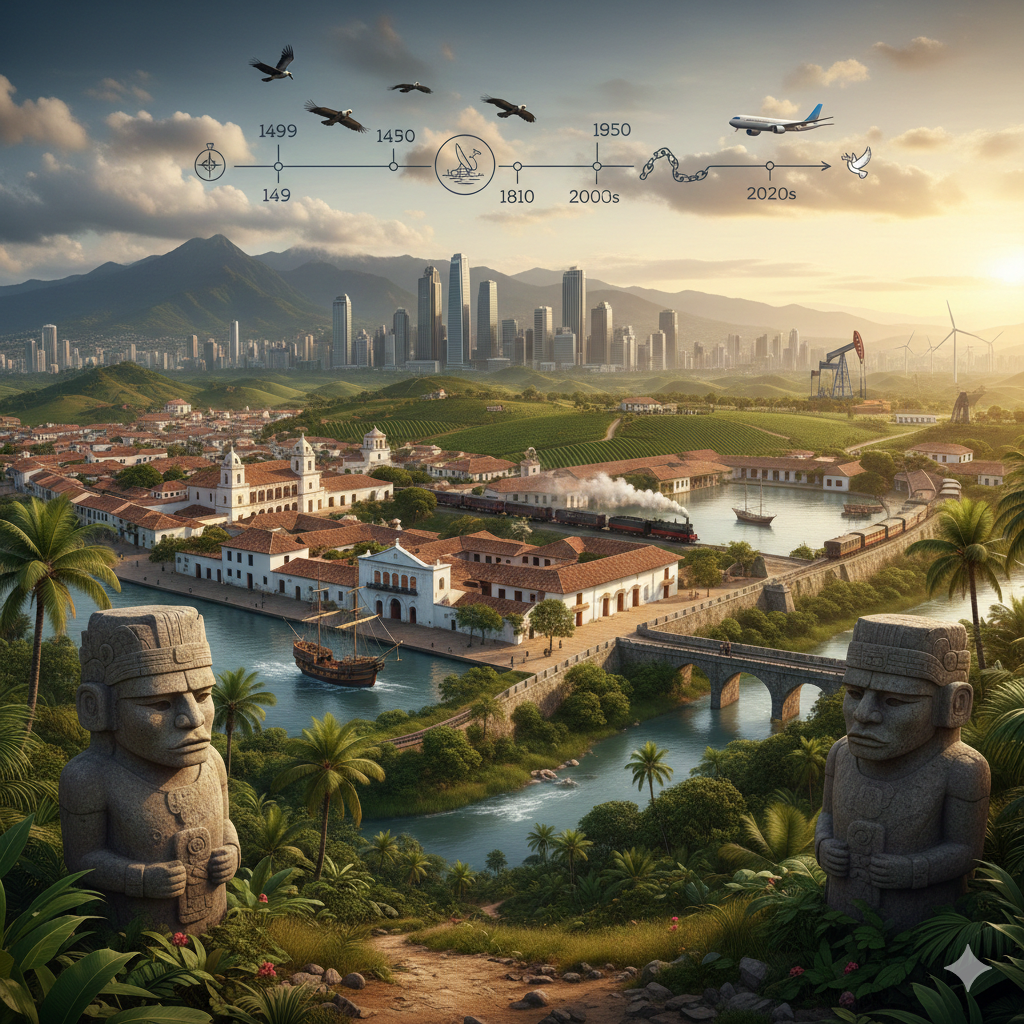
History of Colombia
1. Pre-Columbian Era: The Cradle of Gold
Long before the arrival of Europeans, the territory of modern-day Colombia was home to sophisticated indigenous cultures. Unlike the centralized empires of the Aztecs or Incas, Colombia was a mosaic of diverse chiefdoms.
-
- The Muisca (Chibcha): Settled in the high Altiplano Cundiboyacense (near modern Bogotá), they were masters of goldwork and social organization. Their ritual of covering a new chief in gold dust and sending him into Lake Guatavita gave birth to the Legend of El Dorado.
-
- The Tairona: Located in the Sierra Nevada de Santa Marta, they built impressive stone cities like Ciudad Perdida (The Lost City), featuring advanced engineering and drainage systems.
-
- San Agustín: Known for mysterious, monumental stone statues that date back to 1000 BCE, representing a spiritual culture we are still trying to fully decode.
2. Conquest and the Colonial Period (1499–1810)
The Spanish arrival transformed the landscape forever. Rodrigo de Bastidas first explored the coast in 1500, leading to the founding of Santa Marta (1525) and Cartagena (1533).
The Viceroyalty of New Granada
By the 18th century, Bogotá became the capital of the Viceroyalty of New Granada, which included present-day Panama, Venezuela, and Ecuador. This era was defined by:
-
- The Encomienda System: A labor system that often exploited indigenous populations.
-
- Cartagena’s Fortifications: Built to protect the Spanish Crown’s gold from pirates like Francis Drake.
-
- Social Hierarchy: A rigid caste system based on “purity of blood” (Peninsulares, Creoles, Mestizos, and enslaved Africans).
3. The Fight for Independence (1810–1819) Discontent with Spanish taxes and the Napoleonic invasion of Spain sparked the revolution. On July 20, 1810, a dispute over a flower vase in Bogotá led to the first cry of independence.
The struggle was long and bloody until Simón Bolívar (The Liberator) and Francisco de Paula Santander led the patriot army to a decisive victory at the Battle of Boyacá on August 7, 1819.
4. Gran Colombia and the 19th Century
Bolívar dreamed of a united South America, forming Gran Colombia (1819–1831). However, regionalist tensions and ideological divides between “Centralists” (Bolívar) and “Federalists” (Santander) led to the union’s collapse.
Throughout the 1800s, Colombia (then known as the Republic of New Granada) suffered through 10 major civil wars. The century ended with the devastating Thousand Days’ War (1899–1902), which left the country bankrupt and led directly to the loss of Panama in 1903.
5. The 20th Century: “La Violencia” and Conflict
The mid-20th century was defined by the assassination of populist leader Jorge Eliécer Gaitán in 1948. This triggered the Bogotazo, a massive riot that evolved into a decade of rural warfare known as La Violencia.
The Rise of Guerillas and Cartels
By the 1960s, social inequality led to the formation of leftist guerrilla groups like the FARC and ELN. In the 1980s, the rise of the Medellín and Cali Cartels introduced a new era of narco-terrorism, as Pablo Escobar declared war on the state to avoid extradition.
6. Modern Colombia: Peace and Progress
The 21st century has seen a dramatic shift.
-
- The 2000s: Increased military pressure under the “Democratic Security” policy weakened guerrilla groups.
-
- The 2016 Peace Accord: Under President Juan Manuel Santos, the government signed a historic peace deal with the FARC, for which Santos received the Nobel Peace Prize.
-
- Economic Boom: Today, Colombia is known for its coffee, flowers, and a growing tech sector, though challenges regarding rural implementation of peace and wealth inequality remain.
Key Historical Figures
| Figure | Role | Legacy |
| Simón Bolívar | Liberator | Founded Gran Colombia; visionary of Latin American unity. |
| Policarpa Salavarrieta | Spy/Heroine | A seamstress who spied for patriots; executed by the Spanish. |
| Gabriel García Márquez | Author | Won the Nobel Prize; his “Magical Realism” defined Colombian identity. |
| Pablo Escobar | Drug Lord | His reign of terror shaped the late 20th-century security landscape. |
Visit: www.dkbtech.com and www.allcircular.com