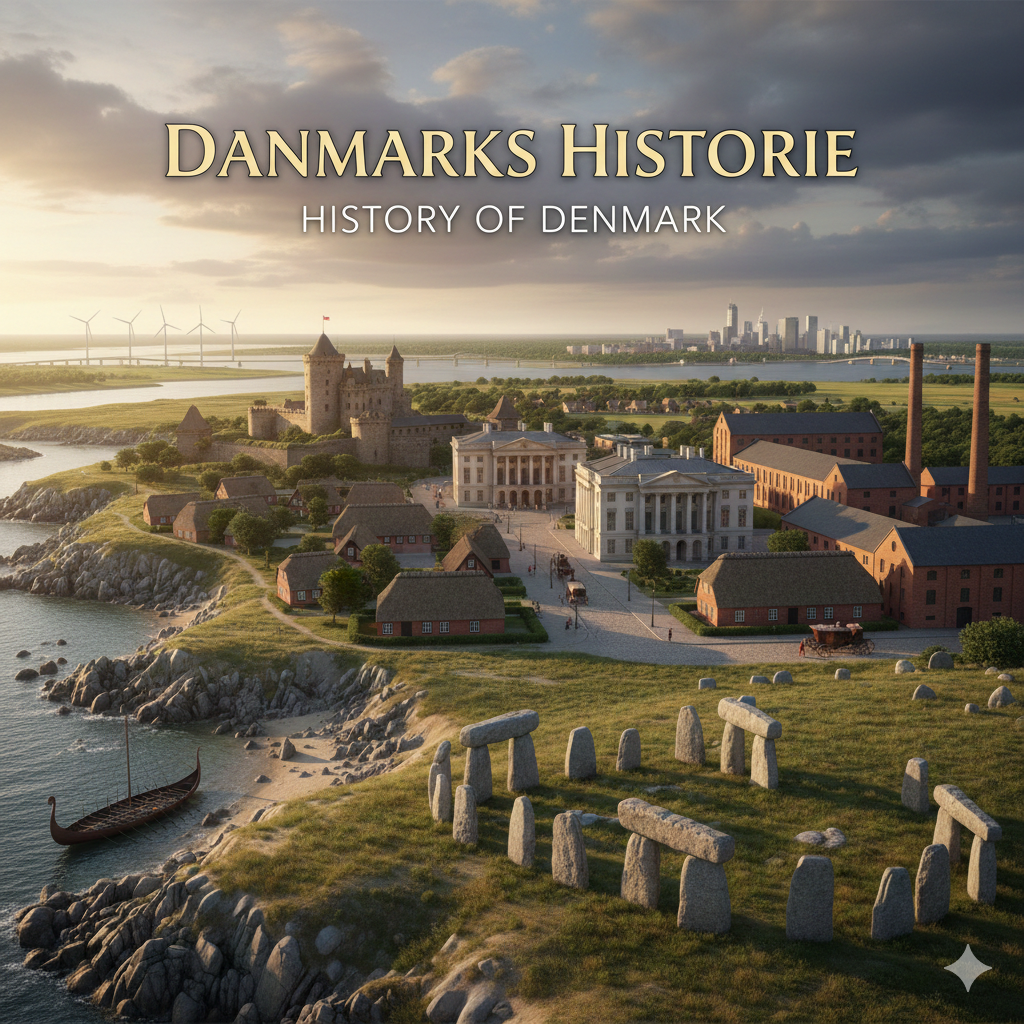
History of Denmark is one of incredible transformation—from the seafaring Vikings who once terrified Europe to a modern, peaceful social democracy consistently ranked as one of the happiest nations on earth.
1. Prehistory: From the Ice Age to the Dolmens
The first inhabitants of Denmark were nomadic hunters following reindeer herds as the ice sheets retreated around 12,000 BCE. By 4,000 BCE, the Neolithic Revolution reached the Danish islands, bringing agriculture and the construction of massive stone tombs known as dolmens.
By the Bronze Age (1800–500 BCE), Denmark became part of a sophisticated trade network, exchanging amber for bronze from Central Europe. This era left behind iconic artifacts like the Sun Chariot (Solvognen), reflecting a highly developed spiritual culture centered on the sun.
2. The Viking Age (793–1066 CE)
This is perhaps Denmark’s most famous era. Driven by land scarcity and a desire for wealth, Danish Vikings began raiding across Europe.
-
- Expansion: Danish Vikings primarily focused their efforts on England (establishing the Danelaw) and France (eventually founding Normandy).
-
- Unification: King Gorm the Old is considered the first traditionally recognized King of Denmark. His son, Harald Bluetooth, famously unified the Danes and “made the Danes Christian,” as inscribed on the Jelling Stones.
-
- The North Sea Empire: Under Cnut the Great (1016–1035), Denmark sat at the center of a massive empire that included England, Norway, and parts of Sweden.
3. The Middle Ages and the Kalmar Union
Following the collapse of the North Sea Empire, Denmark faced internal strife until the Valdemar Era. During the 12th and 13th centuries, Denmark expanded into the Baltic, conquering Estonia. Legend has it that the Danish flag, the Dannebrog, fell from the sky during the Battle of Lyndanisse in 1219.
The Kalmar Union (1397–1523)
Queen Margaret I, one of the most capable monarchs in European history, succeeded in uniting Denmark, Norway, and Sweden under the Kalmar Union. For over a century, Copenhagen was the de facto capital of a Nordic superpower. However, tensions with Sweden eventually led to the union’s collapse following the “Stockholm Bloodbath.”
4. Reformation and Absolute Monarchy
The 16th century brought the Protestant Reformation. In 1536, Christian III established Lutheranism as the state religion, seizing church lands and consolidating royal power.
-
- The Era of Christian IV: Known as the “builder king,” Christian IV shaped the face of Copenhagen with projects like the Børsen (Exchange) and Rundetårn (Round Tower). However, his involvement in the Thirty Years’ War led to significant territorial losses.
-
- Absolutism (1660): Following a disastrous war with Sweden where Denmark lost its eastern provinces (Skåne, Halland, and Blekinge), King Frederick III introduced Absolute Monarchy, which would last until 1849.
5. The 19th Century: Crisis and Golden Age
The 1800s began with catastrophe. During the Napoleonic Wars, the British Navy bombarded Copenhagen (1807) and seized the Danish fleet. In 1814, Denmark was forced to cede Norway to Sweden.
Despite the political decline, this was the Danish Golden Age. It was the era of:
-
- Hans Christian Andersen (Fairy tales)
-
- Soren Kierkegaard (Philosophy)
-
- Bertel Thorvaldsen (Sculpture)
In 1849, King Frederick VII signed the first constitution, ending absolutism and turning Denmark into a constitutional monarchy.
6. The 20th Century: World Wars and the Welfare State
Denmark remained neutral during WWI. However, during World War II, despite declaring neutrality, Denmark was occupied by Nazi Germany in April 1940. The Danish government maintained a policy of “negotiated cooperation” to protect the population until 1943, when the resistance movement grew. Notably, the Danes managed to evacuate nearly 95% of the Danish Jewish population to Sweden.
The Rise of the Nordic Model
Post-1945, Denmark underwent rapid industrialization. The Social Democratic party led the creation of the modern welfare state, characterized by:
-
- High taxes funding universal healthcare and education.
-
- The “Flexicurity” labor market model.
-
- Joining the European Economic Community (now the EU) in 1973.
7. Modern Denmark
Today, Denmark is a leader in green energy (wind power) and design. It remains a constitutional monarchy under King Frederik X, who ascended the throne in 2024 following the abdication of Queen Margrethe II.
Visit: www.dkbtech.com and allcircular.com